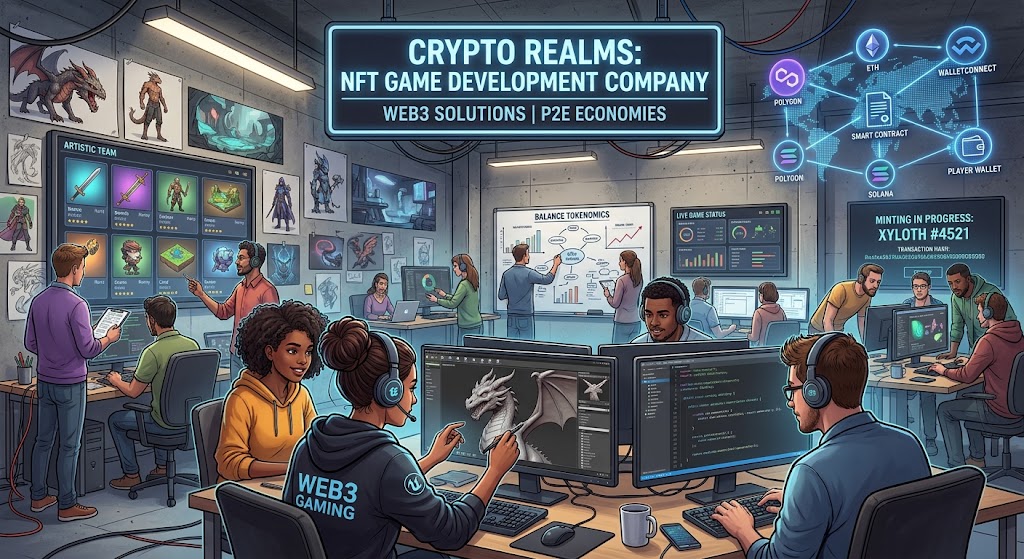
NFT Game Development Company Infrastructure And Engineering
Building a successful game today looks very different than it did a decade ago. Players no longer want to spend hundreds of hours earning in-game items that they never actually own.
They want real digital asset ownership. They want tradeable assets, interoperable items, and transparent economies. That is where an experienced NFT game development company comes into the picture.
We build blockchain-powered gaming ecosystems from the ground up. Whether you need a simple card battle game or a complex 3D metaverse, our team delivers complete end-to-end solutions.
And we do it while keeping player experience at the absolute center of design. No clunky blockchain interfaces. No complicated wallet setups for beginners. Just fun gameplay powered by modern decentralized technology.
Blockchain technology has fundamentally shifted how players interact with digital worlds. When players know their rare sword or piece of land belongs solely to them, engagement rises dramatically. But launching a Web3 project requires far more than just writing code. It demands tight integration between game engines, smart contracts, distributed storage, and secure payment gateways.
So how do we turn a raw concept into a thriving playable economy? Let us break down the full lifecycle of Web3 title creation.
Why Partnering With An NFT Game Development Company Matters
Creating a traditional video game is hard enough. Adding smart contracts, tokenomics, and decentralized security makes it twice as challenging. One mistake in a smart contract can cause permanent financial losses.
Working with a specialized partner eliminates these massive technical risks. Our team brings deep hands-on expertise in game design, smart contract auditing, and backend server scaling.
We do not just write code for your project. We help you design balanced token economies that keep players returning every single day without inflating asset value into oblivion.
And we make sure your title abides by evolving global regulatory standards. Security, scalability, and long-term economic stability form the structural foundation of every build we deliver.
Look at the traditional gaming market right now. Gamers spend billions every year on cosmetic skins and battle passes. Yet, when the game servers shut down, all those investments disappear instantly. Web3 changes this dynamic entirely by placing control back into the hands of the community.
However, building on the blockchain introduces unique technical hurdles. Transaction throughput, gas fee spikes, and network latency can quickly ruin fluid gameplay if not handled properly. That is why choosing the right technical partner is critical for your vision.
Core Architecture Of A Modern Web3 Gaming Platform
Every decentralized game relies on a multi-tiered architecture working together in real time. The frontend game engine handles user input, visual rendering, and local audio.
Meanwhile, the backend coordinates multiplayer sessions, validates player movements, and communicates directly with blockchain networks. Here is how these layers connect together seamlessly.
| System Layer | Primary Component | Core Functionality |
|---|---|---|
| Client Layer | Unity / Unreal Engine | Renders 2D/3D graphics, user interface, real-time input handling. |
| Blockchain Layer | EVM / Solana / L2s | Executes smart contracts, mints tokens, records ownership records. |
| Backend Layer | Node.js / Go / Rust | Manages multiplayer sessions, anti-cheat validation, user profiles. |
| Storage Layer | IPFS / Arweave | Stores metadata, decentralized artwork, media, and game state backups. |
| Wallet Integration | Web3Auth / WalletConnect | Provides frictionless onboarding via social logins and non-custodial wallets. |
This architecture ensures that heavy game actions happen instantly off-chain. Only critical transactions like minting, trading, and reward distribution hit the blockchain.
This hybrid approach keeps gameplay silky smooth while maintaining complete decentralized security where it matters most.
This separation of concerns prevents the game from lagging during heavy network activity. Players enjoy standard 60 FPS performance without waiting for block confirmations every time they swing a sword or open a chest. When they decide to sell that sword on an open marketplace, the smart contract takes over and handles the peer-to-peer settlement instantly.
Primary Blockchain Networks For Modern Web3 Games
Choosing the right blockchain network directly impacts your game’s user experience, transaction costs, and scalability. Not all networks are built equal for high-speed gaming workloads.
Ethereum offers unmatched security and liquidity, but layer-1 gas fees remain too expensive for microtransactions. That is why layer-2 scaling solutions and high-throughput layer-1 chains have become the gold standard.
- Polygon & Arbitrum: Offer rapid transaction speeds with tiny gas fees while maintaining direct security links to the main Ethereum network.
- Solana: Delivers sub-second finality and high throughput, making it ideal for fast-paced action and arcade games.
- Avalanche (Subnets): Allows game creators to launch dedicated, custom blockchains designed strictly for their own game logic and token execution.
- Immutable X: Built specifically for NFT creation and trading, providing zero gas fees for peer-to-peer transactions.
Our team evaluates your game mechanics, target market, and expected transaction volume before selecting the best blockchain network. This upfront strategy prevents expensive migration issues down the road.
Services Offered By Our NFT Game Development Company
We offer end-to-end development packages tailored specifically to your project requirements. Whether you are starting with a blank slide deck or converting an existing game, we handle every phase.
From early concept art to smart contract deployment, we take full responsibility for technical delivery. Here is a closer look at our primary services.
Our engineering team works closely with your business leaders to translate game mechanics into efficient, gas-optimized code. We maintain rigorous standards for code quality and test coverage across every module.
- Custom Smart Contract Development: Writing secure ERC-721, ERC-1155, and SPL token contracts audited against known vulnerabilities.
- Full-Cycle Game Engineering: Complete client-side and server-side coding in Unity and Unreal Engine 5.
- Tokenomics & Economic Design: Designing dual-token and single-token sustainable game economies to control inflation.
- Custom Marketplace Creation: Building branded, low-fee Web3 marketplaces for direct player asset trading.
- Cross-Chain Bridges: Implementing secure cross-chain bridges to allow seamless token movement between networks.
Security is integrated into every step of our build pipeline. We run rigorous automated security tests and engage third-party security auditors before any code hits a mainnet network.
Key Development Phases For Blockchain Gaming Titles
Building a successful game requires structured discipline. We follow a battle-tested milestone framework that keeps projects running smoothly, on schedule, and on budget.
This systematic pipeline keeps clear lines of communication open at every phase of production. Take a look at how we take a concept from napkin sketch to global release.
| Phase | Focus Area | Key Deliverables |
|---|---|---|
| Phase 1 | Concept & Architecture | Game design document, technical roadmap, smart contract specs, tokenomics model. |
| Phase 2 | Prototyping & Art | Core gameplay loop prototype, 3D/2D asset creation, UI/UX wireframes. |
| Phase 3 | Contract & Server Build | Smart contract writing, testnet deployments, backend API engineering, wallet setup. |
| Phase 4 | Full Integration & Beta | Unity/Unreal SDK integration, closed multiplayer beta testing, contract auditing. |
| Phase 5 | Mainnet Launch & Support | Mainnet contract deployment, marketplace launch, server scaling, live operations. |
Each phase ends with concrete deliverables that you can test and evaluate directly. No black-box development or vague progress reports.
This iterative process lets us incorporate real player feedback early during testing. It leads to far stronger player retention metrics when the game finally launches publicly.
Designing Balanced And Sustainable Game Economies
Early Web3 games struggled with extreme economic volatility. Tokens spiked in value during early hype phases, then crashed hard as inflationary pressures mounted.
A top-tier NFT game development company designs token models with long-term stability in mind. We balance token generation mechanics with realistic token destruction sinks.
If players earn tokens faster than the system burns them, hyperinflation is inevitable. We prevent this by building dynamic sinks directly into the core gameplay loop.
So how do we maintain high token utility over time? Here are the proven economic levers we integrate into our builds.
- Crafting & Upgrades: Requiring players to burn base tokens and assets to forge rarer, more powerful equipment.
- Tournament Entry Fees: Routing competitive entry tokens into community reward pools and treasury reserves.
- Repair & Durability Costs: Introducing recurring asset maintenance costs paid in native project tokens.
- Land & Guild Governance: Staking project tokens to earn territorial control rights and revenue shares.
By keeping economic velocity healthy, we build games that retain active players and maintain real token value over years, not weeks.
Essential Security Best Practices In Blockchain Development
In Web3, smart contracts act as immutable vaults holding real financial value. Reentrancy bugs, integer overflows, and unhandled exceptions can result in devastating exploits.
Our engineering team writes clean, modular smart contract code following strict security practices. We utilize established framework libraries like OpenZeppelin to minimize contract risk exposure.
Before launching on mainnet, we conduct extensive unit test coverage and run static analysis tools to identify edge-case flaws.
Then, we submit the entire codebase to independent security firms for complete formal verification. Security is never an afterthought in our office-it is built in from day one.
The Future Of Decentralized Interactive Entertainment
The line between traditional gaming and Web3 gaming is fading fast. AAA game studios are actively exploring decentralized asset ownership models, while Web3 studios continue to elevate visual quality.
Next-generation titles will feature invisible blockchain mechanics. Account abstraction will allow users to create wallets automatically using standard Google or Apple accounts.
Gas fees will be completely subsidized by game operators via custom paymasters. Players will simply enjoy high-fidelity gameplay, trade rare items, and control their digital destiny effortlessly.
This frictionless shift will welcome hundreds of millions of mainstream players into decentralized ecosystems. Positioning your project today with the right technical foundations gives you a massive head start.
Frequently Asked Questions
What Is An NFT Game Development Company?
An NFT game development company is a specialized agency that designs, builds, and deploys blockchain-powered video games. They combine traditional game engine engineering in Unity or Unreal Engine with smart contract development, tokenomics design, and secure wallet integration. This allows players to truly own, buy, sell, and trade their in-game assets across open marketplaces.
How Long Does It Take To Build A Web3 NFT Game?
Development timelines depend heavily on scope, visual complexity, and backend features. A simple 2D casual game or card battler usually takes 3 to 6 months to complete. A complex 3D multiplayer action game or MMORPG with custom tokenomics can take anywhere from 9 to 18 months. Working with an experienced team speeds up time-to-market using pre-built Web3 infrastructure modules.
Which Blockchains Are Best Suited For NFT Game Projects?
The choice depends on your specific performance requirements and target audience. Polygon, Arbitrum, and Immutable X are excellent for high-volume transactions with ultra-low gas fees. Solana provides ultra-fast settlement speeds for action games. Avalanche offers dedicated subnets for studios needing complete control over network fees and custom operational rules.
How Much Does It Cost To Develop A Blockchain NFT Game?
Costs vary widely depending on visual fidelity, gameplay mechanics, and smart contract complexity. A basic prototype or simple 2D game typically ranges between $30,000 and $70,000. Full-scale production titles featuring 3D graphics, multiplayer servers, custom smart contracts, and dedicated Web3 marketplaces generally range from $100,000 to $300,000+.
Can You Convert An Existing Traditional Game Into An NFT Game?
Yes, traditional games built on engines like Unity or Unreal Engine can be retrofitted with Web3 features. We integrate custom software development kits to connect your existing game backend to blockchain smart contracts. This lets you add NFT asset minting, token rewards, and marketplace trading without rebuilding your core game logic from scratch.
How Do Players Interact With The Game Without Crypto Knowledge?
We implement modern account abstraction frameworks like Web3Auth and Biconomy. This allows new players to log in using standard social accounts like Google, Twitter, or email. The system creates a non-custodial wallet silently in the background, handling gas fees on behalf of the player. This removes onboarding friction and lets users play immediately.
How Do You Ensure Smart Contracts Are Completely Secure From Exploits?
We enforce strict security protocols at every phase of development. Our team writes code using audited libraries like OpenZeppelin, conducts continuous automated testing, and runs static analysis tools. Before launching on mainnet, we partner with top independent cybersecurity firms to perform thorough third-party smart contract audits and fix any identified vulnerabilities.
Conclusion
Web3 technology is reshaping the gaming industry by giving real power and asset control back to players. Building a successful decentralized game requires a delicate balance between engaging gameplay mechanics, scalable cloud servers, and rock-solid blockchain smart contracts. Partnering with a dedicated team turns complex technical challenges into a streamlined, high-performance product ready for global players. If you are ready to bring your gaming vision to life, reaching out to an expert team is the very best place to start.


Leave a Reply