Fortnite concept art: how visual development becomes a shippable game asset
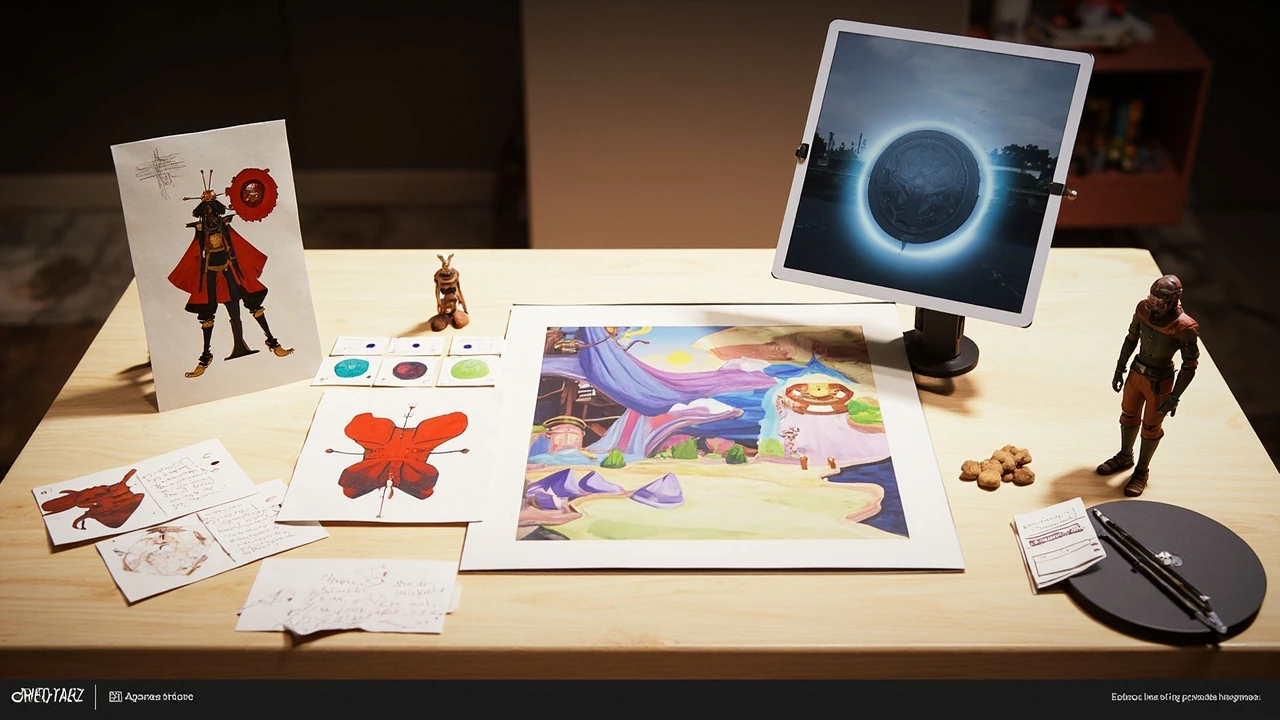
A Fortnite skin is usually judged from the finished 3D model in motion, but its visual quality is decided much earlier. Concept art gives the art team a way to test silhouette, costume construction, color separation, and character identity before modeling, rigging, texturing, animation, and lighting absorb the cost of a weak idea.
This guide follows the development path of Fortnite concept art from a brief to an approved visual direction. It focuses on skin and environment art, including the use of generative tools described by Epic Games. The useful question is not whether an image looks striking in isolation. It is whether the design communicates the intended experience, survives translation into a game asset, and can be evaluated by the people responsible for the rest of production.
Epic Games has publicly described a workflow in which artists develop and iterate on designs by hand, then use AI prompts to explore selected changes before human artists correct errors and refine the result. That distinction matters. Generative output can accelerate exploration, but the source material shows that the design process still depends on artist direction, review, and quality control.
What should concept art prove before 3D production begins?
Concept art should prove that a proposed design is visually distinctive, buildable, and appropriate for its game context. A single polished illustration can hide construction problems, material conflicts, and areas that will become difficult to read once the asset moves into a real-time engine.
For Fortnite-style cosmetics, the early visual answer should establish several linked qualities:
- The silhouette can be recognized at gameplay distance.
- The costume reads as a coherent object rather than disconnected accessories.
- The color scheme supports player and opponent readability.
- Materials have plausible behavior under changing light.
- The design can be divided into practical 3D parts without losing its identity.
- The intended animation and movement remain compatible with the chosen construction.
A successful concept does not need to predict every production detail. It needs to resolve the decisions that would be expensive to reverse. If the team cannot tell whether a hood should be rigid cloth, padded armor, or a soft shell, that uncertainty should be addressed before the asset enters modeling.
The wider discipline is best understood through creature-driven design in Dream Island Pokopia, where visual decisions also need to communicate behavior and function. The exact subject differs, but the production principle remains the same: the concept must provide a useful decision tool, not simply decorate a pitch.
Which concept-art deliverables should a skin brief require?
The correct deliverable depends on the risk and complexity of the cosmetic. A minor back bling does not need the same package as a multi-part character skin. A useful brief specifies what decisions must be supported and leaves the number of images to that purpose.
| Deliverable | Primary question answered | Typical production use | Common weakness to avoid |
|---|---|---|---|
| Silhouette sheet | Is the design recognizable without color? | Shape selection and final art direction | Variations optimized only in color |
| Turnaround drawing | How does the design work from every side? | Modeling reference and part planning | Unresolved costume construction |
| Material and palette study | Which surfaces should read differently in game? | Texture planning and lighting review | Materials distinguished only by paint |
| Gameplay-scale test | Will the design remain legible in motion? | Character art review | Beauty render shown at unrealistic size |
| Animation pose study | Can the costume support the intended movement? | Rigging, cloth, and animation planning | Static pose that hides clipping risks |
| Color and thumbnail tests | Does the design read in small images and menus? | UI representation and player recognition | Decisions made only at poster scale |
These deliverables overlap, but they are not interchangeable. A turnaround is strong evidence for shape and construction, while a gameplay-scale test is strong evidence for readability. Asking one image to perform both jobs often makes the image too controlled to reveal the real production risk.
How should an art brief turn a broad skin idea into visual constraints?
Broad ideas fail during production because they contain unresolved choices. “Make a powerful ice warrior” may generate attractive images, but it leaves unanswered whether the character reads as ice, armor, royalty, elemental magic, or a combination of all three. The concept stage should convert that theme into a hierarchy of visual priorities.
Begin with the player experience:
- Define the character fantasy in one sentence.
- Identify the dominant silhouette feature and one supporting feature.
- State which material or surface should lead the read.
- Define the palette relationship between character, skin, and equipment.
- List protected design areas that must remain recognizable in motion.
- Specify what the team should not change without art direction approval.
For a hypothetical ice-themed skin, that might mean a broad asymmetrical shoulder silhouette, one concentrated cold-blue accent, and faceted armor pieces that should retain their identity under both daylight and indoor lighting. The specification is more useful than “ice queen” because a modeler and a technical artist can both test their work against it.
Briefs also need exclusions. If a design must avoid resemblance to an existing licensed character, show what the art team is solving, not merely state that legal clearance is required. If the costume cannot be a single static mesh, explain the expected construction. If certain elements are too small to read in play, establish the scale at which a decision is valid.
How do artists develop a strong silhouette without overfitting to one pose?
Fortnite cosmetics are seen from many camera angles, at different sizes, and while moving. A concept that relies on one dramatic pose can conceal weaknesses that become obvious when the asset is placed in a lobby or match.
Develop the silhouette through controlled reductions:
- Fill the complete character shape in a flat color and inspect it at thumbnail size.
- Remove small details and check whether the main idea still reads.
- Repeat the test in neutral, back, and three-quarter views.
- Sketch two or three silhouette directions before detailing one.
- Confirm that pose-dependent elements are not carrying the entire identity.
Large shapes should support readability, not dominate it. A broad shoulder piece, head shape, backpack, and leg treatment can establish a character more efficiently than small emblems. At the same time, excessive mass can make movement look heavy and create difficult intersections around the shoulders or hips.
Internal contrast is another frequent problem. If the torso, arms, and legs share nearly the same value, the character can disappear against a busy environment even if the palette is attractive. A useful concept study separates silhouette from interior borders, then shows whether the same hierarchy survives after material detail is added.
Where does concept art meet 3D modeling without losing the original design?
The handoff should be explicit. A high-resolution painting may contain visual information that cannot survive in a real-time asset, especially when seen in motion or on a low-value material. The production team needs to know which features are structural, which are optional surface details, and which may be removed for technical reasons.
Useful handoff information includes:
- A color-coded breakdown of costume parts.
- Named or numbered material regions.
- Front and side views at a consistent scale.
- Notes on thickness, attachment, and movement behavior.
- Examples of acceptable design variation.
- A list of details approved for removal if performance requires it.
For a 3D conversion, ask a modeler to mark potential problem areas directly on the approved art. A cape edge that relies on dozens of tiny ornaments, for example, may need a simplified trim pattern. A glowing ornament that is important to the fantasy may need a real material response rather than a painted highlight. The point is to surface these decisions before topology, texture layout, and shader work harden the design.
Concept review also needs a shared image standard. Mixing flat orthographic drawings, perspective illustrations, and heavily painted turnarounds makes it harder to judge scale and volume. Perspective can express mood, but it should not become the only reference for construction.
How can generative AI support concept development without weakening art direction?
Generative AI can be useful when the artist has a defined design problem and a clear review standard. It is less useful as an unlimited source of random proposals. The Epic Games workflow described by IGN illustrates the former: hand-developed designs are modified with AI prompts during iteration, while artists identify unwanted additions and correct them in a later pass. For location concepts, the same source describes hand sketches in Photoshop, 3D reconstruction in Blender, and prompt-based exploration of alternate lighting or damage states.
That workflow provides three practical safeguards:
- Begin with a human-authored direction before generating variations.
- State a bounded task, such as exploring a damaged version of an established environment.
- Review the result for invented details, anatomy errors, unwanted additions, provenance concerns, and mismatch with the brief.
The source also notes that Epic distinguishes ideation from later AI-assisted changes and says designs are not created from the ground up by AI. For studios evaluating a similar approach, the practical lesson is to preserve ownership of the design decisions. Generative output can be a reference, exploratory image, or modification seed, but it should not silently become the approved source of truth.
Epic’s account of its process is described in this overview of generative AI in Fortnite concept art, which provides useful background for this point. Teams should still establish their own legal, ethical, contractual, and disclosure requirements rather than treating one publisher’s workflow as a universal policy.
A useful review record names the artist, tool, prompt or operation, source material, intended use, and revision history. That documentation makes review easier and helps a team answer where a design element came from. It also makes it possible to reject an attractive result that conflicts with project constraints.
What makes location concept art useful for an Unreal Engine production?
Environment concept art has a different job from character design. A location must establish spatial hierarchy, landmark visibility, route legibility, lighting behavior, and the relationship between built forms and natural terrain. A striking vista can still produce a weak level if the player cannot navigate it or if important structures disappear from the intended camera angle.
For environment concepts, test:
- Landmarks visible from the intended play space.
- Silhouette separation across common camera angles.
- Route clarity at player scale.
- Lighting response for both gameplay and menu capture.
- Destructible or modular elements before they are added to the concept.
- Asset scale relative to characters and familiar objects.
A useful location sheet may combine a hero view, a top-down or sectional study, a modularity diagram, and a small-scale navigation test. The sectional study can expose blocked sightlines or disconnected spaces. The modularity diagram can distinguish permanent architecture from repeated props and later destruction. Neither should replace a blockout, but both can expose decisions before the expensive gray-box stage.
For Fortnite-related environmental development, concept and engine work should meet early. A blockout informed by a drawing is not a failure of concept art. It is a validation step. If the intended landmark cannot be seen from the route, the concept may need revision before detailed art is produced.
Which review gates prevent expensive concept-art revisions later?
Concept work becomes expensive when feedback arrives without a shared subject. A review should ask whether a specific criterion is satisfied, identify the evidence, and record who owns the next decision. “Make it cooler” is not an actionable review note.
| Gate | Question | Evidence required | Decision |
|---|---|---|---|
| Theme | Does the design express the intended fantasy? | Silhouette, palette, and material study | Approve direction or revise brief |
| Readability | Does it remain identifiable at gameplay scale? | Thumbnail and in-engine mockup | Approve hierarchy |
| Construction | Can the design translate into 3D parts? | Turnaround and part breakdown | Approve modeling plan |
| Motion | Do the proportions and attachments support animation? | Pose test or gray-box animation | Flag rig and cloth constraints |
| Technical budget | Can the team meet the target performance limits? | Asset estimate and representative test | Set detail priorities |
| Originality and rights | Can provenance and similarity concerns be resolved? | Source record and review notes | Approve, revise, or escalate |
The final gate should not be “the painting is finished.” It should be “the design is ready for production.” Those are different conditions. A finished painting can still contain an unbuildable material, an unreadable palette, or an unresolved movement problem.
For deeper pipeline thinking, teams can use the kind of production-specific analysis seen in the sailor piece in chess, where a constrained visual form is interpreted through its rules rather than by appearance alone. Game assets follow the same discipline: form matters because it must operate inside a system.
How do thumbnail tests change concept-art decisions?
Thumbnail tests remove the protection of a large canvas. A costume that looks detailed in a full illustration may collapse into a dark mass at the size used in a character-selection screen. Because cosmetics are often evaluated through menus, store thumbnails, and gameplay encounters, the team should test those scales before final polish.
A practical test sequence is straightforward:
- Place the concept on a neutral background at intended thumbnail dimensions.
- Reduce it to a small image without adding outlines or labels.
- Compare the silhouette with several approved designs.
- Test the character over bright, dark, and busy backgrounds.
- Adjust the dominant shape or value structure rather than adding tiny details.
Do not judge thumbnail quality from one viewing distance. A readable image at one size can still fail in the next. Designers, artists, and QA should agree on the representative contexts, including small mobile displays where applicable.
The result of this test is not a separate piece of marketing art. It is evidence about which features deserve production effort. If an emblem disappears but the shoulder silhouette carries the design, the team can allocate modeling and texture resources accordingly.
What feedback should artists receive when a concept is not working?
Useful feedback identifies the problem, its observable effect, and the decision required. It separates creative taste from production constraints. “The ice arm is hard to model” is a technical observation. “The ice arm distracts from the face” is a readability issue. “Make the arm colder” is not yet a reviewable instruction.
Art leads can turn comments into a compact revision brief:
- Keep the elements that meet the approved hierarchy.
- Change the element that causes the identified failure.
- Preserve the protected design features.
- Provide one target image or diagram for the revision.
- State which decision the revision must support.
This prevents revision churn. Without those constraints, a new image can solve one problem while silently altering several approved choices. A useful comparison is shown side by side, at the same scale, with the intended change identified. Verbal references to earlier concept files are less reliable because artists may remember different versions.
What should a production-ready Fortnite concept-art package contain?
A production package is a coordinated set of evidence, not a folder of attractive images. Its final contents depend on the asset, but a common structure should include:
- Approved hero concept and final color script.
- Orthographic front, back, and side references.
- Clean linework or simplified construction views.
- Material and texture notes with explicit naming references.
- Gameplay-scale and thumbnail validation images.
- 3D part breakdown or annotated proxy model.
- Animation, cloth, attachment, or destruction notes where relevant.
- Documented revisions, approvals, and source provenance.
The package should also state what is not approved. Experimental silhouettes, discarded accessories, and unresolved AI variations can be useful internally, but including them in the main handoff invites the wrong references to enter production. Keep approved and exploratory work clearly separated.
A concise approval note prevents a common failure mode: the reference folder is considered final because the images are complete, even though the design has never been tested at scale. Production readiness should require confirmation from art direction, technical art, and the discipline that will implement the asset, with engineering review added when performance or material behavior is unusual.
Frequently asked questions
What is Fortnite concept art used for?
Fortnite concept art develops the visual direction of skins, characters, props, and environments before they are built as final 3D assets. It helps the team settle silhouette, costume construction, materials, palette, and identity. Its main production value is providing decisions that reduce uncertainty during modeling, texturing, rigging, lighting, and animation.
Does Fortnite use generative AI for concept art?
Epic Games has described a workflow in which artists develop designs by hand and use generative AI during later iteration to explore modifications. The cited account also describes artists reviewing and correcting generated changes before anything enters a game. That does not mean the character or location is designed from the ground up by AI; it means selected stages can use the technology while human artists retain design and review responsibility.
Should a concept artist deliver a finished painting before 3D modeling begins?
Not always. The deliverable should answer the decisions needed to start 3D production. A highly finished illustration may be useful for a hero cosmetic, while a turnaround, material study, part breakdown, and scale test may be more valuable for a technically complex asset. The team should define the required package before work begins.
How many concept-art views does a Fortnite skin need?
There is no universal number. A simple accessory may need a front view, color study, and thumbnail test. A complex skin may require front, back, side, detail, material, pose, and in-engine scale references. The correct set is the smallest group that resolves silhouette, construction, readability, and implementation risks before the asset enters production.
What is the purpose of testing Fortnite concept art at thumbnail size?
Thumbnail testing checks whether the character’s identity survives the small images used in menus and selection interfaces. It exposes weak silhouettes, collapsed color hierarchy, and designs that rely on details rather than large shapes. The test is also a production-planning tool because it indicates which features deserve modeling and texture effort.
How should artists review AI-generated concept variations?
Compare each variation with the approved brief and record the purpose of the generated change. Review for unwanted additions, errors, inconsistent construction, style drift, and conflicts with protected design features. Keep the human-authored source direction, the generated result, and the artist’s final revision distinguishable through version history and source records.
What makes environment concept art useful in Unreal Engine?
Useful environment concepts communicate spatial hierarchy, landmark visibility, scale, route legibility, modular construction, lighting behavior, and possible destruction. They should be tested against a blockout or navigation view because a dramatic painting can conceal poor sightlines. The reference needs to support both visual development and engine planning.
Can concept art fix an unsuitable 3D asset?
Usually not once modeling and rigging are complete. Concept art can expose that a design was poorly translated, but it cannot repair a fundamentally inefficient mesh or rig without additional production work. Review construction, scale, motion, and material intent before modeling so the concept can guide the asset rather than merely document it afterward.
How do artists resolve conflicting feedback on a Fortnite skin?
Translate each comment into an observable failure, such as poor silhouette recognition, unclear material behavior, or an impractical construction method. Then record what must be preserved, what must change, and which production decision the revision should enable. This produces a bounded revision brief and reduces changes that solve one issue while damaging approved features.
What is the final sign that concept art is production-ready?
The concept is production-ready when the team can identify the approved design, understand its intended experience, and see how it will become a real-time asset. Required views, material decisions, part construction, scale, movement, performance priorities, provenance, and unresolved risks should be documented. A finished painting alone does not establish that readiness.

Leave a Reply