
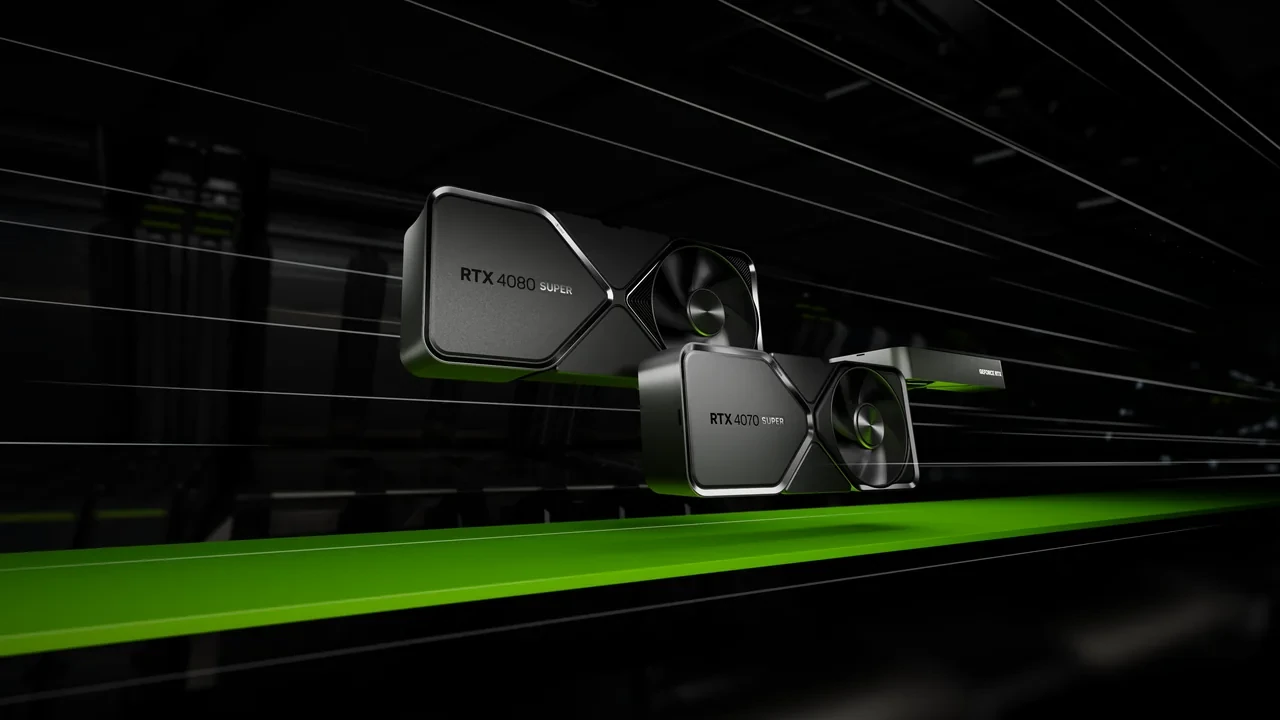
GeForce RTX 4060 DLSS 5 compatibility: the current state
NVIDIA has not announced official DLSS 5 support for the desktop GeForce RTX 4060, and no launch driver lists it as a supported target. DLSS 4.5 remains the latest confirmed route, including Super Resolution, Ray Reconstruction, and Frame Generation.
This mid-range Ada card appears in developer workstations and across a sizable part of the player base. Studios targeting 2026 or 2027 should build around its shipping 4.5 features and leave DLSS 5 as an unknown until NVIDIA publishes a GPU list, driver, and SDK.
Research papers and partner events have used DLSS 5 as the label for a new neural-rendering generation. Their descriptions cover neural shading and feature synthesis, but research output does not make a specific retail GPU compatible. If NVIDIA later changes the card’s status, the build matrix can change with it. Until then, 4.5 is the production target.
What NVIDIA has announced so far
Current DLSS 5 information comes from research previews and partner demonstrations rather than a generally available driver. NVIDIA has discussed the underlying technique, network, and visual goals without publishing a complete GPU list, release SDK, or public-driver date.
- NVIDIA describes DLSS 5 as a generation separate from DLSS 4.5, not a small plugin update to the 4.5 SDK.
- The previewed methods assume hardware that NVIDIA has not yet enumerated for game deployment.
- Driver enablement normally follows a public SDK by several weeks, so an SDK preview is not runtime support.
Those points are enough for a schedule. Visual demonstrations show where the technology is heading, but they do not prove that an RTX 40 desktop SKU will run the shipping version on launch day.
How the RTX 4060 maps to current DLSS versions
RTX 40 cards use Ada Lovelace hardware, including Tensor cores and an optical-flow accelerator required by DLSS 4.5. The desktop RTX 4060 is a cut-down Ada implementation, but it follows the same runtime contract: the application calls NGX and the driver dispatches enabled work to Tensor hardware.
That shared contract explains why the card receives 4.5 updates despite sitting at the bottom of the product range. It does not guarantee a later generation. A new DLSS release may bring another network, input format, or minimum hardware capability.
| DLSS generation | Status for GeForce RTX 4060 | Primary use in a shipping game | Developer action |
|---|---|---|---|
| DLSS 3.5 Ray Reconstruction | Supported | Improved ray-traced denoising | Use as a stable baseline |
| DLSS 4 Super Resolution | Supported | Neural upscaling from lower internal resolution | Default upscaling path for RTX 40 series |
| DLSS 4.5 Super Resolution and Ray Reconstruction | Supported (current generation) | Latest 4.5 generation features | Ship in 2026 builds as the default path |
| DLSS 4.5 Frame Generation | Supported | Synthesised intermediate frames for higher perceived frame rate | Enable on RTX 40 series targets; gate latency behind input options |
| DLSS 5 | No official launch support has been announced; future support remains unknown | Not applicable until official support is published | Do not depend on DLSS 5 in production |
The 4060 remains a fully supported 4.5 target. Its DLSS 5 status is an open compatibility question, not a present defect.
Why the lowest desktop Ada card matters
The RTX 4060 is the lowest-priced desktop Ada GPU and therefore the floor of many RTX 40 matrices. If a renderer fails on it, the project loses a large share of the generation’s audience.
- Use the lowest Ada card in the matrix as the gate for a new feature until NVIDIA publishes a higher minimum.
- Keep a software fallback for every DLSS route so a missing or disabled feature still produces a correct frame at a lower rate.
- Treat the driver as the release channel, since an unchanged SDK surface can load a different underlying model.
The version number will change. Those engineering rules should not.
Verify support in the project, not in marketing copy
The dependable answer for a given card and driver comes from a real render test.
- Pin a trusted NVIDIA driver for QA and put its exact version in every bug report.
- Create a scene that combines the heaviest ray tracing, densest particles, and largest internal resolution the game will support.
- Capture frame time at one output resolution and scene for every intended DLSS path, including off as the baseline.
- Save the NGX capability-query JSON beside the trace.
- Repeat on an RTX 4060, a higher RTX 40 card, and an RTX 30 card when the project still supports that generation.
If NGX does not report DLSS 5 for a given driver on the RTX 4060, that is the result for the tested pair. A later driver may differ, which is why the versions and JSON belong in the record. The same harness can test a future feature string without new instrumentation.
Rendering choices that are safe today
For most 2026 projects, DLSS 5 is outside the shipping list. That leads to straightforward implementation choices.
Use DLSS 4.5 as the reference build
QA can sign off the shipping 4.5 runtime on a clean driver installation. Visual claims should come from that configuration rather than a research preview.
Keep several sensible internal scales
Super Resolution needs enough information to reconstruct detail. Native internal resolution leaves no upscaling work, while an excessively low input creates artifacts. Offer a small scale ladder shared by RTX 30, RTX 40, and later hardware.
Let players disable Frame Generation
Frame Generation adds latency, so latency-sensitive players need an explicit option and an honest tooltip. Separate control also makes it easy to disable the path on any GPU excluded by a later driver.
Fall back when a future feature query fails
If NVIDIA later enables DLSS 5 on the card, detect it at startup. An empty capability should send the game to DLSS 4.5. That small branch has protected releases through earlier DLSS transitions.
Research material is not a shipping contract
NVIDIA’s DLSS 5 research page is the strongest public source for the technology’s direction, but it can discuss methods and images without promising support for an RTX 4060.
It can still help a technical director forecast art budgets, let a renderer programmer study likely architecture, and give publishers and platform holders accurate terminology. None of those uses turns a research demonstration into a hardware commitment.
Wait for a matching driver or SDK release before stating that a specific GPU is supported.
Where the card sits in the Ada lineup
The desktop RTX 4060 belongs to the Ada Lovelace RTX 40 family and shares its broad architecture with higher-tier models. That common base often produces similar support patterns, but the card’s low-end position makes it the boundary engineers need to verify.
The RTX 40 series reference covers launch timing, individual models, and shared architectural features. It is useful context for comparing the 4060 with larger Ada cards in a wide hardware matrix.
Common claims that go too far
“DLSS 5 is only a model swap inside 4.5”
A new generation can change network architecture, input buffers, temporal data, and dispatch behavior. Any one of those changes may set a new hardware floor, so a drop-in assumption is unsafe.
“The RTX 4060 is definitely too old”
NVIDIA has neither excluded nor included it in a public future list. Until NVIDIA publishes a support list, only the lack of official support today is confirmed.
“DLSS 5 will replace Frame Generation”
The research does not retire existing shipping features. A driver and game can carry Frame Generation alongside a newer path.
“A future driver will add it automatically”
A feature generally needs an application-side SDK update, a compatible driver API, and hardware that meets the minimum. None of those conditions is automatic.
Milestone checklist for the rendering lead
- Confirm DLSS 4.5 as the shipping path, with Super Resolution, Ray Reconstruction, and Frame Generation where appropriate.
- Record QA’s driver and save the NGX capability output with the build manifest.
- Keep a software fallback for every DLSS option.
- Expose Frame Generation separately and explain its latency.
- Reserve a DLSS 5 capability branch without enabling it until NVIDIA confirms the target GPU.
- Review the render budget on the desktop RTX 4060, the minimum card in the RTX 40 line.
Each item can be checked in code, a test record, or the shipping UI.
DLSS 4.5 now versus a possible DLSS 5 path
The right column remains hypothetical and should be read as a planning constraint rather than a prediction.
| Integration area | DLSS 4.5 on the GeForce RTX 4060 | DLSS 5 on the GeForce RTX 4060 |
|---|---|---|
| SDK availability | Publicly available and shipping | Not publicly listed as supported for this card |
| Driver enablement | Standard in current drivers | No official launch support has been announced; future support remains unknown |
| Production recommendation | Ship as the default DLSS path | Do not depend on it for a 2026 or early 2027 release |
| Visual quality target | Known and reproducible in QA | Based on research demos, not yet shipping benchmarks |
| Minimum hardware requirement | Documented for the RTX 40 series | Not publicly documented for the RTX 40 series |
| Risk to the build matrix | Low; covered by existing driver support | Unknown; treat as out of scope until published |
A renderer is behaving correctly when it runs the officially supported generation on the officially supported hardware.
Give publishers the same answer as engineering
For 2026 milestone and marketing documents, state that the project supports DLSS 4.5 on RTX 40 hardware and that DLSS 5 is not in the current matrix. The wording leaves room for an update without promising one.
Certification usually asks which neural features ship, the minimum driver, and the hardware floor. The desktop RTX 4060 is a reasonable floor only for features officially supported on it.
Copy editors need the NGX-backed feature list too. A claim made before engineering can reproduce it becomes a compliance problem after the press kit has shipped.
Signals that justify changing the matrix
Watch for a public SDK that names supported DLSS 5 GPUs and a driver branch that returns the feature through a runtime query. Either justifies updating internal planning. Both should exist before the feature appears in shipping copy.
Until then, keep 4.5 as the baseline. Subscribe to NVIDIA’s developer release notes and mirror changes into the team’s changelog so the rendering lead doesn’t have to reconstruct support after every driver. The same feed can report dropped support for an older card.
Why the integration point may change
DLSS 4.5 reconstructs each frame from low-resolution color, motion vectors, and depth. Its Frame Generation extension uses optical flow to create an intermediate frame while the host remains responsible for simulation and presentation cadence.
Published DLSS 5 research describes more guidance buffers and a network that can make decisions about shading, material appearance, or both. That puts the integration closer to the shading stage than the existing upscale pass. A renderer should not assume a thin wrapper around 4.5, although it can reserve an appropriate place in the frame graph.
On the RTX 4060, the unanswered question is whether those extra inputs and dispatch cost fit the lowest-tier Ada budget. A project running 4.5 with margin will be better placed to absorb any supported upgrade.
Related production context
The site’s related coverage of gaming technology and structured in-game systems supplies useful background. One concerns how newer technology enters production engines; the other shows why explicit options and runtime queries matter.
Neither changes this narrow hardware answer.
Frequently asked questions
Does the GeForce RTX 4060 support DLSS 5 today?
No. NVIDIA has announced no official support and no launch driver names the card. DLSS 4.5 Super Resolution, Ray Reconstruction, and Frame Generation remain its latest confirmed features.
Will the GeForce RTX 4060 receive DLSS 5 in a future driver?
NVIDIA has not published a later support list. Only an official driver or SDK update can change the current unknown status.
What is the latest DLSS version that the RTX 4060 supports?
DLSS 4.5 is the latest officially supported desktop version. Studios targeting a 2026 RTX 40 mid-range build should use it as the baseline.
Is DLSS 5 a drop-in replacement for DLSS 4.5?
No. New generations can change the runtime contract as well as network parameters. Retain a 4.5 fallback until NVIDIA documents the upgrade path.
Can I detect DLSS 5 support at runtime?
In principle, yes, through the NGX capability query. If the returned feature set omits DLSS 5, fall back to 4.5. Pin the QA driver so results remain reproducible.
Will Frame Generation still work if I add a DLSS 5 fallback?
Yes. Frame Generation is part of the supported 4.5 set and can coexist with a separate future path when each has its own capability gate.
Does DLSS 5 require a different SDK?
A new generation normally arrives in a new SDK while retaining the wider NGX surface. Stay on 4.5 until NVIDIA publishes the new SDK and its confirmed cards.
Should marketing material mention DLSS 5 support?
Not for the RTX 4060 today. Any claim must reproduce on a clean driver installation for the exact GPU named.
Where can I follow the official DLSS 5 status?
NVIDIA’s research page tracks the technology’s direction. NVIDIA developer documentation tracks what the SDK and driver actually ship.
What is the minimum RTX 40 series card I should test against?
For most desktop projects it is the GeForce RTX 4060, the lowest-priced Ada card. A renderer that fails there misses a large share of the RTX 40 install base.



Leave a Reply