
Dream Island Pokopia: what the upcoming cozy life-sim is teaching small studios about creature-driven design
A new creature-driven life-sim called Dream Island Pokopia has been drawing attention well before launch, partly because of its unusual production profile and partly because the design philosophy its developers keep describing lines up with several patterns small studios are already adopting. For a working game developer, designer, or producer, the project is more useful as a case study than as a consumer product. The open-world pacing, the way creatures are treated as simulation citizens rather than collectibles, and the way the studio talks about scope, AI, and content density all carry lessons that can be applied to other cozy sims, creature collectors, and small-team worldbuilding projects.
This article walks through Dream Island Pokopia from a production and design perspective. It looks at the confirmed information the studio has published, the design problems the game is trying to solve, the technical patterns small teams can borrow, and the realistic risks that come with building an open-world life-sim around creature behavior rather than around combat, narrative, or quest chains. The goal is to give a developer, technical artist, or producer a working mental model they can use to evaluate similar projects, plan their own creature-driven systems, and avoid the scope traps that often sink cozy sims in late production.
What Dream Island Pokopia is and what kind of game it actually is
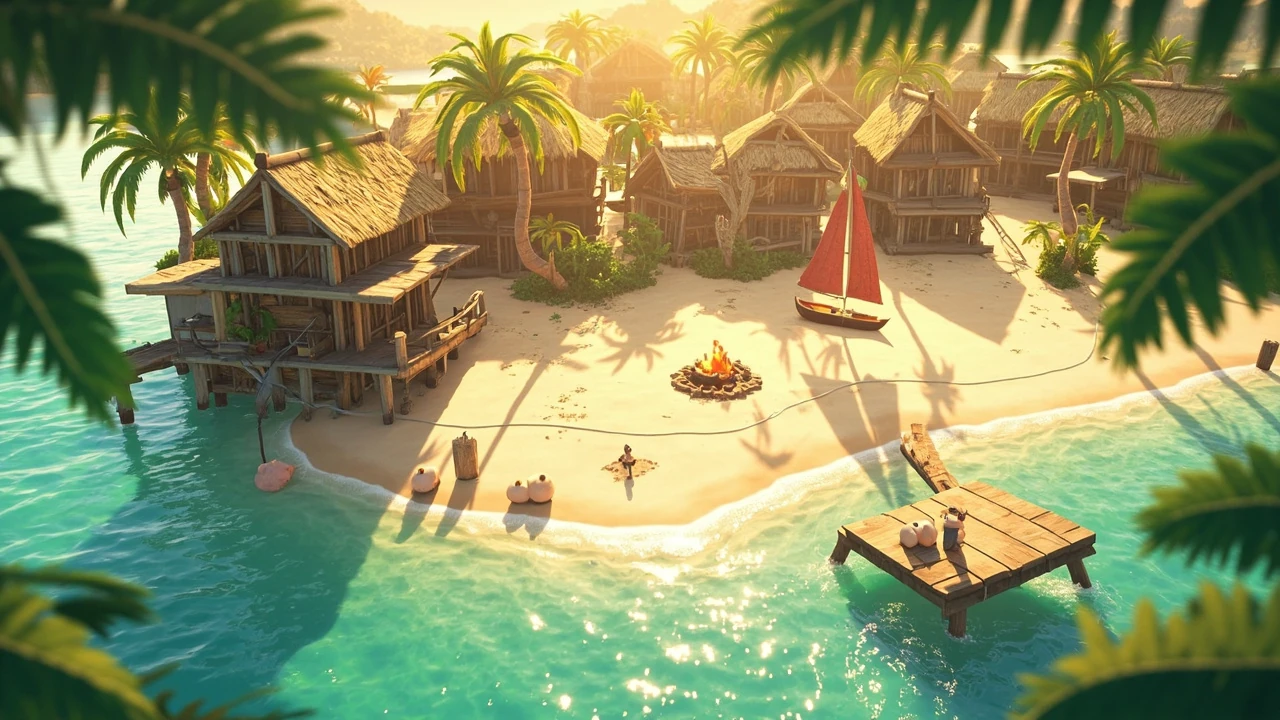
Dream Island Pokopia is an upcoming creature-driven life-sim set on a tropical island, built around exploration, creature friendship, crafting, and the slow restoration of an abandoned village. The premise is deliberately light: the player arrives on an island, befriends a population of small round creatures, gathers resources, builds and decorates structures, and gradually expands a small community. There is no announced combat system, no large-scale narrative campaign, and no seasonal battle structure, which puts it in the same broad family as Animal Crossing, the recent Story of Seasons entries, and games such as Coral Island or Ooblets.
Several things set it apart from that family, however. First, the creature roster is treated as the population of the world rather than as a collection you cycle through. Creatures have daily routines, sleep schedules, and preferences, and they can take up residence in buildings you construct. Second, the world is described by its developers as a single connected island rather than a series of gated zones, with the player expected to walk, swim, and boat across the entire map from the first hour. Third, the developer, Game Source Entertainment, has positioned the title as a smaller, more focused experience compared with the major Nintendo life-sim entries, which has implications for scope, content density, and post-launch plans.
For a developer reading the announcements closely, the important detail is not the exact feature list but the design priority. Creature simulation and the feeling of a living island are first, and gameplay verbs such as crafting, farming, and building are layered on top. That order matters because it changes how content is authored, how systems are budgeted, and how performance is approached.
Why small studios are watching the production model
The reason Dream Island Pokopia is interesting from a production standpoint is that it sits in a small but growing band of creature life-sims that have been delivered or announced by studios with headcounts in the tens rather than the hundreds. These projects have to solve a familiar cozy-sim problem on a tighter budget: how do you make a world feel populated, hand-crafted, and full of small moments without paying for the same level of authored content a larger studio would generate.
Several recurring production patterns are visible in how these smaller life-sim teams structure their work.
- They use a single island or small region rather than a continent, which keeps streaming distances and memory budgets predictable.
- They treat creatures and NPCs as the main content surface, which lets one well-tuned behavior tree produce many “moments” the player notices.
- They push decoration, building, and personalization to the player, which reduces the amount of bespoke environmental art the studio has to author.
- They accept a slower, less event-driven arc, which means less reliance on cutscenes, voice acting, and branching quest trees.
Dream Island Pokopia appears to be working inside that same envelope. The studio has not published a headcount, but the design priorities it has described line up with the constraints of a small team: a focused setting, a creature roster rather than a roster of human NPCs, light narrative, and a heavy emphasis on player-driven decoration. For a studio lead or producer, this is the useful lens. The question is not whether the game is good, but which production patterns are being repeated and which are being refined.
Creature-driven design as a content strategy
Creature-driven design is the most distinctive technical and editorial choice behind Dream Island Pokopia. Rather than designing quests, dialogue, and level encounters first, the studio designs creature behaviors and then lets the rest of the game grow out of interactions with those behaviors. This is a well-established pattern in small-team simulation, and it shows up clearly in the way the project has been presented.
Why creatures are a useful content surface
Creatures are an efficient way to make a small world feel populated because each creature can carry several layers of design at once. A single species can have a sprite, a behavior tree, a set of preferred biomes, a favorite item, a friendship curve, a sleep schedule, and a unique line of ambient dialogue. When the player encounters a creature, they are seeing the combined output of all of those layers, which gives the impression of a rich, hand-authored encounter even though the underlying system is shared across the roster.
This is how games such as Ooblets, Slime Rancher, and parts of the later Animal Crossing titles have produced a feeling of variety from relatively small art and logic budgets. The efficiency comes from reuse: the creature controller is one system, the friendship curve is one system, the ambient chat is one system, and each new species is mostly data plus a new rig and animation set.
Where the strategy breaks down
The strategy is not free. Creature-driven worlds need a careful balance between the number of species, the number of individuals the player sees at once, and the cost of simulating all of those individuals every frame. A small team that decides to ship 120 species with rich behavior trees is committing to a long content pipeline and a non-trivial runtime cost, and a team that ships only 12 species with very rich behavior risks a roster that feels thin. Most successful small-team life-sims land somewhere in the middle, with a moderate roster, a small handful of common species, and a longer tail of rarer creatures that act more as discovery rewards than as daily companions.
For a developer evaluating Dream Island Pokopia as a case study, the useful question is how the studio plans to keep the creature roster feeling fresh without expanding the behavior budget linearly. Possible answers include seasonal variants, personality axes, friendship-driven cosmetic changes, and player-built housing that alters creature behavior, all of which can extend the visible variety of a small roster without paying for new behavior logic each time.
Open-world pacing for a cozy audience
The pacing model of a cozy life-sim is one of the hardest design problems in the genre, and Dream Island Pokopia is openly working on it. Cozy players generally reject the aggressive pacing of traditional open-world games, where map reveals, level gates, and combat difficulty are used to stretch content. At the same time, a fully flat experience with no sense of progression tends to feel empty after a few hours.
The pacing contract with a cozy player
The unspoken contract with a cozy player is that the game will not punish them for not playing, will not lock core verbs behind grind, and will offer visible, satisfying change in short sessions. Dream Island Pokopia appears to design around that contract in a few concrete ways.
- The island is open from the start, so the player is never gated away from a region of the map they can see.
- Creature friendship and building are the main progression curves, which means progress is expressed through the world rather than through numbers.
- Days and weather are short and readable, so a five-minute session still produces a clear “I did something” feeling.
- Restoration of the village provides a slow, visible arc without forcing a main quest timeline.
For a designer, this is a useful example of a pacing model that runs in the opposite direction to a typical open-world design. The interesting design work is not in gating but in giving the player a reason to come back tomorrow without a checklist.
The risk of “too quiet” worlds
The most common failure mode for cozy life-sims is not that they are too demanding but that they are too empty. If the player can walk across the entire island in ten minutes and there is nothing in the world that surprises them, the pacing collapses. Small studios deal with this in different ways. Some lean on random events, some on creature routines, and some on a slow, scripted series of unlocks that operate more like a gentle narrative than like a difficulty curve.
Dream Island Pokopia seems to be betting on creature routines and weather as the main source of surprise, with player-built structures providing a secondary layer of variation. The bet is plausible because both creatures and weather are cheap to run and easy to tune, but it does mean that the studio has to ship enough variety in creature schedules and weather types that the player does not feel they have seen everything in the first week.
Scope discipline, build time, and the cost of a living island
One of the most useful lessons small studios can take from Dream Island Pokopia is the importance of scope discipline in creature-driven life-sims. The genre is unusually prone to late-stage scope creep, because almost every new feature is easy to describe and feels like it belongs. “Add a cooking system”, “add a museum”, “add seasonal festivals”, “add a romance system” – each of these is a small line on a design document that becomes a multi-month effort once art, animation, UI, and balance are accounted for.
| Scope area | Why it is tempting to add | Real cost on a small team | How Dream Island Pokopia appears to handle it |
|---|---|---|---|
| Cooking and recipes | Easy to describe, high player appeal | Art for dishes, UI, balancing, localization | Reported as present, but framed as one of several crafting verbs rather than the main loop |
| Seasonal events | Strong retention signal | Multi-month content pipeline every year | Not yet confirmed in detail; treated cautiously in developer comments |
| Romance or relationship systems | Player expectation in the genre | Dialogue, VO, branching, art variants | Not central; creature friendship appears to be the main relationship axis |
| Player housing and decoration | High engagement, social media friendly | Catalog size, snapping rules, performance | Explicitly a priority, positioned as a long-tail content surface |
| Multiplayer or shared islands | Strong word-of-mouth, retention boost | Networking, authority, cheating, testing | Not described as a launch feature in current materials |
For a producer or lead, the useful question is not whether a feature belongs in the genre but whether the studio can carry the cost of that feature across art, engineering, QA, and post-launch support. The studios that ship successful creature life-sims on small budgets tend to be the ones that are willing to say no to features that are easy to imagine and hard to maintain.
Technical patterns small teams can borrow
From a technical standpoint, the design choices in Dream Island Pokopia point to several production patterns that small studios can borrow regardless of engine choice. None of these are exotic, but they are the patterns that show up again and again in shipped small-team life-sims.
Behavior trees over large state machines
Creature AI in cozy life-sims is almost always cheaper and more maintainable as a behavior tree than as a hand-written state machine, because the number of states tends to grow faster than expected. A small team that starts with a single state machine per creature will usually refactor to a behavior tree within a year, and the refactor is painful. A small team that starts with a behavior tree from the first creature has a much easier time adding a hundredth creature.
Time and weather as a single system
Day-night cycles, weather, and seasonal change are best treated as a single time-and-environment system rather than as three separate features. When they share a state model, designers can attach creature routines, plant growth, and shop hours to the same source of truth, which means fewer synchronization bugs and easier balancing. The pattern shows up in Animal Crossing, Stardew Valley, and most successful small-team life-sims, and it is a reasonable guess that Dream Island Pokopia is using a similar approach.
Streaming a small island rather than a continent
By keeping the playable area to a single island, the studio can stream the whole world as a single open space, with creatures and objects persisted locally and updated on a fixed tick. This avoids the cell-loading, instancing, and seam-hiding problems that come with larger open worlds. The trade-off is that the world has to feel like enough, which puts more pressure on content density and creature variety.
Player content as a long-tail budget
Decoration, housing, and small customization options are some of the cheapest ways to extend a cozy life-sim’s content life without growing the main development team. The cost is mostly in catalog art and in the snapping and placement rules, not in scripting or AI. Studios that treat player content as a first-class system rather than as an afterthought tend to ship more items over the life of the game, because the pipeline is already in place.
The art and animation pipeline behind a creature roster
For artists and technical artists, a creature-driven life-sim has a particular pipeline that is worth understanding. The visible variety of the world depends on a small number of shared rigs, a moderate number of shared animations, and a much larger number of palette swaps, accessory slots, and behavior variations.
| Pipeline layer | What it carries | Typical cost on a small team | Risk if rushed |
|---|---|---|---|
| Creature rigs | Shared skeleton, facial rig, accessory bones | Moderate, one-time per rig family | Animation reuse becomes harder later |
| Animation sets | Idle, walk, run, sleep, interact, emote | High, scales with roster size | Creatures feel stiff or repetitive |
| Creature art variants | Color palettes, accessories, seasonal skins | Low to moderate, can be data-driven | Roster feels small after launch |
| Environment art | Tiles, props, lighting, weather | High, often the largest line item | World feels empty or repetitive |
| Audio and ambient | Footsteps, calls, music, weather layers | Moderate, scales with zones and creatures | World feels lifeless |
The lesson for a small studio is that the creature roster is not just an art decision. It is a pipeline decision, because every new species multiplies the animation, audio, and QA work that has to be done. A team that plans the rig family and animation budget before designing individual species can ship a larger roster on the same budget than a team that treats each species as a separate art task.
QA, playtesting, and the difficulty of testing a cozy sim
Creature life-sims are unusually hard to QA, because the game’s quality is mostly in the feeling of routines, weather, and small interactions, not in any single mechanical pass or fail. A bug report for a cozy sim often reads as “the world felt flat today” or “I did not know what to do”, and those are not stack traces. For a studio planning a project in the same space as Dream Island Pokopia, this has practical consequences.
- QA needs to include long-running playtests, not just short mechanical passes, because the pacing problem only shows up over hours.
- Telemetry, if used, has to be designed around session length, return rate, and daily activity rather than around win or fail events.
- Bug triage has to distinguish between hard bugs, which block shipping, and feel bugs, which block the game from being itself.
- External playtesting matters more than for many other genres, because the target audience is very specific about the feel of a cozy sim.
For a producer or QA lead, the useful takeaway is that the test plan for a creature life-sim is structurally different from the test plan for an action game. Building that test plan early is one of the cheaper decisions a small team can make.
Live operations, post-launch content, and the small-studio reality
One of the more interesting questions around Dream Island Pokopia is what its post-launch life will look like, because the creature-driven design has clear implications for live operations. A game whose main content surface is creature behavior, routines, and player-built structures is well suited to a long tail of small additions: a new creature here, a seasonal variant there, a new decoration set every few months. It is less well suited to the kind of large expansions that drive revenue in action or shooter games, because the world is intentionally small.
That has a few practical consequences for small studios thinking about a similar project.
- Live operations can be a meaningful retention strategy, but the content per update is smaller and the cadence is more often than a big expansion.
- Decoration, clothing, and creature accessories are good candidates for paid or earned content, because they sit naturally in the player loop.
- Major reworks are risky, because cozy players do not react well to changes that affect the basic feel of the world.
- Community feedback loops are valuable, because the cozy audience is unusually articulate about what they like and what they want next.
None of this is a recipe; it is a pattern. The studios that have done well in this space tend to combine a careful launch with a steady drip of small, focused updates, and to treat the world itself as the live product rather than as a one-time delivery.
What a developer should take away from the project
If you are a developer, designer, technical artist, or producer reading about Dream Island Pokopia, the most useful way to treat the project is as a real-world example of a particular design and production approach. It is not the only way to make a creature life-sim, and it is not the right approach for every team, but it is a coherent one, and several of its choices are worth understanding.
Design takeaways
- Treat creatures as citizens of the world, not as collectibles in a menu, and let that choice drive the rest of the design.
- Use a single connected space rather than a series of gated regions, and accept the resulting pressure on content density.
- Push decoration and personalization to the player, and build a catalog pipeline that can grow over time.
- Be honest about pacing. Cozy pacing is a design choice, and it has to be designed, not assumed.
Production takeaways
- Plan the rig family, animation budget, and creature pipeline before designing individual species.
- Treat time, weather, and seasons as one system, not three.
- Build a long-running QA process that includes feel testing, not only mechanical testing.
- Plan post-launch content from the start, especially if the studio’s revenue model depends on it.
Risk reminders
- An open world with a small team can feel empty if creature variety and routines are not enough.
- Player-built structures are a major performance and UX surface, and they need their own budget.
- Post-launch updates change the feel of a cozy sim if they are not handled carefully.
- Marketing the game to the right audience matters more than in many other genres, because cozy players are very specific about what they want.
How Dream Island Pokopia compares with other small-team life-sims
It can help to place the project next to a few of the small-team life-sims that have shipped recently, because the similarities and differences make the design choices clearer. The table below uses only design and production characteristics that have been described in public materials; it is not a quality ranking.
| Title | Team scale | World shape | Main content surface | Pacing model |
|---|---|---|---|---|
| Dream Island Pokopia | Small, studio-led | Single tropical island, open | Creature routines, building, decoration | Slow, restoration arc, no combat gating |
| Ooblets | Small, two-person lead | Single region, open | Creature collecting, farming, town restoration | Slow, quest-driven restoration |
| Coral Island | Small, mid-size team | Single island, open | Farming, diving, town relationships | Seasonal, quest-driven |
| Slime Rancher 2 | Small, established studio | Connected open zones | Creature ranching, exploration | Exploration-driven, light combat |
| Story of Seasons: A Wonderful Life | Mid-size, experienced studio | Single farm, open | Farming, family, town relationships | Seasonal, narrative arc |
The comparison makes the niche visible. Dream Island Pokopia is closer to the creature-collecting end of the cozy spectrum than to the farming-and-family end, and it is also more focused on routines and player-driven restoration than on a scripted narrative arc. For a studio, that positioning has consequences for art budget, writing budget, and post-launch planning.
What to watch as the project moves toward launch
Because Dream Island Pokopia is in development rather than shipped, the most useful thing a developer can do is watch for specific decisions that will reveal how the design is actually holding up. A few of those decisions are easy to track from public materials.
- The size and structure of the creature roster at launch, and how much of the variety comes from species versus from variants and accessories.
- The number of unique animations per creature, which is a good proxy for the animation budget actually delivered.
- The size of the decoration and building catalog at launch, because that is a strong signal of how the player-content pipeline was prioritized.
- The presence or absence of any large scripted events, which would tell you whether the studio is using a narrative arc to support the pacing.
- Post-launch communication, which will show whether the studio is treating the game as a live product or as a one-time delivery.
None of these are guarantees. They are signals, and they are the signals a developer can read from outside the studio. Over time, the pattern of those signals is what will tell you whether the production model behind Dream Island Pokopia is the kind of model you want to copy, adapt, or avoid in your own project.
Practical next steps for studios and developers
If the approach behind Dream Island Pokopia resonates with a project you are working on, the cheapest first step is to prototype the most expensive assumption, not the most exciting one. For most creature-driven life-sims, the most expensive assumption is whether the creature routines, weather, and player-built structures can carry the world on their own. A two-week prototype with a single creature, a small island, a day-night cycle, and a basic building system will tell you more about your design space than another month of feature design.
From there, three practical checks tend to separate a viable small-team life-sim from an over-scoped one.
- Can you describe your world in one sentence without using the word “and” more than once? If not, the design is probably too broad for the team.
- Can you list the five systems the player will notice most, in priority order? If not, the design is probably not focused enough for a small studio.
- Can you describe the feel of a five-minute session, not the feel of a fifty-hour save? If not, the pacing is probably not designed yet.
These checks are not specific to Dream Island Pokopia, but they are the checks that the project appears to be working through, and they are a useful starting point for any small studio thinking about a similar game. The genre is generous, the audience is engaged, and there is room for new entries, but only for teams that are willing to design the kind of world they can actually ship and support.
Frequently asked questions
What is Dream Island Pokopia in one sentence?
Dream Island Pokopia is an upcoming creature-driven life-sim set on a single tropical island, focused on befriending small creatures, restoring a village, and building a slow, cozy routine rather than on combat or a large scripted story.
Who is the developer of Dream Island Pokopia?
The project is being developed by Game Source Entertainment, a studio that has positioned the title as a focused, smaller-scale life-sim aimed at players who enjoy creature collecting, exploration, and light crafting.
How is the game different from Animal Crossing or Story of Seasons?
The main difference is that the creature roster is treated as the population of the world rather than as a separate collecting layer, the world is a single open island rather than a series of regions, and there is no announced combat or large scripted narrative arc. The pacing is also explicitly slower than many entries in the genre.
What can small studios actually learn from the project?
The most useful lessons are to treat creatures as the main content surface, plan the rig and animation pipeline before designing individual species, use a single connected world rather than gated regions, and budget for post-launch content from the start rather than treating it as an afterthought.
Is Dream Island Pokopia a good fit for a two- or three-person team?
It is a better fit for a team of that size than a typical open-world game, but only if the team is willing to keep the creature roster modest, the world small, and the decoration system simple. A two-person team trying to ship a hundred unique creatures with rich behavior trees will run out of runway quickly.
What are the biggest risks for a project like this on a small budget?
The biggest risks are an empty-feeling world, a creature roster that feels thin after the first week, a decoration system that becomes a performance or UX problem, and a post-launch plan that does not match the studio’s actual capacity to ship updates.
Does the game need a live operations plan to succeed?
Not necessarily at launch, but the design is well suited to a steady drip of small updates, especially around creatures, decoration, and seasonal events. A studio that plans live operations from the start will have an easier time keeping the game fresh than one that treats post-launch content as a separate project.
What engine choices make sense for a creature life-sim of this size?
Any mainstream engine that supports a single open world, a behavior tree system, and a stable day-night cycle is a reasonable starting point. The choice matters less than the discipline of keeping the world, roster, and decoration catalog within the budget the team can actually ship.
How should a studio test whether the cozy pacing actually works?
Long-running playtests with target audience members are the most reliable signal. Short mechanical QA passes will not catch the pacing problems that show up after ten or twenty hours, and a studio that skips this step usually finds the problems too late to fix cheaply.
Where can I read more about the design ideas behind cozy life-sims?
The For additional context, Dream Island entry on English Wikipedia is a useful reference for the broader history of island settings in simulation games, and official developer diaries for similar titles are a good source of design intent. Treat any specific feature claim as unverified until the developer has confirmed it in an official update.

Leave a Reply