
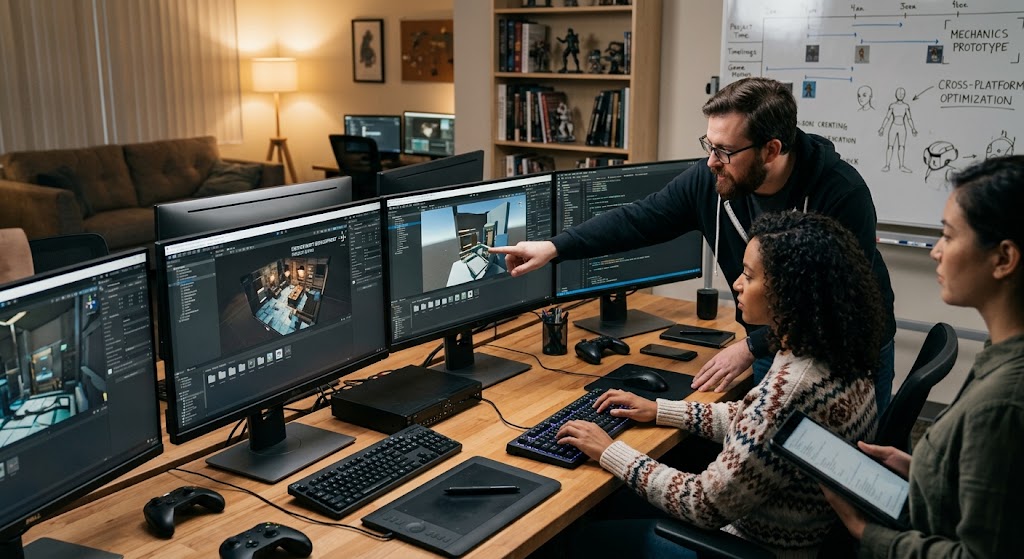
Custom Unity Game Development Services That Bring Ideas to Life
Creating a game takes more than just a good idea. You need execution, technical expertise, and a clear vision. That is where custom Unity game development services come into play. Whether you want to build a mobile title, a complex PC game, or a multiplayer experience, Unity provides the tools to make it happen.
Every project starts with a concept. But turning that concept into something playable requires skill. Many studios struggle with performance bottlenecks, buggy mechanics, or missed deadlines. Working with experienced developers helps avoid those traps completely.
In this guide, we will look at how tailored development works. We will cover the core benefits, key stages, and why Unity remains a top choice for game creators worldwide. Let us dive right in.
Game design is constantly changing. Players expect smooth graphics, fast loading times, and engaging gameplay. Fulfilling those expectations requires solid code and intelligent architecture.
When you choose specialized development, you gain access to dedicated programmers, designers, and artists. They handle the heavy technical lifting so you can focus on creative goals and audience growth.
Unity powers thousands of successful games across app stores and consoles. Its flexibility allows developers to build games for almost any genre or platform. But taking full advantage of this engine requires real experience.
Custom Unity game development services cover everything from early prototypes to full launch support. You get a team that understands mechanics, shader coding, asset optimization, and backend architecture.
Why do so many creators prefer custom solutions over off-the-shelf templates? Templates are often rigid. They limit what you can build. Custom development gives you total control over how your game looks, feels, and plays.
Let us look at a comparison between template-based development and tailored studio development.
| Feature | Template-Based Development | Custom Unity Game Development |
|---|---|---|
| Originality | Low – uses repeated assets and mechanics | High – built from scratch for your vision |
| Scalability | Limited – hard to add new features | High – designed for long-term updates |
| Performance | Average – often bloated with unused code | Optimized – tailored specifically for target hardware |
| Ownership | Shared or restricted license | 100% full intellectual property ownership |
| Bug Fixing | Reliant on template seller updates | Immediate support from your direct dev team |
Building a custom game guarantees that your gameplay mechanics feel unique. You are not forced to fit your idea into someone else’s framework.
Instead, developers write code specifically designed for your mechanics. This approach makes your game stand out in a crowded market.
Another big advantage is scalability. If your game becomes popular, you will want to add content, events, or multiplayer features. Custom architecture allows for smooth expansions without breaking existing systems.
Why Choose Custom Unity Game Development Services for Your Next Title
Unity stands out because of its cross-platform engine capabilities. You can write code once and deploy it across iOS, Android, PC, macOS, Xbox, PlayStation, Nintendo Switch, and VR headsets.
This cross-platform capability saves time and reduces production costs significantly. You do not need separate teams writing code in different languages for different platforms.
However, cross-platform deployment still requires careful tuning. Touch controls differ from gamepad inputs. Mobile processors have tighter memory limits than high-end PC hardware. Custom Unity game development services ensure your game is optimized properly for every single device.
Here are key areas where professional teams bring immediate value:
- Architecture design that ensures modular code and easy feature integration over time.
- Custom shader development and visual effects tailored to match your specific artistic style.
- Memory management and frame rate stabilization across low-spec and high-spec target devices.
- Backend integration for user authentication, cloud saves, leaderboards, and analytics tracking.
- Multiplayer networking code designed for low latency and secure player communication.
- Physics engine tuning for natural movement, combat mechanics, and environmental interactions.
Performance optimization is often where amateur projects fail. A game might run smoothly on a high-end development PC, but stutter on mid-range phones. That ruins player retention quickly.
Professional developers use Unity Profiler to track CPU spikes, memory leaks, and draw calls. They optimize texture compression, reduce batching overhead, and clean up scripts to maintain a steady 60 frames per second.
Let us break down the standard stages involved in professional game creation.
| Development Phase | Primary Deliverables | Main Objective |
|---|---|---|
| Pre-Production | GDD, concept art, technical roadmap | Define scope, art style, and core mechanics |
| Prototyping | Playable grey-box prototype | Test core loop and verify fun factor |
| Production | 3D/2D assets, sound design, gameplay systems | Build out full game content and levels |
| Optimization & QA | Bug fixes, device testing, frame rate tuning | Ensure stability across target hardware |
| Launch & Post-Launch | Store submission, live ops, patches | Release game and support community updates |
Pre-production sets the foundation. Skipping this phase leads to scope creep and inflated budgets later on. During pre-production, the team writes the Game Design Document (GDD) and plans the technical architecture.
Next comes prototyping. This step focuses purely on gameplay mechanics. Developers use simple shapes to test jumping, shooting, puzzle solving, or driving. If the prototype is not fun, mechanics are refined before art assets are created.
Once the prototype is validated, production begins. Artists model 3D assets, write animations, and construct levels. Programmers link systems together while sound engineers add music and audio feedback.
Quality assurance runs parallel to development. Regular testing catches bugs early when they are easy to fix. The team conducts playtests to verify balance and user flow.
Finally, the game moves to launch. Store pages are prepared, submission builds are generated, and server infrastructure is tested for peak player loads.
How Custom Unity Game Development Services Deliver Long-Term Value
Launching a game is rarely the end of the journey. Modern games rely on live operations, updates, and seasonal events to keep players engaged.
Custom Unity game development services build games with post-launch support in mind. By keeping code modular, adding new levels or items does not require rewriting core code.
Here are several reasons why long-term planning matters for successful titles:
- Frequent updates maintain active player bases and increase long-term user retention metrics.
- Flexible backend infrastructure supports seasonal events, battle passes, and special store offers.
- Clean code architecture allows new team members to onboard quickly and contribute code safely.
Monetization strategy also depends heavily on clean implementation. Whether your game uses in-app purchases, ad networks, or premium pricing, integration must be seamless.
Poorly implemented ads or broken store purchases alienate players immediately. Professional developers integrate native SDKs securely so transactions complete without glitches.
Art direction is another crucial component. Unity supports both 2D and 3D pipelines, including Universal Render Pipeline (URP) and High Definition Render Pipeline (HDRP).
URP works great for mobile and lightweight games, balancing visuals with performance. HDRP delivers high-fidelity graphics for PC and console titles, supporting advanced lighting and ray tracing.
Selecting the right render pipeline early saves hundreds of hours of rework later. Experienced developers evaluate your target hardware and choose the pipeline that fits best.
Audio design often gets overlooked, but it contributes heavily to player immersion. Spatial audio, dynamic background music, and punchy sound effects make gameplay feel rewarding.
Unity integrates with powerful audio engines like FMOD and Wwise. Professional dev teams use these tools to create reactive soundscapes that respond dynamically to player actions.
Multiplayer game creation adds another layer of technical complexity. You need server hosting, matchmaking, state synchronization, and anti-cheat protection.
Unity provides built-in networking solutions, but complex titles often require custom backend servers using Photon, Mirror, or dedicated server builds. Expert developers set up low-latency network setups that keep matches smooth and fair.
Here are key elements to consider when planning a multiplayer project:
- Choosing between peer-to-peer connection and dedicated server architecture based on gameplay needs.
- Implementing client-side prediction and lag compensation to mask latency for players.
- Protecting game state logic on the server to prevent cheating and data manipulation.
Finding the right development partner makes all the difference. Look for teams with a proven portfolio, clear communication habits, and transparent development practices.
Good communication prevents misunderstandings. Weekly updates, playable builds, and clear progress tracking ensure everyone stays aligned with the project vision.
If you want to turn your game idea into a reality, investing in tailored engineering pays off. You get a polished product that performs well and keeps players coming back.
Frequently Asked Questions
What Is Included In Custom Unity Game Development Services?
These services cover full-cycle development, including game design, 2D/3D art creation, C# programming, UI/UX design, sound creation, quality assurance testing, and post-launch maintenance across multiple target platforms.
How Much Does Custom Unity Game Development Cost?
Costs depend on project scope, visual complexity, platform choices, and multiplayer features. Simple 2D mobile titles cost significantly less than complex 3D multiplayer console games. A clear project brief helps establish accurate budget estimates.
How Long Does It Take To Develop A Unity Game?
Development timelines range from a few months for simple hyper-casual games to a year or longer for feature-packed PC or mobile titles. Pre-production planning helps establish realistic timelines for milestones and launch dates.
Can Unity Handle High-End 3D Graphics For PC And Console?
Yes. Unity features the High Definition Render Pipeline (HDRP), which supports advanced lighting, realistic materials, volumetric effects, and ray tracing for high-end visual fidelity on PC and current-gen consoles.
Will I Own The Source Code And Intellectual Property?
Yes. Professional custom development agreements transfer full ownership of source code, art assets, documentation, and intellectual property rights directly to you upon project completion and final payment.
Why Choose Unity Over Other Game Engines?
Unity offers unmatched cross-platform support, a massive asset store ecosystem, strong community support, and flexible rendering pipelines suitable for both simple 2D games and advanced 3D titles across mobile, desktop, and VR.
Can An Existing Game Be Ported To Other Platforms Using Unity?
Yes. Developers can adapt user interfaces, optimize graphics assets, and reconfigure control schemes to port existing Unity projects to mobile, PC, Xbox, PlayStation, or Nintendo Switch efficiently.
Building a successful game requires the right combination of creative vision and technical expertise. Utilizing custom Unity game development services gives your project the structural foundation, performance optimization, and unique gameplay polish needed to succeed in today’s competitive gaming market. Partnering with skilled developers turns your ideas into engaging experiences that players love.


Leave a Reply