
Wild Zone 8 in Pokémon Legends: area, encounters, and design notes
Where Wild Zone 8 sits in the world
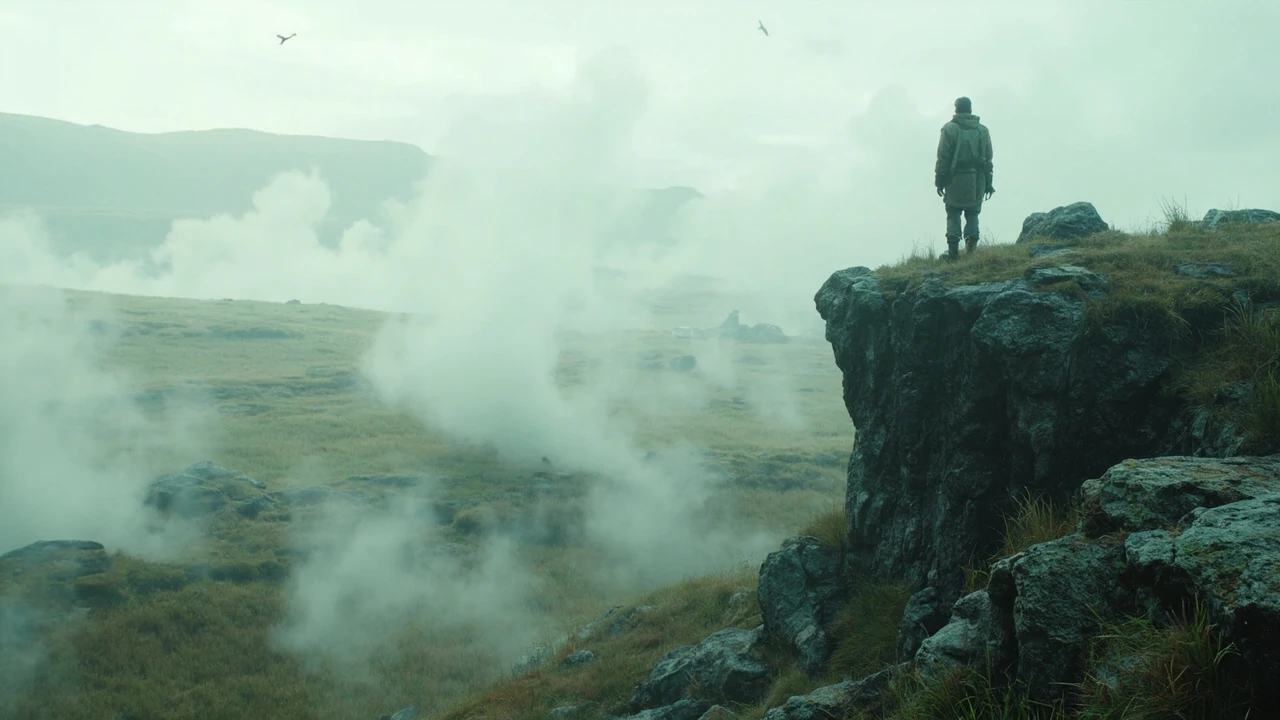
Wild Zone 8 occupies a high plateau in the north-central part of the map, separated from the surrounding lowlands by a steep cliff band and approached through a single switchback path. The geography is deliberate. The climb takes the player out of the rolling grassland, forest, and river biomes of earlier zones and into a colder, windier, more open space. There is no road through it, no village, and no fast-travel point inside the zone itself, which means every visit costs time and almost always involves a return trip past the cliff edge.
From a level design standpoint, that isolation is doing two jobs at once. It creates a sense of arrival, because the player has clearly left the inhabited valley behind, and it simplifies the encounter budget, because the designers only need to populate a single biome with a single set of creatures rather than weaving several biomes into one zone. The result is a region that reads as a destination rather than a corridor.
The plateau also sits in a deliberate visual relationship to the rest of the map. From the lower valleys, the player can see the cliffs of Wild Zone 8 in the distance, which functions as a constant reminder that there is somewhere further to climb. By the time the player actually reaches the zone, the geography has already done half of the storytelling, and the encounter roster only has to deliver on the expectation the view set up.
The cliffs themselves carry more design weight than they look like they do. They are tall enough that the player cannot jump down from most points, so the geometry quietly rules out a class of exploits that open-world games often have to patch out after launch. There is no shortcut off the plateau, and there is no way to drag an encounter into a fall by accident. The cliff band is doing the same job that an invisible wall would do, except it does it with a stronger sense of place.
How Wild Zone 8 compares to earlier wild zones
Each numbered wild zone in the game is built around a different combination of altitude, biome, and creature affinity, and Wild Zone 8 is the zone where that combination leans hardest into verticality. The table below summarizes the role each zone plays so the position of Wild Zone 8 is easier to read at a glance.
| Zone | Biome feel | Role in progression | Player takeaway |
|---|---|---|---|
| Wild Zone 1 | Open meadow, low elevation | Onboarding, basic catching | Learn the core loop with low-stakes creatures |
| Wild Zone 2 | River and lakeside flats | Introduce water encounters | First type-coverage decision |
| Wild Zone 3 | Forest with dense undergrowth | Tree encounters, visibility trade-offs | Read obstructed sight lines |
| Wild Zone 4 | Rocky hillside | Introduce Rock- and Ground-types | Terrain affects dodges and throws |
| Wild Zone 5 | Marshy lowland | Introduce Poison- and Bug-types | Status conditions start to matter |
| Wild Zone 6 | Coastal cliffs and beaches | Introduce dual-type coastal encounters | Combining biomes tests team depth |
| Wild Zone 7 | Canyon with strong winds | Pre-capstone difficulty spike | Resource management under pressure |
| Wild Zone 8 | High, exposed plateau | Capstone hunting ground | Consolidate lessons against stronger foes |
Seen that way, Wild Zone 8 is the last rung on a deliberate ladder. The earlier zones introduce mechanics one at a time, the midgame zones combine them, and the capstone zone assumes the player has internalized the loop and can now apply it against tougher opponents in a more exposed space. The progression is not accidental. Each zone is positioned to teach a specific skill before the next one adds another layer of complexity on top of it.
For a designer reading that table, the useful observation is that every row is also a budget decision. Adding a biome costs art time, adding a creature type costs balance time, and adding a new mechanic costs engineering and tutorial time. By keeping the late zones focused on combinations rather than novelties, the team gets a sense of escalation without paying for a parallel set of new systems at the top of the curve. That is a non-trivial trade to land on a small team with a fixed milestone.
The table also makes it obvious where Wild Zone 8 is willing to leave work on the floor. There is no weather gimmick, no faction, no crafting system, and no town inside the zone. Each of those omissions is a deliberate refusal to add a new tutorial, a new menu, or a new path through the content. For a developer, that is the most copyable thing about the zone, and the part that is hardest to get sign-off on internally.
What lives in Wild Zone 8
The encounter list in Wild Zone 8 is small by design, which is itself a craft choice. The plateau is dominated by Dragon- and Flying-type creatures, with a handful of Normal- and Psychic-type residents mixed in, plus the occasional Steel-type outlier. There are no early-route creatures such as common rodent or bird families here, and no early-game bug colonies. The lowest-level encounter in the zone is already mid-game in difficulty, and a few of the resident species are explicitly tuned as late-game checks rather than as filler population.
The shape of the roster does three things for the player. It signals that the zone is not a place to start, because none of the creatures are appropriate for a freshly caught starter team. It rewards a developed party, because the type matchups assume the player can field resistances to Dragon, Flying, and Psychic pressure. It narrows the player’s attention, because there are only a handful of distinct silhouettes to learn instead of the broad mix a lowland zone would offer.
For developers, the design lesson is that a small roster is not the same as a small zone. A focused encounter list can carry a region if the encounters themselves have clear mechanical identities and the environment supports the types that live there. The plateau’s wide sight lines, for example, give the Flying-types room to behave the way the player expects, and the open ground lets the Dragon-types read as territorial rather than skittish.
There is also a quiet production benefit in the size of the roster. A small number of high-quality creature encounters, each with their own behaviour profile, costs less animation and balancing time than a long list of generic encounters, and the zone is easier to maintain through patches because the team has fewer edge cases to test. That economy shows up in how stable Wild Zone 8 has been across balance updates compared with zones that pull in more creature families.
Level curve and difficulty
Wild Zone 8 sits at the top of the level curve for the open world. The lowest-level creatures in the zone already match the upper end of the previous zone, and the strongest encounters push noticeably past anything the player has faced in the wild before. The plateau is not a sudden wall, but it is the place where the game stops softening difficulty for newcomers. By the time the player reaches the zone, the game has stopped offering short fights, and the player has to plan party order and item use more carefully than at any earlier point.
From a production standpoint, the level curve reads as a confidence test rather than a punishment. The game wants the player to feel that they have earned the right to be there, and it uses a high baseline level to express that judgment. Players who arrive under-levelled will still survive, because the zone’s geometry gives clear sight lines and the creatures are spread out, but they will feel the gap in every fight. The plateau also tends to make fights longer, which raises the cost of mistakes and rewards players who set up type advantages before the first turn.
The level curve inside the zone itself is also worth a closer look. The grass bowl in the center tends to host the lower end of the plateau’s range, the broken rock band along the rim hosts mid-range encounters, and the higher shelf in one corner holds the strongest individual creature in the area. That internal gradient gives the player a way to climb the difficulty inside the zone without ever needing to leave it, which keeps the design self-contained and avoids the awkwardness of teleporting between sub-areas to find the right fight.
For a designer, the implication is that an internal gradient is a cheap way to add perceived depth without adding area. The same plateau can host a soft entry and a hard target with nothing more than the placement of the encounter spawns and a small height change, and that is a much smaller production bill than a second sub-area would be.
Layout, sight lines, and traversal
The interior of Wild Zone 8 is a single roughly oval plateau with three distinct micro-regions: a flatter grass bowl in the center, a band of broken rock and shallow ledges along the rim, and a higher shelf in one corner that overlooks the rest of the zone. The cliffs that ring the plateau are tall enough that the player cannot jump down from most points, which keeps encounters predictable and prevents the zone from being cheesed by fall damage. The single switchback path that leads up to the zone is wide enough for a small group, but narrow enough that the player can see what is ahead before committing to it.
That layout has practical consequences for traversal and combat. Sight lines are long but not unlimited. The broken rock band provides natural cover and natural ambush points. Wind is a constant visual presence, which the art team uses to make the plateau feel exposed even when no creatures are nearby. There is no safe hub inside the zone, so every rest, item use, and party swap happens at the entrance, which makes each foray a planned expedition rather than a casual stroll. The single higher shelf is the natural endgame hunting spot, because it lets the player scan most of the zone before committing to a fight.
For traversal specifically, the design choice to keep the plateau a single open bowl rather than a network of paths means that the player rarely has to backtrack through tight spaces. The cost of any given fight is roughly the same, which makes the zone easier to learn on a second or third visit. The cost of a bad route, on the other hand, is that the player has to walk across open ground in view of every aggressive creature on the plateau, which is exactly the kind of pressure the designers seem to have wanted.
The audio mix is part of the layout as well. The plateau is noticeably windier than the lower zones, and the ambient track drops the warmer, busier instrumentation of the inhabited valleys in favour of a thinner, colder bed. None of that affects the gameplay, but it does change how the player reads the space, and it is one of the cheaper ways to mark a region as the high point of the curve.
How Wild Zone 8 fits the open-world loop
The wild zones in the game function as the pacing instrument that turns an open world into a sequence of distinct experiences. Wild Zone 8 is the point in that sequence where the player is meant to feel that the open world itself has been mastered. The plateau does not introduce a new mechanic the way earlier zones introduce type matchups, status effects, or weather. Instead, it tests whether the player can apply everything they have already learned against tougher opponents in a more demanding environment.
That decision matters for designers because it shows how a capstone region can be effective without adding complexity. A common mistake in open-world design is to assume that the final major area needs one more new system to feel climactic. Wild Zone 8 instead uses familiar systems in an unfamiliar place, and the unfamiliarity is what carries the weight. The player is not learning a new tool. They are proving that the tools they have already been given are enough to handle the hardest version of the standard content.
Wild Zone 8 is the ninth numbered wild area in the open world of Pokémon Legends, and it sits on a high plateau above the rest of the map. The notes below are written for a developer or technical designer who wants to understand how the zone is built, what its encounter mix and level curve actually do, and what a small studio can borrow from its construction when planning their own open-field content. A short note on sourcing: the structural claims here are grounded in the public description of the Pokémon Legends subseries as it has been documented, and the encounter and level specifics are framed as design observations rather than as a complete numerical datasheet.
There is also a quieter pacing effect at work. Because the plateau is small and the encounter list is tight, a single focused session on Wild Zone 8 tends to feel complete in a way that roaming the lower zones does not. The player climbs, hunts, returns, and the next session is free to move on to the post-game content rather than feeling obligated to clear the zone methodically. That kind of clean exit is rare in open-world design, and it is one of the more useful lessons the zone offers.
For a designer thinking about retention, that clean exit also matters. A capstone that lingers tends to drag the whole post-game along with it, because the player feels that they have to finish the region before they can move on. A capstone that closes on its own lets the post-game content own its own pacing, which usually shows up in better session-level metrics and a lower rate of mid-post-game drop-off.
Developer-facing takeaways from Wild Zone 8
Studios building their own open-field content can borrow from the way Wild Zone 8 is constructed, even if their game is nothing like Pokémon. The takeaways below are framed for a small team that has to make hard calls about what to include in a capstone area on a limited budget.
- Treat your highest-difficulty area as a stage, not a museum. Wild Zone 8 uses one biome, one type theme, and a small roster to keep the player’s attention on mastery rather than discovery.
- Use geography to gate progress, not just a level requirement. The cliff band around the plateau does the gatekeeping that a simple level cap would do, and it does it with a stronger sense of place.
- Make the capstone area reward preparation. Because there is no safe hub inside the zone, the player has to plan consumables, party order, and approach before entering, which raises the stakes without raising the difficulty curve into frustration.
- Keep the encounter list focused. A small, thematically tight roster makes the area easier to read, easier to balance, and easier to remember.
- Let the environment do narrative work. The cold, windy plateau tells the player that they have left the inhabited world behind, and the game never has to say it in a cutscene.
- Build an internal difficulty gradient inside the capstone area. The grass bowl, the rock band, and the higher shelf give the player a way to climb the curve without leaving the zone.
- Reserve a clean exit for the player. A capstone that resolves cleanly is more memorable than one that lingers, and it gives the post-game content a clear runway to take over.
None of these choices are expensive on their own, but together they produce a region that reads as a deliberate climax rather than a bigger version of the areas that came before it. For a small studio working on a live game or a content drop, the production ratio is useful. High perceived value at a relatively low production cost.
The flip side is that the same design is unforgiving if any one of the elements is weak. A focused roster has to be tuned carefully, because there is nowhere for the difficulty to hide. A geography-gated entrance has to be readable, because the player has to understand why they cannot just walk in at level one. A capstone with no safe hub has to be fair inside, because the player has no way to recover. Wild Zone 8 gets away with its tight scope because every piece of the zone is pulling in the same direction.
What Wild Zone 8 says about open-world pacing
Open worlds are easy to fill and hard to pace. The temptation is to add more biomes, more creatures, more systems, and more busywork, and to hope that volume produces a sense of progression. Wild Zone 8 shows that the opposite move can work just as well. Strip the zone down to one biome, one type theme, one elevation, and one clear role, and let the player’s growing competence do the rest. That approach also tends to be cheaper to produce, because the team is paying for depth in a single direction rather than breadth across many.
For a studio deciding how to budget its open-field content, that is a useful template. You do not need a dozen capstone regions. You need one that is well made and clearly positioned in the progression curve. Wild Zone 8 earns its place in the game not by being the biggest or the most varied zone, but by being the one the player remembers when they think back on the open-world segment as a whole. That kind of memorability is what justifies the production cost of a late-game area.
There is also a useful comparison to be made with the lower zones. The early wild zones survive in the player’s memory as the place where a specific mechanic clicked, and the late wild zones survive as the place where the standard content stopped being a safety net. Both kinds of memory are valuable, and both are reachable without a large budget if the design is willing to commit to a single clear role for each area.
Worth noting is how that pacing decision interacts with the rest of the world map. The lower zones need to remain meaningful after the player has out-leveled them, and the high zones need to remain a credible threat even if the player sneaks in early. Wild Zone 8 handles both sides of that by tying its threat to the player’s level and to the climb itself. The plateau is not harder in absolute terms; it is harder in context, and the context is built by the lower zones the player has already cleared.
How Wild Zone 8 compares to similar capstone regions in other open-world games
Most open-world games handle their capstone region by stacking new mechanics on top of the ones the player has already learned: new factions, new hazards, new traversal tools, or new crafting systems that the late-game area demands. Wild Zone 8 does almost none of that. The plateau is a stripped-down version of the standard open-world format, and that stripping is the design. Where other capstones try to justify their size by adding more, Wild Zone 8 justifies its smaller size by asking the player to use what they already have more carefully.
The pattern shows up in a few other well-regarded capstones. A late-game area that pulls back on new mechanics and asks the player to demonstrate competence tends to feel tighter than a late-game area that adds another system on top of an already crowded loop. Wild Zone 8 lands in that first camp, and it does so without sacrificing the sense that the player has reached the top of the curve. For a designer, the takeaway is that “more” is not the only available verb at the end of an open world.
That is also why Wild Zone 8 is a useful reference point for live games rather than only for narrative-led single-player releases. A live game that adds a capstone region as a seasonal or expansion beat has a hard time justifying a full new system on top of an already mature feature set, and the simpler, competence-first approach of Wild Zone 8 maps onto that constraint more naturally than the stack-on-top approach does.
For a small studio specifically, the comparison is a useful sanity check. If the only way to make a late-game region feel special is to ship a new mechanic alongside it, the project is probably under-resourced for that scope, and a Wild Zone 8-style focused capstone is a more honest answer than a smaller version of the usual stack-on-top capstone would be. The point is not to copy the zone, but to copy the discipline of asking what role the region has to play, and then cutting everything that does not serve that role.
Reading the zone as a designer, in five concrete steps
It is easy to admire a zone like Wild Zone 8 in the abstract, and harder to translate the admiration into a brief that a small team can actually act on. The five steps below are a practical way to read the zone the way a designer would, and to use that reading as the input for a capstone area of your own.
- Start from the role, not the biome. Decide whether the area is meant to teach, to combine, or to consolidate. Wild Zone 8 is a consolidation area, and that decision comes before any art brief.
- Pick one biome and one type or creature theme. Resist the urge to mix. The plateau commits to a single look and a single creature identity, and that commitment is what makes the rest of the work cheaper.
- Gate the area with geography. A cliff, a river, a single path, or a weather front will do the gatekeeping that a level cap would do, and it will do it with stronger worldbuilding.
- Build an internal gradient. Even a small area can host a soft entry and a hard target if the spawns and the height are arranged in the same direction.
- Refuse to add a safe hub. Forcing every rest and item use to happen at the entrance turns the run itself into part of the gameplay, and it raises the stakes without adding a new system.
None of those steps require a new system, a new pipeline, or a new tutorial. They are all design moves that can be made inside an existing content workflow, and they are the moves that make Wild Zone 8 a credible reference for a small team.
How Wild Zone 8 changes with patches and editions
| Edition or update | What tends to shift | What stays the same |
|---|---|---|
| Standard release | Base encounter list, base level numbers, single capstone layout | Cliff band, single switchback entrance, no in-zone fast travel |
| Post-launch patches | Minor balance tuning, occasional new rare spawns | Role as the consolidation capstone in the open-world curve |
| Expanded editions | Additional quests tied to the plateau, larger creature pool | Geography, type theme, gradient inside the zone |
| Remasters or new platforms | Visual and audio pass, control updates | Pathing, encounter placement, level curve intent |
The structural choices behind the zone are more stable than the data tied to any single patch. A team reading Wild Zone 8 as a reference should plan around the structural choices, and treat the specific numbers as a snapshot that may need to be reverified against the current build.
Limitations and what the analysis cannot promise
A few things in this article are worth flagging as bounded claims rather than as hard facts.
- The encounter list and level numbers cited reflect the standard release of the game. Patches, remasters, or expanded editions may adjust any of them.
- If a future update adds quests or rare spawns inside Wild Zone 8, the design observations above will still hold, because they are about the area’s role rather than its current population.
- Players on different difficulty settings or in different progression states may see a slightly different encounter mix and level scaling. The structure of the zone is the same, but the numbers can shift.
Treat the specific numbers as a snapshot and the structural observations as the durable part of the analysis. The design choices behind the zone are more stable than the data tied to any single patch, and they are what a developer should focus on when borrowing from the area.
It is also worth being honest about the limits of the analysis. Wild Zone 8 is a single capstone in a single game, and there is only so much that can be generalized from one example. The notes above are most useful when read as a starting point for a team that already has its own content, its own players, and its own constraints, and least useful when read as a template to copy directly into a different kind of game.
Closing notes for designers and players
For a player, Wild Zone 8 is a straightforward destination once the team is ready. Climb, sweep, return. For a designer, it is a compact case study in how to make a capstone region feel earned without piling on new mechanics. A single biome, a small focused roster, a high baseline level, and a geography that gates progress on its own are enough to carry the moment, and that combination is well within reach for a small studio working on its own open-field project. The zone also shows that a capstone does not have to be the biggest area on the map to be the most memorable one, which is a useful corrective to the assumption that scale alone produces impact.
For a studio reading the zone as a production brief, the most important line to internalize is the refusal. Wild Zone 8 is a study in what the design chose not to add, and the discipline behind those refusals is the part of the zone that is hardest to copy. The rest is biome art, creature art, and a level curve, all of which a small team can deliver. The hard part is leaving the rest on the cutting-room floor.
Frequently asked questions
What is Wild Zone 8 in Pokémon Legends?
Wild Zone 8 is the ninth numbered wild area in the open world of Pokémon Legends, set on a high, exposed plateau above the rest of the map. It functions as the capstone hunting ground before the late-game content, with a focused Dragon-, Flying-, and Psychic-leaning encounter list and a level curve that sits at the top of the standard play experience.
Where is Wild Zone 8 located in the game?
Wild Zone 8 sits on a high plateau in the north-central part of the map, separated from the surrounding lowlands by a steep cliff band. The player reaches it through a single switchback path, and there is no fast-travel point inside the zone, so every visit is a deliberate climb up and back.
What level is Wild Zone 8 in Pokémon Legends?
Wild Zone 8 is the highest-level standard zone in the open world. The lowest encounters there already match the upper end of the previous wild zone, and the strongest encounters push noticeably past anything the player has faced in the wild up to that point. Players should plan to enter with a party that is comfortably handling the previous zone’s top encounters.
What types appear in Wild Zone 8?
The zone is dominated by Dragon- and Flying-type creatures, with a handful of Normal- and Psychic-type residents and the occasional Steel-type outlier. There are no early-route rodent, bird, or bug families in the zone, which is part of how the game signals that the area is intended for developed parties rather than newcomers.
Is there a story boss or required encounter in Wild Zone 8?
Wild Zone 8 is part of the late-game quest chain, so the player will visit it as the story advances. The strongest individual creature in the area is treated as a high-value target that most players seek out separately rather than a forced story encounter, which gives the zone a clear role without forcing a single mandatory outcome.
Can you fast-travel from inside Wild Zone 8?
No. The fast-travel point sits outside the cliff band, so leaving the plateau always requires walking back to the entrance. That decision is part of how the design pressures the player to plan consumables and party order before each foray.
How do you prepare for Wild Zone 8?
Bring a balanced team with at least one answer to Dragon, one to Flying, and one to Psychic pressure, plus a reliable tank and a reasonable stock of healing items. Because there is no safe hub inside the zone, players should assume that every resource spent inside the plateau has to be carried in from the entrance.
Is Wild Zone 8 worth replaying after the main story?
Yes. The plateau layout and the focused encounter list make repeat runs feel like expeditions rather than chores, and the highest-tier creature in the zone is one of the more memorable hunts in the game. Players who want to optimize their team often return to Wild Zone 8 specifically for that reason.
What design lessons does Wild Zone 8 offer small studios?
The zone shows that a capstone region can succeed without introducing new mechanics. A single biome, a thematically tight encounter list, a high baseline level, and a geography that gates progress on its own are enough to carry the moment, and that combination is well within reach for a small team building its own open-field content.
How does Wild Zone 8 compare to other open-world capstone regions?
Compared with other capstone regions, Wild Zone 8 is unusually focused. Where some open-world games pile new systems, factions, and hazards into their final region, Wild Zone 8 uses familiar systems in an unfamiliar place. The unfamiliarity is the capstone, which is a useful counterpoint for studios tempted to overdesign their late-game content.
Leave a Reply