
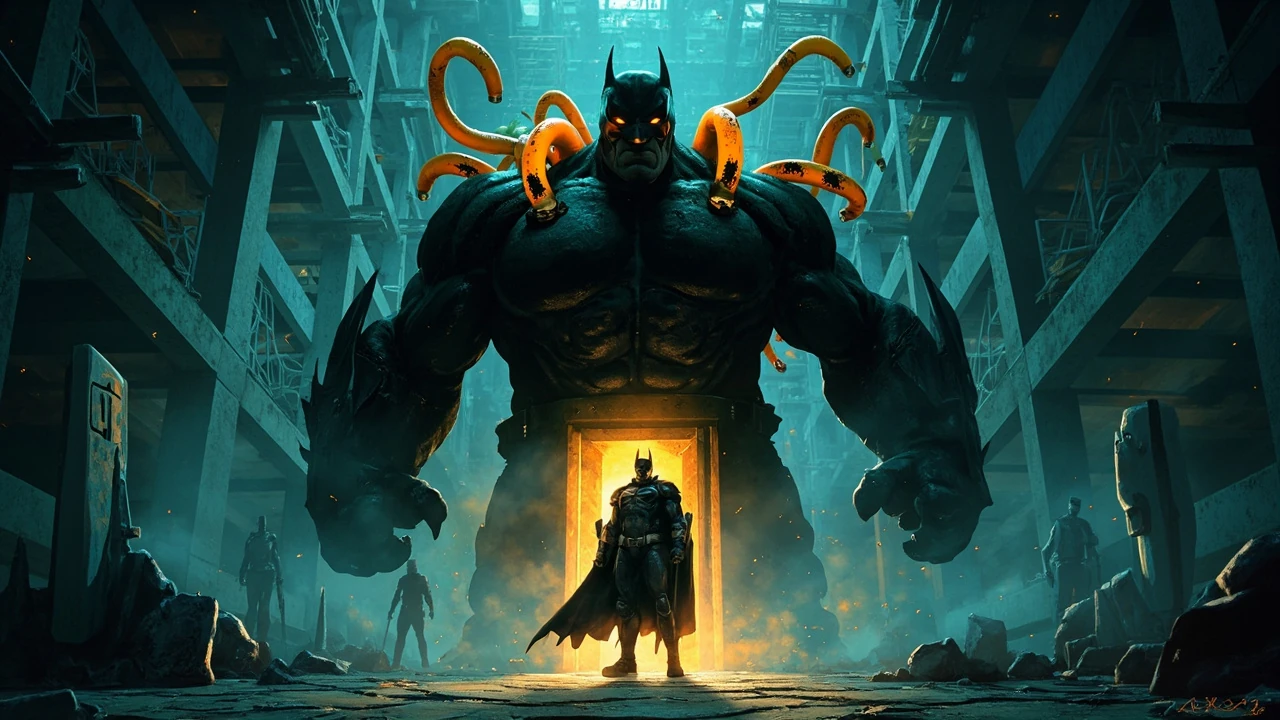
Absolute Bane and what the character means for game developers
When DC and writer Scott Snyder introduced the Absolute line, the central creative constraint was inversion: take the most familiar pieces of the Batman mythos and rebuild them so a 2025 audience has to relearn them. The first major boss in that rebuilt world is absolute bane, a version of the Venom-fueled strongman who is not a cunning counterweight to a lean Dark Knight but the largest human silhouette in the story. For a game developer, that single design decision is the most important thing about the character. It tells you what the fight is supposed to feel like before you ever touch a controller, and it gives you a clear vocabulary for the encounter design, animation priorities, and technical-art budgeting that follow.
This article treats absolute bane as a game-design case study rather than a comic-book recap. It looks at how the character is staged, how his silhouette is sold, what his first encounter implies about a boss-fight structure, and which of those choices translate cleanly into an Unreal or Unity project. The character only exists in a comic right now, so the goal here is to extract reusable principles, not to invent unverified details about an in-game release.
Why a size-first villain is a deliberate design choice
The most common mistake when a team ports a known villain to a new medium is to treat “bigger” as a stat number. The interesting creative decision is which property of the character survives the rewrite. For absolute bane, the property that survived is the silhouette: he is the only character in the scene whose body shape overrides Bruce Wayne’s, which is itself an inversion of how DC’s main line has staged Bane for decades.
That choice cascades through the whole encounter. If your boss is bigger than the player, the camera, the collision, the hit reactions, and the readable feedback all have to change at the same time. Planning the silhouette first is what lets a team scale the rest of the fight to match.
What the silhouette tells the player
A character who takes up more vertical and horizontal space than the protagonist communicates three things before combat starts:
- Damage will be presented as area and impact, not as precision or speed.
- Standard player attacks will visibly fail to move the boss, so the encounter needs a different satisfaction loop.
- Survival windows depend on positioning and timing, not on the player’s own damage output.
For absolute bane, the comic leans on each of those signals. The first impression is mass, then a quiet, well-spoken threat, then a single brutal finish. A game adaptation that copies the silhouette but skips the quiet beat ends up with a generic juggernaut, not the same character.
How the absolute bane reveal is staged
Staging is the part of encounter design that often gets described as “the cutscene before the fight.” In practice it is the sequence of readable signals that prepare the player for what they are about to do. The first appearance of absolute bane uses three layered signals, and a developer can study them in order.
Signal one: a public, scripted event
The character is introduced at a peace summit between two foreign leaders. The audience knows the context is meant to be ceremonial, which raises the cost of any violence. For a level designer, the equivalent is the “calm before” pattern: a long, low-tension walk or dialogue segment that gives the encounter its first rhythm. The walking pace, the camera height, and the ambient sound should be calmer than the rest of the level so the transition into combat is felt in the body, not just in the HUD.
Signal two: a single dominant action
The reveal culminates in one decisive act of violence rather than a long fight. This is a useful budget signal: you do not need to fully animate a combat system for the reveal. You need one well-keyframed action, plus the camera work and sound design that make it feel earned. For an indie or mid-budget project, that single high-quality moment often carries the introduction better than a half-finished combat rehearsal.
Signal three: a calm voice
Absolute bane speaks in measured dialogue rather than shouting. The contrast between his body size and his tone is part of the design. In a game, this typically maps to a boss who is composed in their barks and taunts. Audio engineers should plan a lower-frequency voice pass for any large villain so the calm reads as calm and not as quiet. If the recording is mixed at the same level as a standard NPC, the player will turn up the volume for the taunts and the hits will feel disproportionately loud.
Technical lessons for a size-first boss
Translating a comic-book giant into a real-time scene forces decisions that the art team, the engineering team, and the animation team all have to agree on. The list below is the minimum set a producer should walk through before a boss like this goes into a sprint.
| System | What changes because the boss is larger than the player | Risk if the team does not plan for it |
|---|---|---|
| Camera | Framing must keep the full silhouette readable without losing the player character on screen. | Player avatar disappears during big swings; the player feels disoriented, not threatened. |
| Animation | Hits need exaggerated recovery, since the player will read the boss as heavier than the rig actually is. | Light, snappy recovery breaks the size illusion and turns the boss into a normal enemy. |
| Collision | Hurtboxes and grab volumes have to scale; a giant fist cannot use the same capsule as a melee grunt. | Players walk through the boss or get stuck in geometry during the grab. |
| Performance | Skeletal mesh, cloth, and Venom-style VFX inflate the per-frame cost at the same moment the camera is busiest. | Frame-time spikes during the most cinematic part of the fight. |
| Audio | Footsteps, voice, and impact layers must be authored at lower frequencies than the player character. | The boss does not feel bigger, only louder. |
None of these items are exotic. They are the reason a team that has shipped only human-scale characters will see a quiet budget explosion the first time they put a 3.5-meter rig on screen.
What absolute bane says about difficulty design
Bosses that outscale the player are tempting to design as attrition tests: give them high health, give the player low damage, and call the fight hard. That approach usually produces a fight the player survives rather than enjoys. A more useful structure is to treat the size gap as a constraint on the player’s toolset, then design encounter phases around how the toolset opens up.
| Phase | Player toolset | Boss behavior | What the player learns |
|---|---|---|---|
| Phase 1: read the silhouette | Limited dodges, no parry | Slow, committed attacks with long wind-ups | Timing windows are generous, but positioning matters because of the boss’s reach. |
| Phase 2: exploit the gap | Parry or counter added | Mixes in grabs and area denial | Defensive options have to be used at the right distance, not just at the right time. |
| Phase 3: resource pressure | Full kit, limited healing | Adds a transformation that increases the silhouette further | The player must convert openings into damage instead of waiting them out. |
The three-phase structure is not new. What the absolute bane silhouette does is force every phase to be readable in body language. When the boss is 1.5 times the player’s height, a one-frame animation difference is still readable on a 65-inch television; when the boss is 3 times the player’s height, a one-frame difference is invisible at the same camera distance. Animation has to be longer, slower, and more committed to remain readable.
Designing the Venom transformation as a system, not a costume swap
The For additional context, absolute version of the character still has Venom, but the comic frames it as a deliberate choice the boss makes during the fight, not as a permanent state. For a game team, that distinction is the difference between a cosmetic toggle and a real subsystem. A good transformation has its own animation set, its own hurtbox profile, and its own audio pass, and the transitions in and out of it have to be readable from the player’s position.
It is worth listing the minimum subsystem checklist for any in-fight transformation:
- Distinct skeletal mesh or blend shape, not just a material swap, so the silhouette change is real.
- Re-authored hit reactions, because a heavier boss cannot reuse the lighter version’s flinch.
- Audio pass that re-balances footsteps, breathing, and voice without re-mixing the music bed.
- Damage and health values that reflect the new silhouette: bigger targets are easier to read but should not become easier to kill.
- Camera re-framing, because the existing camera may now frame the player as a small element of the boss’s body rather than the other way around.
A team that has shipped a smaller boss can usually absorb this list in a single sprint, but only if the work is scoped before the boss enters animation. A team that tries to add it during polish will pay the cost twice, once in the original rig and once in the override.
How the absolute bane silhouette changes level layout
Most boss arenas in mid-budget action games are designed around the player’s traversal kit. The moment the boss is larger than the room was planned for, the room itself becomes the design problem. A 4-meter-tall enemy needs at least 5 meters of vertical clearance to swing a heavy weapon without intersecting the ceiling, and at least 6 meters of horizontal clearance to maintain camera framing during a charge.
That has a knock-on effect on the environment art team. Pillar placement, ceiling trusses, and light fixtures can no longer be set dressing. They become collision boundaries for the boss’s attacks. A level designer who knows the boss’s intended range can use those elements as readable telegraph points; a level designer who does not will get bugs where the boss’s fist clips through the world geometry every third swing.
The same logic applies to friendly NPCs in the arena. If the boss is large enough to grab a bystander, the animation team needs a set of pre-baked bystander rigs that can be swapped in and out without re-authoring the grab. This is one of the easiest things to forget in a vertical-slice build and one of the hardest things to retrofit when the boss is already animated.
What writers and narrative designers can borrow from the comic
Writers working on a game adaptation of a size-first villain often default to a single tone: either silent menace or loud bravado. The absolute bane introduction does neither. He is composed, slightly philosophical, and visibly competent at the moment he speaks. The verbal restraint is part of the threat.
For a narrative team, the practical lessons are simple but specific:
- Write a short barks list that fits the boss’s emotional register, not the player’s expectation of the archetype.
- Plan for the barks to be triggered by player actions, not just by the boss’s own phase changes, so the dialogue feels reactive.
- Localize the barks before they are recorded, because a calm villain in English can read as sleepy in a language with different stress patterns.
- Keep at least one line of dialogue for the post-fight state. A boss whose final words contradict the rest of their script is one of the cheapest ways to make the encounter feel finished.
None of these notes require a new system. They require the writer to be in the room when the encounter is scoped, which is the part of production that most often gets cut.
QA and validation passes for a giant boss
QA on a size-first boss has to cover the same ground as any other boss, plus a small set of cases that only appear when the silhouette changes the rules. The list below is a useful starting scope, not a complete plan.
- Verify that the camera can frame both the boss and the player during every attack in the kit, at the lowest and highest difficulty settings.
- Confirm that the grab volumes do not intersect level geometry at any player height, including crouch and prone.
- Test the transformation in and out of the player’s line of sight. A transformation that the player cannot see should not exist.
- Profile the boss under the minimum-spec target hardware, not just on a development kit, because the VFX cost of large characters scales with pixel coverage as well as polygon count.
- Run an accessibility pass on colorblind modes, because Venom-style glow effects often depend on a single hue that disappears under deuteranopia filters.
If the team cannot close at least three of those five cases with automated tooling, the boss should not enter final certification on its first build. A second pass is almost always cheaper than a re-release.
How absolute bane fits into a larger boss roster
A single giant boss can work as a one-off, but a roster that contains more than one of them needs an internal logic. Players learn to read silhouettes faster than they learn to read movesets, so two giant bosses in the same game need to differ in shape before they differ in tactics. The absolute bane silhouette, with broad shoulders and a Venom-tube rig, is distinct enough from a typical brute silhouette that the comparison mostly works in the comic’s favor. The same cannot be said for two generic “big guy with hammer” encounters in the same action game.
Producers building a multi-boss structure should ask three questions before greenlighting any giant boss beyond the first:
- What readable silhouette does this boss add that the previous one did not have?
- What player tool does this boss force the team to design or re-balance, and is that tool used elsewhere in the game?
- What does this boss cost in animation, audio, and environment art that the previous giant boss did not already pay for?
If the answer to any of those questions is “not sure,” the boss is probably a reskin with new art, which is the most expensive kind of reskin in a real-time engine.
Adapting the absolute bane idea without copying the IP
Most teams cannot ship a comic-book boss directly, but the underlying design pattern is portable. A size-first boss with a transformation phase and a calm voice works in a fantasy action game, a sci-fi shooter, or a horror title, as long as the silhouette change is the point of the design rather than a costume. The IP is not the lesson; the lesson is that the size has to come with a re-authored camera, re-authored audio, and re-authored hit reactions, or the player will read the boss as ordinary.
For studios planning their next vertical slice, the cheapest experiment is a single boss arena with one large enemy, one quiet voice line, and one transformation. If that slice reads as a different kind of fight from the rest of the game on a developer playtest, the design language is doing its job. If it reads as the same fight with a bigger mesh, the work has to start over from the silhouette.
What to take into pre-production
If your team is evaluating a size-first boss for a future project, the short list below captures the questions that need answers before the boss enters production.
- Has the camera team approved framing for the planned silhouette at every phase of the fight?
- Has the animation team budgeted for separate recovery and grab animations?
- Has the audio team planned a separate mix bus for the boss’s voice and footsteps?
- Has the level design team reserved vertical and horizontal clearance in the arena?
- Has the narrative team written the barks in the boss’s own register rather than the archetype’s?
Each of these is a known cost, and each is a cost that a size-first boss like absolute bane is built to expose. Teams that answer them up front spend less time re-cutting the boss later, and they keep the silhouette honest.
Frequently asked questions
Who is absolute bane in DC’s Absolute Batman?
Absolute bane is the reimagined version of the classic Venom-powered strongman in DC’s Absolute line. The design emphasis is on raw physical scale rather than the lean, tactical build familiar from earlier continuities, and the character is staged as a deliberate counter-silhouette to the larger-than-usual Absolute Batman.
What makes the absolute bane design different from classic Bane?
The most visible difference is size. Where classic Bane is often framed as a strategist in a luchador mask, absolute bane is presented as a physically massive figure whose silhouette competes with the protagonist. The character also speaks in a calm, measured voice during his first appearance, which is part of how the design signals threat without volume.
Why is the absolute bane reveal useful as a game design reference?
Because the reveal is built on three layered signals: a public, scripted event; a single dominant action; and a calm voice. That sequence maps cleanly onto a boss introduction in a video game and gives a level designer, animator, and audio engineer a shared script for the encounter.
What is the biggest technical cost of a size-first boss?
It is usually the camera and animation work, not the mesh. A boss that is several times the player’s height needs re-authored framing, longer recovery animations, and a separate audio mix. A team that plans for these from the start can ship the boss in one pass; a team that does not usually pays the cost twice.
How should a Venom-style transformation be designed as a system?
It should change the silhouette, the hit reactions, the audio, and the damage profile at the same time. A material swap on its own is a costume change, not a transformation. The transition into and out of the state also has to be readable from the player’s position, or the moment will land as a visual effect instead of a phase change.
What level-design adjustments does a giant boss require?
Vertical and horizontal clearance for the boss’s attacks, consistent placement of structural elements that can serve as telegraph points, and pre-baked bystander rigs if the boss is allowed to interact with NPCs. A standard arena sized for a human-scale fight will not work without these changes.
Why is a calm voice important for a large villain?
Because volume is the cheapest way to make a character feel dangerous, and a designer who relies on it skips the harder work. A calm voice in a heavy body is a contrast, and contrast is what the player remembers. The audio mix should support that contrast rather than fight it.
Is the absolute bane design pattern usable outside comic-book IP?
Yes. The size-first, transform-into-something-heavier, speak-quietly pattern is portable to fantasy, sci-fi, and horror settings. The IP is not the lesson; the lesson is the discipline of re-authoring camera, audio, and animation to match the silhouette.
Leave a Reply