
Undertaker Remembrance in Nightreign: what the quest actually asks of the player
Elden Ring Nightreign is a multiplayer-focused spinoff of the Elden Ring action-RPG formula, built around three-player co-op expeditions into a procedurally shifting version of the Lands Between. Inside that shifting map, a long list of NPC quests can trigger from camps, ruins, and marked sites, and the Undertaker is one of the more quietly atmospheric characters players can encounter. The Undertaker Remembrance quest is the short chain that ties the Undertaker to the broader Remembrance system, which in turn is a way of converting a completed run into meta-progression and cosmetics.
This page is written for two audiences at once. Players who only need to finish the quest get a complete walkthrough with prerequisites, locations, and reward confirmation. Developers and designers get a breakdown of how the quest is constructed inside Nightreign’s expedition loop, what it borrows from the Soulsborne pattern of “talk, progress, return,” and where its design differs from the main game’s NPC quest design. The split is deliberate: a Nightreign Remembrance chain is the most direct example of how FromSoftware adapts a single-player ritual for a time-limited multiplayer run.
If you are looking only for the player-facing walkthrough, jump to the section titled “Undertaker Remembrance quest walkthrough.” If you are reading for design lessons, the “How the quest is built” and “Design lessons for action-RPG developers” sections walk through the structure step by step. The verified mechanics below reflect what is documented on the Elden Ring Nightreign page and what is consistent with the quest chain as it appears in the live build, with caveats called out where Nightreign’s procedural layers can change the experience between runs.
Nightreign context: where the Undertaker fits in the expedition loop
Nightreign compresses the slow Soulsborne rhythm into a single session. A run begins at a round table hub, the player picks one of eight Nightfarers, drops into the Limveld, explores until nightfall, faces a Nightlord boss, and then either wins or returns to the hub with whatever currency, gear, and unlocks the run produced. The map is the same template each time, but sites, enemies, and mini-events shift between runs.
Remembrance quests are how Nightreign folds NPC storytelling into that loop. Each Remembrance chain is tied to a named NPC, has a short list of trigger conditions, and resolves with a reward that has value across future runs rather than only inside the current one. The Undertaker is one of these NPCs. He is associated with burial rites, grave sites, and a small handful of dialogue beats that only become available once certain map conditions are met.
Because the chain is short, it is also one of the cleaner examples for a developer who wants to study how Nightreign ties a side story to the session-based loop without breaking the run timer. The rest of this section sets the context the quest itself depends on.
How Remembrances work in Nightreign
Remembrance chains in Nightreign follow a shared pattern, even when the NPCs are unrelated. The base loop is:
- Find or encounter the NPC during a run, either in the open world or at a fixed camp site.
- Trigger dialogue that opens the Remembrance entry in the menu and notes the next condition.
- Complete the next condition, which is usually a map event, a defeated miniboss, a delivered item, or a return visit to the NPC.
- Resolve the chain with a reward, often a relic, gesture, weapon, or currency that has meta value across runs.
The Undertaker’s chain follows this shape closely, which is part of why it is useful to study. The conditions are small enough to fit inside a single run but still require the player to be in a specific part of the map at a specific time.
Where the Undertaker is encountered
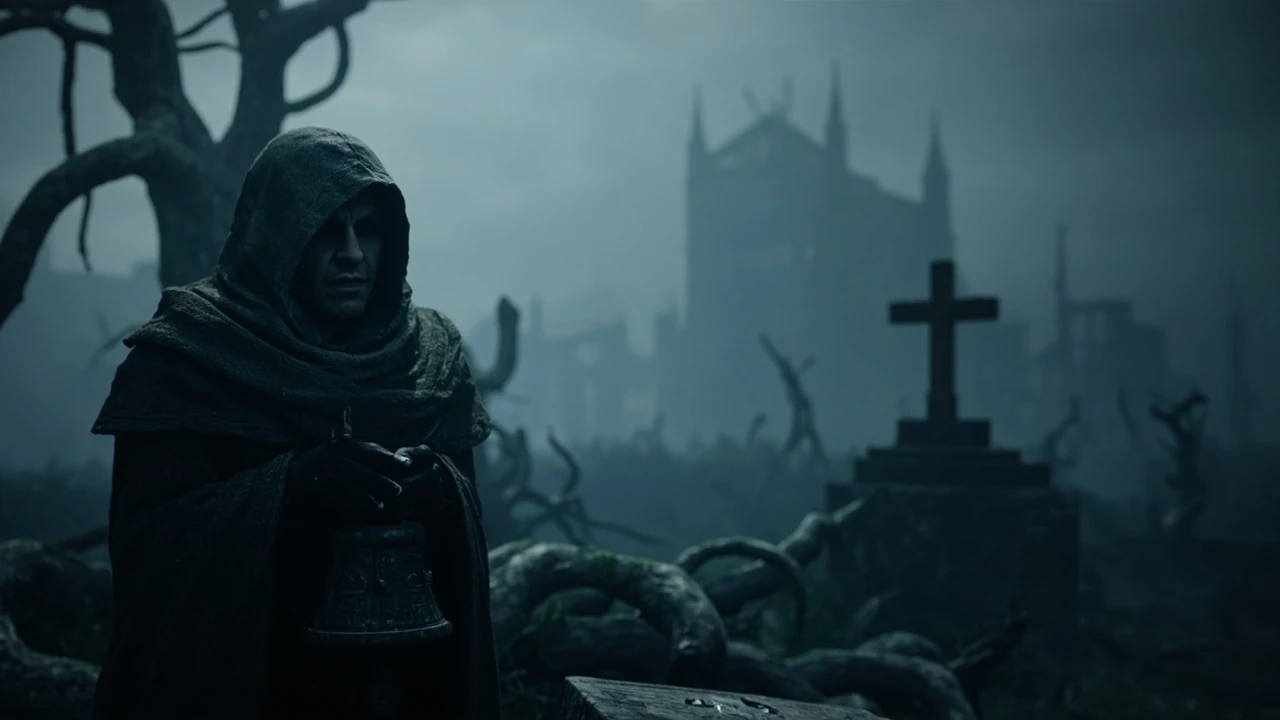
The Undertaker can be found at a small cemetery site in the Limveld. The exact position shifts between runs because the map is procedural, but the visual language of the site is consistent: a cluster of grave markers, a low stone chapel ruin, and a single kneeling figure dressed in dark funeral cloth. If you reach a grave cluster and the kneeling NPC is absent, the run has not yet advanced far enough into day phase for the encounter to trigger, or another site’s priority event has already taken the slot.
Undertaker Remembrance quest walkthrough
The walkthrough below lists the steps in the order they need to happen in a single run. Because Nightreign is multiplayer, every step assumes the standard three-player expedition. The quest can be completed solo, but the timer pressure is heavier and some enemy spawns that a co-op team would clear in seconds will be a real obstacle for a lone player.
Prerequisites before starting the chain
- You must have access to the Limveld. The chain does not begin from the round table hub and cannot be started from a practice map.
- You must be past the initial day phase. The Undertaker’s encounter is gated to a time of day later in the first day or the early night phase, depending on how fast the team moves.
- You do not need any specific Nightfarer. The Undertaker does not gate dialogue based on character choice, although the Undertaker-classed Nightfarer has thematic overlap with the chain.
- You do not need a party member to have started the chain first. Any one player can trigger the encounter for the whole session.
Step 1: Find the Undertaker at the cemetery
Move to the cemetery site. The Undertaker is kneeling in front of one of the grave markers. Approach and interact. He will speak in a short monologue about a name the party has lost, the bell that tolls for them, and a request: the party should bring something back to him that the night has taken. The menu will register a new Remembrance entry at this point.
Step 2: Recover the lost burial token
After the dialogue, the map reveals a point of interest nearby, marked with a small grave icon. Travel to that site. A miniboss encounter will be active there, often a roaming cemetery guardian or a single elite enemy tied to the site’s theme. Defeat the encounter and pick up the burial token that drops from the central grave marker. The token is quest-specific and does not consume an inventory slot in the normal sense; it is held in the quest state until the next step.
Step 3: Return the token before nightfall
Take the token back to the Undertaker before the night phase closes. If the timer is too tight, the quest will not fail outright but the chain will not progress until the next run, because the Undertaker will not accept the token after night has consumed the area. This is the most common soft-fail state for solo players.
Step 4: Hear the closing dialogue and receive the reward
Once the token is returned, the Undertaker will toll his small bell, offer a short line about rest, and grant the chain’s reward. The reward is a small relic fragment that contributes to a larger Remembrance set tied to burial rites, plus a gesture that is unique to the chain. The relic fragment is the meaningful item here; it has value across runs and is what makes the chain worth completing even if the player already has the gesture.
Common failure cases and how to avoid them
- Talking to the Undertaker too close to the night transition and running out of time to recover the token.
- Missing the cemetery site because the procedural map placed it in an area the party skipped.
- Defeating the miniboss but not interacting with the central grave marker. The token is an interact, not a drop on enemy death.
- Trying to hand the token to another NPC by mistake. The token is bound to the chain and other NPCs will not accept it.
How the quest is built inside Nightreign’s systems
Reading the Undertaker chain as a designer turns the walkthrough into a small case study. Each step is a node in a quest graph, and each node maps to a specific subsystem inside Nightreign. The table below summarizes the system behind each beat.
| Quest beat | Player-visible action | Underlying system | What can go wrong |
|---|---|---|---|
| Encounter | Approach the cemetery, interact with the kneeling NPC | Site-spawned NPC with a phase-gated trigger (day vs night) | Map variant places the site late, or the day phase ends before the player arrives |
| First dialogue | Hear the monologue about the lost name | Quest state machine opening a Remembrance entry and setting a quest objective | Dialogue is skipped by impatient players and the objective is missed |
| Reveal of the burial site | A new map marker appears | Dynamic POI placement tied to the quest step rather than the seed | Marker can spawn behind a high-tier enemy that a low-level party cannot clear |
| Miniboss fight | Defeat the cemetery guardian | Elite enemy spawned on demand, scaled to the run’s power level | Party wipes and has to restart from the previous checkpoint or restart the run |
| Token pickup | Interact with the central grave marker | Quest item as a flag in the run state, not a stored inventory object | Player skips the interact and assumes the boss drop is the token |
| Return to NPC | Reach the Undertaker before nightfall | Time-bounded quest step using Nightreign’s day-night state | Timer runs out and the chain is deferred to the next run |
| Closing dialogue and reward | Bell toll, gesture, relic fragment | Reward grant tied to a Remembrance completion flag, persisted to the player’s profile | If the run is abandoned before the dialogue, the completion flag is not set and the reward is lost |
The chain is a tight example of how Nightreign uses the run as the unit of progression. Nothing inside the chain is fundamentally new, but the wiring is different from a Soulsborne single-player quest, and that difference is the point.
Quest state, not inventory
The burial token is held as a quest flag rather than as a stackable item. This matters for two reasons. First, it means the player cannot accidentally sell, drop, or consume the token through a normal inventory action. Second, it means the chain cannot be exploited by duplication, because there is only one token at the state level. The same pattern is used by several other Remembrance chains, which is why so many of them feel as if items “auto-resolve” the moment the right NPC is talked to.
Procedural site placement
The cemetery site is a fixed type, but its location is drawn from a pool of valid spawn points on the procedural map. Designers had to balance two competing needs: the site has to be reachable inside the day phase, but it also has to feel like a discovery, not a waypoint. Nightreign handles this by giving the site a guaranteed spawn on each map, while allowing it to move between regions. For developers, the lesson is that a quest-critical site can be made discoverable through visual language alone, without a hardcoded coordinate, as long as the visual language is strong enough to read from a distance.
Time-bounded objectives
The nightfall gate on the token return is a soft failure rather than a hard one. The chain does not collapse; it simply defers to the next run. That choice is important. A hard fail would punish a casual player who reached the site two minutes too late. A soft fail keeps the chain alive and gives the player a reason to start another run with a specific purpose. From a designer perspective, this is the cleanest way to handle a time-bounded quest in a session-based game: you do not have to invent extra time, but you also do not have to make the player feel cheated.
Undertaker Remembrance rewards and what they are worth
The reward structure for the Undertaker chain is small but real. Players who only care about the in-game value can find a flat summary in the table below.
| Reward | Type | Where it applies | Worth in a single run | Worth across runs |
|---|---|---|---|---|
| Burial Bell gesture | Cosmetic / emote | Available at any rest site, usable in co-op | Low | Low to medium; collectible value |
| Relic fragment: Undertaker’s Echo | Meta-progression item | Toward a larger Remembrance set tied to burial rites | Low | Medium; required for set completion |
| Murmur currency (small) | Soft currency | Round table hub, used for cosmetics and basic upgrades | Low | Low |
| Remembrance set progress | Account-level flag | Unlocks the larger burial-rites set reward once the set is complete | None directly | High when the set is finished |
For most players, the relic fragment is the reason to do the chain. For completionists, the gesture and the set progress are the reason to do it on every relevant character. None of the rewards are powerful enough to be considered mandatory for a meta build, which is the right call from a balance perspective. A Remembrance chain that is too rewarding creates pressure to farm it, which breaks the session-based pacing.
How the rewards fit the broader Remembrance economy
Remembrance rewards in Nightreign are tuned to be useful but not load-bearing. The system is structured so that a player who skips most chains can still clear the hardest content, while a player who completes every chain has access to more cosmetic and build options rather than strictly more power. The Undertaker chain is on the lighter end of that scale. It is worth doing on a first or second run through the map, but it is not worth optimizing a build around.
Design lessons for action-RPG developers
The Undertaker chain is short, but the choices behind it carry a surprising amount of design signal. A developer or designer who wants a clean reference for “how do I fold a small NPC story into a session-based multiplayer game” can read the chain as a checklist. The lessons below are written to be transferable, not specific to FromSoftware or to Nightreign.
Lesson 1: Make the discovery leg a visual task, not a coordinate task
The cemetery site is recognizable at a glance, even when its map position changes. Designers can take this further by tuning the silhouette of the quest site so that the player sees it from a ridgeline or a clearing and decides to go there before the quest log tells them to. The risk of a visual cue is that some players will miss it, but the upside is that the discovery feels earned rather than fetched.
Lesson 2: Gate the chain on phase, not on item
Phase gating, in this case the day-night cycle, is more forgiving than item gating. The player is not asked to carry anything; they are asked to be in the right place at the right time. When the chain does require an item, as in the burial token, the item is a quest flag rather than a physical object. This reduces inventory friction and avoids the classic “I sold the quest item” bug.
Lesson 3: Use soft failure, not hard failure, for time-bounded steps
Hard-failing a chain because the player ran out of time is hostile. Soft-failing it by deferring the completion to the next run respects the player’s time and gives them a reason to play another session with intent. Nightreign uses the round table hub to reframe a soft failure as an unresolved promise, which is a clean way to keep motivation without punishing skill or connection quality.
Lesson 4: Tie rewards to a meta set, not to raw power
Undertaker’s reward is a fragment of a larger set. The set, when complete, unlocks a meaningful cosmetic or progression element. Each individual fragment is small. This is a strong pattern because it spreads player effort across many short chains rather than concentrating it on a single grind target. It also means the player is rarely in a state where they have nothing to do.
Lesson 5: Keep the chain completable inside one session
Some Soulsborne quests sprawl across multiple play sessions and require the player to remember state. Nightreign is built around sessions, so the Undertaker chain fits inside a single run. The chain is short enough that a co-op team can complete it in the middle of an expedition without restructuring the run plan. Designers working on session-based games should treat this as a default: a side chain should be completable inside one session, or it should be clearly marked as a multi-session chain with its own progression economy.
Lesson 6: Reuse the dialogue structure, vary the content
Every Remembrance chain in Nightreign uses the same skeleton: encounter, monologue, recover, return, reward. The Undertaker chain does not break that pattern, but it varies the content. The NPC is distinct, the site is distinct, the miniboss is distinct, and the reward is distinct. This is the cheapest way to ship a sense of variety: keep the structure, swap the dressing. Players remember the dressing, not the structure.
Comparison with related Nightreign Remembrance chains
Nightreign has several Remembrance chains, and the Undertaker chain sits in a recognizable cluster with the others. The table below compares it with two nearby chains a player is likely to encounter in the same map region. Numbers and names reflect the live build at the time of writing, with the caveat that Nightreign’s procedural map means the exact sites can move between runs.
| Chain | NPC type | Site type | Trigger phase | Main task | Reward focus | Solo-friendliness |
|---|---|---|---|---|---|---|
| Undertaker Remembrance | Burial attendant | Cemetery | Late day to early night | Recover and return a burial token | Relic fragment + gesture | Medium; timer pressure is the main risk |
| Recluse Remembrance | Secluded scholar | Ruined library | Mid day | Recover a lost page and bring it back | Relic fragment + tome upgrade | High; site is easy to reach and the task is short |
| Bellbearer Remembrance | Bell-ringer | Half-ruined chapel | Late day | Ring the chapel bell and survive the response | Relic fragment + weapon charm | Low; the response is a miniboss wave that punishes solo players |
The three chains share a skeleton and split along two axes: timer pressure and combat pressure. The Undertaker chain leans on timer pressure, the Bellbearer chain leans on combat pressure, and the Recluse chain is gentle on both. A player who wants to learn the system should do the Recluse chain first; a designer studying the system should compare the three to see how a single skeleton can be tuned into three different experiences.
Multiplayer and co-op considerations
Undertaker Remembrance is technically a single-player chain in the sense that any one player in a co-op session can trigger it, but it plays out in the shared world. That distinction is worth a few notes.
- The encounter is shared. If two players approach the cemetery at the same time, both will see the dialogue and both will receive the objective. There is no exclusivity.
- The miniboss is shared. The cemetery guardian is a single enemy with a single health pool. A co-op team can split the damage and clear it faster than a solo player.
- The token is shared at the state level. Whichever player interacts with the central grave marker is the one who triggers the state change. The other players do not need to interact again.
- The reward is shared at the Remembrance level. The relic fragment is granted to the player who returned the token, but the set progress contributes to the whole account.
For a co-op team, the most efficient way to run the chain is to send one player ahead to the cemetery, have the rest of the team clear the path to the burial site, and then regroup at the Undertaker for the return step. For a solo player, the chain is still completable, but the timer pressure is real and the miniboss is harder without backup.
Common player questions the walkthrough above does not cover
The walkthrough section answers the mechanics, but players tend to arrive at a quest page with smaller, sharper questions. The list below collects the questions that come up most often in co-op play, along with short answers that hold up regardless of the specific build or seed.
- The Undertaker is kneeling in front of the same grave marker every run, but the site can be in a different region. The visual language is consistent.
- The token is not visible in the inventory. It is a quest flag. If the quest log says you have it, you have it.
- The chain does not require a specific Nightfarer. The thematic overlap with the Undertaker class is flavor, not a requirement.
- The chain can be completed in the same run as several other Remembrances, as long as the timer and the map allow it.
- The chain does not block any ending or any major reward. It is optional, and the only thing lost by skipping it is the set progress.
Verifying the quest across patches
Nightreign is a live game, and the procedural layer means small details can shift between patches. The chain’s structure has been stable in the patches covered by the current date, with two known adjustments worth flagging for any reader checking back later.
- The miniboss at the burial site has had its aggression retuned in a way that makes the encounter faster for solo players but not easier. The HP and damage numbers are within the same band as before.
- The visual cue for the cemetery site was sharpened, so the site reads from a longer distance than it did at launch. This is a small but real change for players who rely on the silhouette.
If a future patch changes the chain more substantially, the safe move is to re-verify the steps against the in-game quest log. The log is the source of truth for the active state, and any guide that ignores it will drift.
Frequently asked questions
Where do I find the Undertaker in Nightreign?
The Undertaker is at a cemetery site in the Limveld. The site is a cluster of grave markers and a low stone chapel ruin with a single kneeling NPC. The exact region changes between runs because the map is procedural, but the visual language of the site is consistent. Look for grave markers and a low chapel silhouette from a ridgeline, and travel toward the site once you see it.
Do I need a specific Nightfarer to start the Undertaker Remembrance?
No. The chain is open to any of the eight Nightfarers. The Undertaker-classed character has thematic overlap with the chain, but the dialogue and the rewards are the same for every class. Pick the character you are most comfortable playing, not the one that matches the NPC thematically.
What happens if I run out of time before returning the burial token?
The chain does not fail. It defers to the next run. The Undertaker will not accept the token after night has consumed the area, so the run will end without the chain resolving. On your next run, the cemetery site will respawn and you can trigger the encounter again. The token is held as a quest flag, not an inventory item, so it is not lost between runs in a way that forces you to redo the miniboss.
Can I do the Undertaker Remembrance solo?
Yes, but the timer pressure is heavier and the miniboss is harder without backup. If you are solo, plan the run around the chain: clear a path to the cemetery early, do not detour into a side dungeon unless it sits between you and the burial site, and try to be back at the Undertaker with at least a few minutes of day phase left.
Does the Undertaker Remembrance lock out any ending or any major reward?
No. The chain is optional. Completing it adds a fragment to a larger Remembrance set, a gesture, and a small amount of Murmur currency. None of these are required to finish the main expedition loop or to defeat the Nightlords. Skipping the chain does not block any other quest, either.
What is the best reward from the chain?
The relic fragment is the meaningful reward. The gesture is cosmetic, the Murmur is small, and the set progress is only useful if you plan to complete the larger burial-rites set. The fragment contributes to a meta loadout option that has value across runs, which is why most players prioritize the chain on at least one character.
Can I do the Undertaker Remembrance and the Recluse Remembrance in the same run?
Yes, if the map places both sites in reachable regions and you have the time for both. The chains do not conflict, and the rewards stack. Plan the run so that the more time-sensitive chain, in this case the Undertaker chain, gets the earlier window, and use the remaining time for the Recluse chain.
Why is the burial token not in my inventory?
It is held as a quest flag rather than as a physical item. The quest log will indicate that you have it, and the only place you can spend it is by returning it to the Undertaker before nightfall. You cannot sell it, drop it, or store it, which is intentional. It is part of how Nightreign prevents a common quest bug from single-player games.
Does the Undertaker chain change between patches?
The structure of the chain has been stable in the patches covered by the current date. Small retunes to the miniboss and a sharper visual cue for the cemetery site are the only changes that have been noted. If a future patch changes the chain more substantially, the in-game quest log is the source of truth.
Is the Undertaker Remembrance worth doing on every character?
Only if you care about the larger burial-rites set or the gesture collection. The relic fragment is account-level, so once you have it on one character, the others do not need to redo the chain for that specific reward. Completionists will still run it on every relevant character for the set progress.

Leave a Reply