
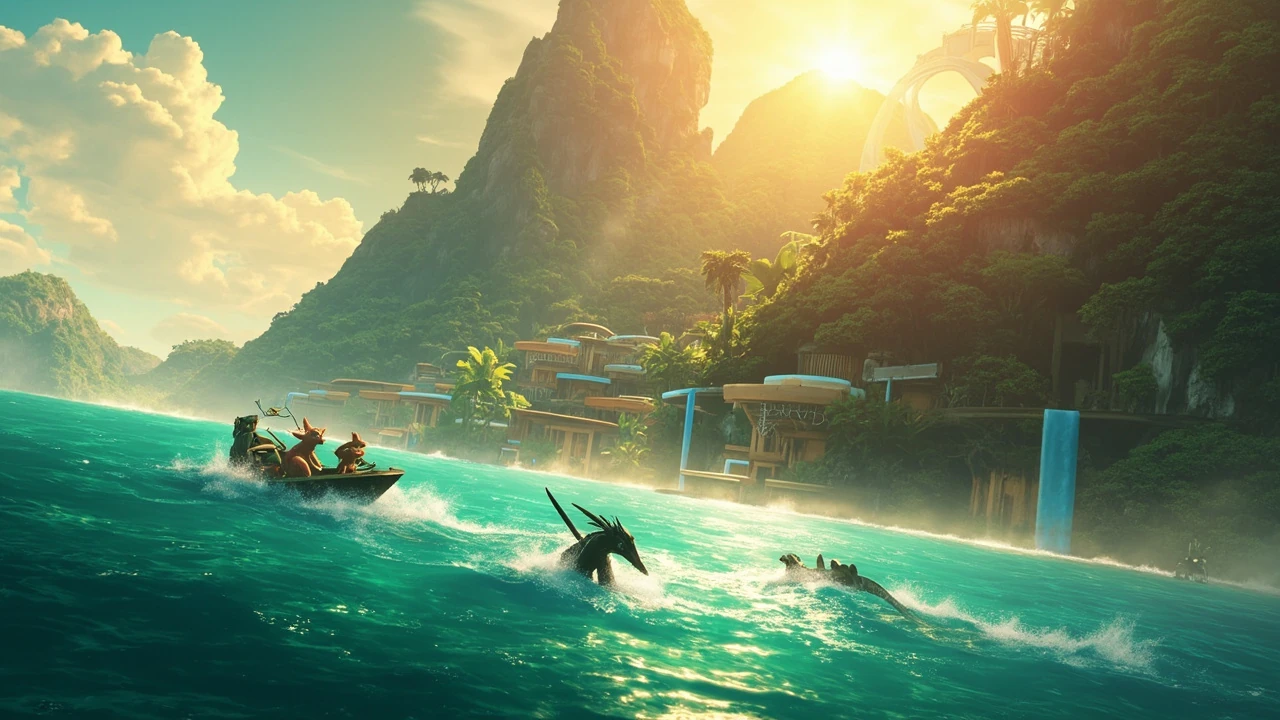
Pokemon gen 10 and the Winds and Waves reveal
The Pokémon Company used the closing segment of its Pokémon Presents broadcast, timed to the franchise’s 30th anniversary, to confirm the title and release window for pokemon gen 10. The next generation will arrive as a paired launch of Pokémon Winds and Pokémon Waves, targeting Nintendo Switch 2 in 2027. The reveal trailer opened with a hand-drawn book of previous regions before pivoting to a vacation-themed opening sequence built around two costumed Pikachu mascots, Mr. Windychu and Ms. Wavychu, that doubles as the in-fiction framing device for the new region.
For a working game developer, the announcement is more than a calendar marker. Pokemon gen 10 is the first mainline entry built explicitly for Switch 2, the first to commit to a sprawling open world as a baseline rather than a per-route choice, and the first to lean into underwater traversal as a structural pillar. Each of those decisions is a production constraint with consequences for world streaming, animation budgets, creature AI scope, and live operations. The rest of this article walks through the confirmed details, the design patterns that have surfaced, and the technical questions a developer should be asking before benchmarking, porting, or planning content around the release.
What was confirmed during the Pokémon Presents stream
The stream delivered a focused, presentation-style reveal rather than a deep dive. The two confirmed games, the platform, the year, the region concept, and the three new starters were named on camera; broader mechanical details were left for follow-up coverage. Working from the official on-screen statements and the presenter’s narration, the locked-in facts are:
- Two retail titles, Pokémon Winds and Pokémon Waves, launching together.
- Release window: 2027, on Nintendo Switch 2.
- Setting: a region built around a string of islands, with dense jungles, mangrove swamps, open ocean, submerged coral reefs, lava-filled caves, and a futuristic resort with water flumes.
- Three confirmed starter creatures: the Grass-type bird Browt, the Fire-type pooch Pombon, and the Water-type gecko Gecqua.
- Open-world structure with a heavy emphasis on water and underwater exploration.
- A new generation roster, with the canonical three-starter pattern preserved.
Everything outside that list, including the number of new species, the rival structure, the legendary duo, multiplayer modes, and the battle engine details, remains unannounced. Speculation that treats trailer cutaways as confirmed mechanics is editorial, not sourced. When you read a feature that says pokemon gen 10 will ship with a 400-creature Pokédex or a particular battle system, treat the number as a guess until The Pokémon Company or Game Freak publishes it.
Why the open-world pivot matters for a Switch 2 title
Open-world design has appeared in the franchise before, most visibly in Pokémon Legends: Arceus, but it was framed there as an experimental offshoot. Pokemon gen 10 is the first mainline generation to treat the open world as the default, which changes several production assumptions. World streaming, asset density, and creature encounter budgets all scale with the size of the traversable area, not the number of routes. A linear region with eight cities can sustain smaller streaming cells and tighter art budgets; a string of islands with underwater caves demands continuous geometry, day-night cycles that hold up across biomes, and a creature population that can be authored once and re-placed procedurally without breaking encounters.
For a studio benchmarking against pokemon gen 10, the practical lessons are:
- Streaming cell size now has to absorb vertical transitions between surface, shallow water, and submerged cave in a single load. Studios used to separate land and water cells will need to revisit their partition strategy.
- Creature idle and combat animation sets are more expensive when the same species has to read at distance on a beach, in a jungle canopy, and in a dim reef. Animation LOD and material variants become budget line items rather than polish.
- AI overhead grows with the encounter radius. Behavior trees that worked in 20-meter grass patches will be tested by 200-meter reef ecosystems where the player can dive in from any direction.
- Save and checkpoint design has to assume a player who can stop playing on a reef and resume there. The traditional gym-clear save structure gives way to continuous autosaves with a stable identity for the player’s coordinates and party state.
The Switch 2’s expected hardware uplift gives a working ceiling for these features, but it also raises the bar. Pokemon gen 10 cannot ship with a 720p target on a console built for higher output, and it cannot ship with 30 fps combat when the marketing will be the open world at scale. The development cost of hitting that bar is real, and it falls on the same teams that have historically delivered two-region, two-version releases on tighter schedules.
Underwater gameplay as a structural pillar
Underwater traversal has appeared in the franchise as a set piece before, but it has rarely been a structural layer that the world is built around. The Winds and Waves reveal positions water as both a connective tissue between islands and an explorable layer in its own right. From a design standpoint, that choice has cascading consequences.
Above water, the canonical affordances are running, biking, surfing, and flying. Below water, the same player character needs a parallel set: a swim stroke, a dive transition, a breath resource, a light source, a movement model that handles currents, and a creature that can be summoned underwater without breaking the encounter design. None of those systems are free. The breath gauge is a tempo tool that paces exploration; the light source changes the readability of the art; the encounter rules underwater are usually different from above water to avoid making surfacing mandatory for every battle.
For developers planning ports, mods, or adjacent designs, the table below maps the systems an underwater layer usually needs and the open questions pokemon gen 10 leaves on the table.
| Underwater system | Why it matters | Confirmed for pokemon gen 10? | Open question |
|---|---|---|---|
| Swim-to-dive transition | Drives the boundary between the two layers and sets the cost of going deeper | Implied by on-screen footage | Whether dive is free, breath-gated, or item-gated |
| Breath resource | Paces exploration and pushes players to surface | Not stated | Whether breath is a hard timer or a soft recovery curve |
| Underwater lighting | Determines art readability and mood | Footage shows darker palettes at depth | Whether the player carries a light or the world provides one |
| Water-type moves outside battle | Opens new field puzzles and traversal options | Not stated | Whether field moves return in any form, or are replaced by ride abilities |
| Encounter rules underwater | Prevents surfacing from feeling mandatory for every battle | Not stated | Whether the random encounter model is replaced by an overworld summon model |
| Save and fast travel | Players need a way to leave the water without losing progress | Not stated | Whether underwater fast travel is open or restricted |
That list is not a wish list. It is the working checklist a team would need to answer before scoping a similar feature. Pokemon gen 10 is the first generation to make those questions central rather than incidental, and the way Game Freak answers them will shape the next several years of design references in the genre.
The three starters and what they signal about encounter design
The three starters revealed for pokemon gen 10 are the Grass-type bird Browt, the Fire-type pooch Pombon, and the Water-type gecko Gecqua. Two of those choices stand out: a Grass-type bird breaks a long-running franchise convention of grass starters being mammals, reptiles, or amphibians, and a Water-type gecko is unusual enough that it signals a deliberate shape language. The Fire-type pooch is the most conventional of the three, sitting close to a familiar archetype without repeating a specific prior line.
For a designer, the signal is that the type-to-shape mapping is loosening. A bird can carry Grass-type identity without competing visually with the owl, parrot, and stork lines that already exist. A gecko can carry Water-type identity without reusing the tortoise, otter, or salamander silhouettes. That is useful when the team is trying to design three creatures that read instantly in a three-icon menu and still have distinct silhouettes in the open world at distance.
What is not yet known is whether pokemon gen 10 will keep the canonical three-typing pattern (Grass/Fire/Water) or whether new typings will enter the starter pool. The trailer confirms the pattern, which is itself a production choice: it keeps the competitive rules intact, it keeps the merchandising hooks intact, and it keeps the early-game tutorial intact. Changing the typing would have changed the league format, the type-chart teaching moment, and the order in which new players meet the first gym leaders.
Open-world streaming and the cost of a string of islands
A string of islands is, mechanically, an open world with hard water boundaries between cells. That sounds easier than a continuous continent because the ocean is a natural streaming boundary, but in practice it pushes more work onto the world-building pipeline. The team has to author a coastline per island that reads as continuous from the water, populate the open ocean with non-trivial content so the player does not resent the travel, and design transitions between islands that do not feel like loading screens.
For a developer porting a similar structure, the cost split usually looks like this:
| Cost center | Where it shows up | Why pokemon gen 10 raises the bar |
|---|---|---|
| World art | Coastlines, reefs, island interiors, resort geometry | Multiple biomes in one region, each at Switch 2 fidelity |
| Creature art | New generation plus regional forms | First generation designed for Switch 2 visuals from the start |
| Animation | Swim, dive, surf, and fly motion sets | Underwater layer requires a parallel animation library |
| Audio | Ambient soundscapes per biome | Underwater audio needs a different mix profile |
| Encounter design | Population rules per cell | Open-world radius plus water/land layering |
| QA | Regression across biomes and layers | More cell combinations than a linear region |
The shift from a linear region to a multi-island open world roughly doubles the QA matrix in practice, because the same creature has to be validated in surface, shallow water, and underwater variants. Studios planning similar projects should reserve QA time for that matrix early rather than at the end of the production cycle.
Why pokemon gen 10 is the first Switch 2-native mainline
Previous generations straddled handhelds and home consoles, with the development kit built around the constraints of the smaller device. That shaped resolution targets, draw distances, encounter density, and animation budgets. A Switch 2-native mainline entry does not have to apologize for any of those constraints. It also does not have the lower-spec device pulling the design down.
For developers, the production implication is that every system in pokemon gen 10 is being authored against the upper hardware target, not the lower one. That matters for:
- Asset budgets. The team can spend polygon count and texture memory on Switch 2 instead of gating it for the smaller device.
- Frame targets. Combat, traversal, and streaming all assume a single performance envelope rather than two.
- Memory budgets. Long streaming cells are affordable when the device has the headroom, and the new region can hold more content in flight.
- Audio budgets. Larger ambient soundscapes and a richer underwater mix are realistic on Switch 2.
The trade-off is that any future port to a smaller device, if it ever happens, will be a real port, not a default. Studios that built their pipelines for dual-target development should not assume the new generation follows the same rule.
Live operations and the two-version launch model
Pokemon gen 10 will launch as two versions, Winds and Waves, with version-exclusive creatures. That model has been part of the franchise for decades and is now part of the live operations playbook. After launch, the team typically runs seasonal events, distribution codes, ranked seasons, and balance updates, often with new content drops that complement one version more than the other.
For a studio studying the model, the relevant questions are not whether there will be events, but how the events are scheduled across two versions and how the balance patches interact with the ranked ladder. The two-version model also drives a measurable second-hand market for version-exclusive creatures, which in turn affects how aggressive the team can be with cross-version promotions. Pokemon gen 10 will be the first generation to launch into a mature live-ops market where players expect cross-play, cross-progression, and seasonal content from day one.
The main operational checklist that any live-service launch has to clear, and that pokemon gen 10 will be measured against, looks like this:
- Server capacity for launch weekend and the first event window
- Cross-version trading and battle parity
- Ranked season reset and reward structure
- Distribution code pipeline and storefront presence
- Patch cadence and the policy for emergency fixes
- Communication channel for outages and known issues
None of those items are unique to pokemon gen 10, but the scale of the franchise and the expectations of its player base turn them into hard production deadlines rather than soft launches.
What developers can benchmark right now
Because the reveal trailer is the only public artifact, the only honest benchmark a developer can run is on the trailer itself and on the public statements. The trailer is a curated vertical slice, not representative gameplay, and any frame-rate, draw distance, or load-time reading should be treated as suggestive rather than definitive. The same goes for storage and download size, which are not announced.
The benchmarks that are still useful are conceptual:
- How many streaming cells does an open-world island region need to feel continuous, and what is the budget per cell?
- What is the minimum creature population density per cell for an open-world game to feel populated without spawning pressure?
- How do you author a coastline that holds up from the water, from a low-altitude flyover, and from a dive transition?
- What is the cost of running a parallel underwater animation library on top of a surface library?
- What is the QA matrix for three traversal layers (land, water surface, underwater) per biome?
These questions are the real contribution of the reveal. Pokemon gen 10 is an opportunity to push the conversation from “what does the next Pokémon game look like” to “what does the next open-world creature-collecting game have to do to scale.”
Production constraints a working team should plan for
A studio planning a similar reveal or a similar scope should treat pokemon gen 10 as a case study in the constraints that follow an open-world promise. The constraints are not unique to the franchise, but they show up in a recognizable pattern:
- A larger world needs more content per cell, not just more cells. Empty islands are not the same as detailed ones.
- Underwater gameplay needs a parallel design language, not a recolored surface layer.
- A two-version launch needs version-exclusive content authored twice, with parity for everything else.
- A Switch 2-native target raises the bar for art and animation across the board.
- A live-ops roadmap needs to be planned during pre-production, not bolted on after launch.
None of these constraints are reasons to avoid the design. They are reasons to budget honestly. Pokemon gen 10 will ship because Game Freak and The Pokémon Company have planned against those constraints for years. A smaller studio that copies the shape without the planning will end up with a world that feels half-finished.
Risks and unknowns to watch between now and 2027
Between the 2026 reveal and the 2027 release window, several things can shift. The most important ones to track, from a developer standpoint, are:
- Engine and platform details. Whether the game is built on a new internal engine, a refined version of the existing one, or a third-party toolchain will shape every downstream decision.
- Creature count and roster size. A larger Pokédex means more animation, more AI, more QA, more balance work.
- Multiplayer and connectivity model. Whether ranked play, trades, and battles run through the existing infrastructure or a new one will determine launch stability.
- Underwater rules. Whether breath, light, and field moves are free, gated, or replaced will determine how the world is authored.
- Patch and balance cadence. How aggressively the team iterates after launch will determine how the meta evolves.
Each of those items is a production question with a public answer at some point in the next 18 months. Until then, the safest editorial position is to plan against the confirmed scope and budget for the unannounced scope separately.
What the Winds and Waves reveal tells us about creature-driven design
The vacation framing of the Winds and Waves reveal, the costumed Pikachu mascots, and the resort setting are not just marketing choices. They are signals about how the team wants the player to feel at the start of the game. The franchise has historically opened with a small-town, indoor, or trainer-meeting framing. A vacation opening pushes the new entry toward a different emotional register, more relaxed at the start, with the conflict introduced later.
For a developer building a creature-driven game, the signal is that the franchise is willing to break its own patterns to mark a generational shift. The three starters already break the type-to-shape convention. The underwater layer breaks the surface-only assumption. The vacation framing breaks the small-town opening. Each of those breaks is an opportunity to teach the player that the rules have changed without telling them outright.
Confirmed regional biomes and what they imply for art direction
The first proper look at the Winds and Waves world listed a specific set of biomes, and reading them as a set is more useful than reading them as a list. The dense jungles, mangrove swamps, open ocean, submerged coral reefs, lava-filled caves, and futuristic resort with water flumes are not six separate art passes. They are six expressions of the same climate and material budget, which means the team has to build a shared kit of foliage, rock, water, and surface materials that holds up across all of them without looking like the same three trees copy-pasted into each scene.
For a developer, that translates to a stricter kit-bashing discipline. A coral prop that reads in a reef also has to read as background in a shallow tide pool. A mangrove trunk that frames a swamp has to scale up as a canopy element above a jungle path. The cost of that discipline is paid up front, in the concept and blockout phase, and the payoff is that the world feels coherent without a per-biome art lead re-authoring the same shapes in isolation.
The futuristic resort with water flumes is the most distinctive biome in the trailer. It is a built environment with a clear architectural language, which means a separate kit of hard-surface props, signage-free wayfinding, water-flume geometry, and lighting that reads both in daylight and at night. For a studio that has never shipped a large-scale resort setting, that kit is a real budget. For a studio that has shipped an open-world city before, the resort is a scaled-down version of the same problem: landmark readability, NPC routing, and a stable lighting model that holds up across the day-night cycle.
The lava-filled caves add a second hard-surface problem on top of the resort. Caves are notorious for lighting, occlusion, and streaming edge cases, and pairing them with a heat source means the team has to author a separate ambient and music pass for the lava layer. For a developer scoping the equivalent scene, the lava cave is a useful stress test: if the engine can hold frame rate inside a cave with dynamic heat haze, animated lava, and creature encounters at the same time, it can hold up in most of the rest of the world.
Trailer analysis: framing, pacing, and the vacation register
The Winds and Waves trailer is a short artifact, but it carries a lot of design weight because it is the only public statement of intent. The opening beat, a hand-drawn book of previous regions, is a framing device that signals continuity. The pivot to two costumed Pikachu in vacation attire, the Mr. Windychu and Ms. Wavychu pair, signals the new register. The cutaway to the resort, the mangrove, the reef, and the lava cave lays out the world. The beat with the three starters landing in the player’s party sets up the gameplay promise.
For a developer, the trailer is a useful example of how to compress a generational reveal into a short runtime without leaving the audience confused. The book of previous regions does the continuity work in a few seconds. The costumed mascots do the emotional work. The biome cutaways do the scope work. The starter beat does the gameplay work. None of those beats is wasted, and each one answers a different question the player would otherwise have to fill in from rumor.
The vacation register is the most under-discussed choice in the trailer. A vacation framing softens the start of the game, gives the team a reason to put the player in swimwear and casual clothing, and creates a contrast when the story introduces its first conflict. It also dovetails with the underwater pillar: a player who has been framed as a tourist is naturally curious about what is under the surface. That is a cleaner narrative setup than the canonical “child moves to a new town and meets a professor” beat, and it gives the writers room to introduce the rival and the antagonist later without a tonal break.
Why the two-version model still holds at this scale
The two-version model is one of the franchise’s most durable design decisions, and pokemon gen 10 will keep it. The model is older than the Switch 2, older than the open-world pivot, and older than the underwater pillar, and it has survived each of those changes because it does real work on the back end. The version-exclusive creatures drive trading, the version-exclusive content drives social play, and the two SKUs give retailers and the eShop a measurable launch split that helps with forecasting and server load.
For a studio studying the model, the lesson is that version exclusivity is not a marketing trick. It is a design constraint that shapes encounter tables, balance passes, and the post-launch content calendar. A team that removes the version split to simplify the SKU matrix removes a lever that the live-ops team has been using for two decades. Pokemon gen 10 will keep the split, and the teams benchmarking against it should plan for a version split in their own designs unless they have a specific reason to remove it.
The two-version model also interacts with the open-world pivot in a specific way. In a linear region, the version-exclusive content is usually a route, a city, or a legendary. In an open-world region, the version-exclusive content has to be authored into the same map, which means two encounter tables, two NPC placements, and two quest chains that share geometry but diverge in trigger conditions. That is a real authoring cost, and it is one of the reasons the QA matrix for an open-world two-version launch is heavier than the QA matrix for a linear two-version launch.
Comparing the three starters against the franchise’s starter history
The starter triangle is a franchise tradition, and the three new additions are worth reading against the history. The Grass/Fire/Water typing is preserved, which keeps the type-chart teaching moment intact. The shape language is deliberately broken: Browt is a bird rather than a mammal, reptile, or amphibian; Gecqua is a gecko rather than a tortoise, otter, or salamander; Pombon is a pooch that sits close to a familiar archetype without repeating a specific prior line.
For a designer, the shape break is the real signal. The franchise has accumulated a large library of starter shapes, and the new team has to find three silhouettes that read instantly, are distinct from the prior roster, and survive the translation from a 3D model on screen to a 2D icon in the menu to a 3D model in the overworld at distance. A bird and a gecko and a pooch cover a wide silhouette spread: a vertical head with a beak, a horizontal body with a tail, and a four-legged body with ears. That spread is deliberate, and it is the kind of decision that gets made in concept review rather than in production.
The typing question is also a production decision. Keeping Grass/Fire/Water keeps the rival’s typing on the same triangle, keeps the first gym leader’s typing on the same triangle, and keeps the early-game teaching order intact. Breaking the typing would have forced a rewrite of the early-game scripts, a rebalance of the first gym, and a rework of the rival’s team. The franchise is willing to break shape language more easily than it is willing to break typing, because typing is load-bearing for the rest of the game’s structure.
Build pipeline notes for a Switch 2-native creature game
A studio planning a Switch 2-native creature game should treat pokemon gen 10 as the upper bound of what is shipping on the platform, and the lower bound of what the platform can do. The art budget, the animation library, the streaming pipeline, and the audio mix all have to be sized against the Switch 2’s headroom, not against a smaller device. The build pipeline for that kind of project has a few specific demands:
- Long streaming cells. The open-world pivot means cells have to span a coastline, a reef, and a cave in a single load, which means the streaming budget per cell is higher than in a linear region.
- Parallel animation libraries. The underwater layer needs a swim, dive, and surface animation set that does not share bones with the surface library, which means the rig count goes up.
- Multiple ambient mixes. The biome count, the day-night cycle, and the underwater audio profile mean the audio team is producing more ambient stems per area than in a land-only game.
- Version-exclusive content authoring. The two-version model means encounter tables, NPC placements, and quest chains are authored twice against shared geometry.
- Live-ops readiness from day one. The post-launch content calendar has to be planned during pre-production, with server capacity, distribution codes, and ranked seasons sized for the first event window.
Each of those demands is a real cost, and the cost is paid by the same team that has historically delivered two-region, two-version releases on tighter schedules. Pokemon gen 10 will ship because the team has planned against those costs for years. A smaller studio that copies the shape without the budget will end up with a world that feels half-finished, and the live-ops roadmap will feel like a patch rather than a plan.
Frequently asked questions
When does pokemon gen 10 come out?
Pokemon gen 10 is scheduled for 2027, with both Pokémon Winds and Pokémon Waves launching on Nintendo Switch 2. The exact date has not been announced, and the 2027 window is the only public target. Studios planning content or ports around the release should use the 2027 window as a planning constraint, not a fixed date.
Are Pokémon Winds and Pokémon Waves two separate games?
Yes. The two titles are version-paired launches in the long-running franchise pattern, each with version-exclusive creatures and likely version-exclusive content. They share a region, an open-world structure, and the same release window, but they are sold and played as separate SKUs. The two-version model drives the trading economy and the post-launch live operations.
What are the three starter Pokémon for pokemon gen 10?
The three confirmed starters are Browt, a Grass-type bird; Pombon, a Fire-type pooch; and Gecqua, a Water-type gecko. All three are new species with no prior franchise history. The Grass/Fire/Water typing follows the canonical starter pattern, and the silhouettes are deliberately distinct from prior generations.
Will pokemon gen 10 be open world?
Yes. The reveal positions the new region as a sprawling open world built around a string of islands, with dense jungles, mangrove swamps, open ocean, submerged coral reefs, lava-filled caves, and a futuristic resort. The open world is the default structure, not a per-route choice, which is a first for the mainline franchise.
Will pokemon gen 10 have underwater gameplay?
The reveal trailer shows underwater traversal as a structural layer, with submerged coral reefs and a dedicated swim or dive model. The exact rules for breath, light, and field moves have not been announced, but the commitment to underwater exploration as a pillar of the world is clear.
Which platform is pokemon gen 10 on?
Pokemon gen 10 is a Nintendo Switch 2 title, launching in 2027. It is the first mainline generation built natively for Switch 2, which raises the bar for art, animation, and streaming budgets. There is no announced version for any other platform.
How many new Pokémon are in pokemon gen 10?
The exact number of new species has not been announced. The reveal confirms a new generation roster and three new starters, with the rest to be revealed closer to launch. Studios planning adjacent content should not assume a specific count until The Pokémon Company or Game Freak publishes it.
Will pokemon gen 10 keep the version-exclusive creature model?
Yes. The two-version launch model is part of the franchise pattern, and the reveal does not signal a change. Version-exclusive creatures drive the trading economy and the cross-version social loop, and that loop is part of the live operations playbook for the new generation.
Will there be DLC or expansions for pokemon gen 10?
The Pokémon Company has not announced DLC for pokemon gen 10 at the time of the reveal. The franchise has a strong history of third-version games and expansion passes, but those are typically announced after launch. Any plan for post-launch content should wait for an official announcement rather than infer one from precedent.
How can developers prepare for the pokemon gen 10 release?
Studios preparing for the release should benchmark their own pipelines against the confirmed scope: open-world streaming, underwater traversal, two-version parity, Switch 2-native art budgets, and a live operations roadmap that runs from day one. The safer plan is to budget against the confirmed scope and treat the unannounced scope as a separate reserve until the official details land. For a broader view of the production context, the Triple A Game development overview covers the standards and budgets that shape a release of this scale.

Leave a Reply