
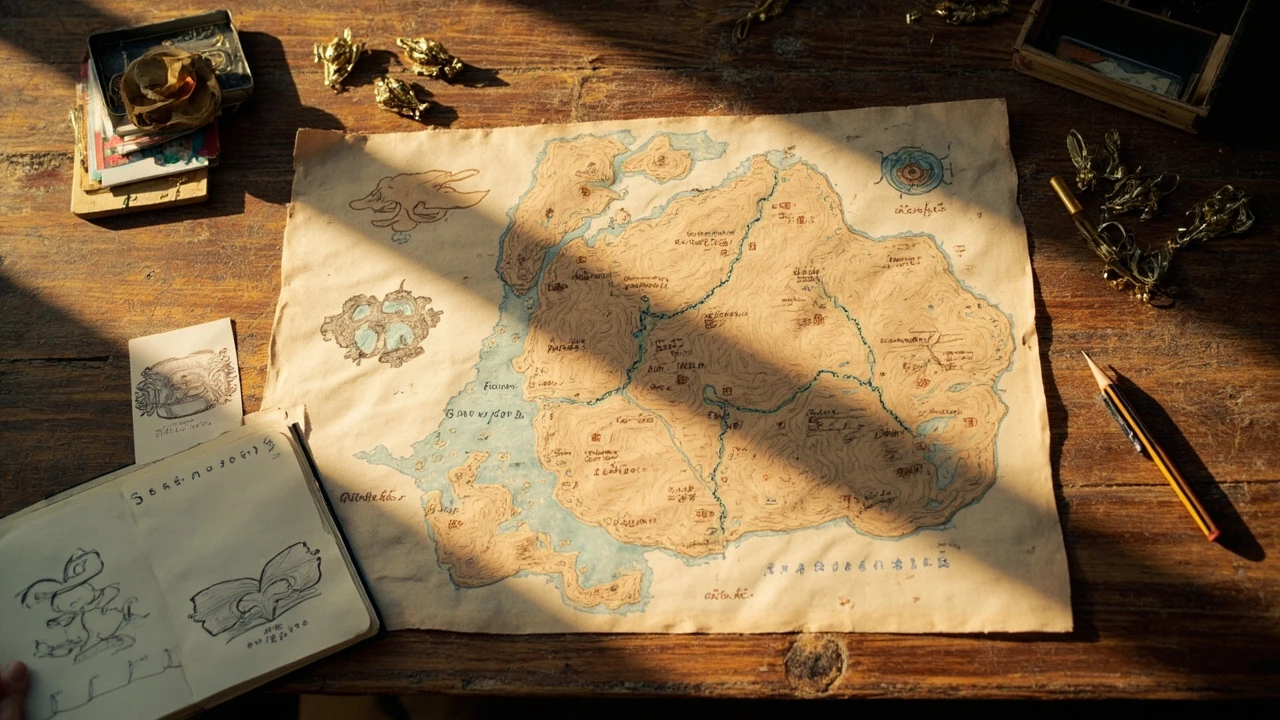
Johto Pokemon: A developer-oriented look at a generation-defining region
For many developers, “Johto Pokemon” is more than a nostalgic reference to a fictional region. It marks a generation where the Game Freak team had to solve a specific production problem: how to grow a handheld RPG that had already defined a genre, without breaking the systems that made the original work. Johto, introduced alongside Pokemon Gold and Silver in 1999 in Japan, became the test bed for dual-region travel, a real-time clock-driven event system, and a much wider encounter design budget. Looking at how that region was built, and how it has been remade, is a useful case study in scaling an established game while preserving its core loop.
This article focuses on the production and design decisions that shaped Johto Pokemon as a piece of game content. It is written for developers, technical designers, and producers who want to understand what the second generation of Pokemon actually attempted at a systems level, what trade-offs were visible in the final product, and what the long-running remakes imply about preserving that design intent on modern hardware. It is not a player’s walkthrough, although it references a verified walkthrough resource for context. Where a claim depends on a specific source, that source is named directly.
The regional design problem Johto Pokemon had to solve
When Gold and Silver entered development, the original Red and Green had already established a tightly tuned 8-bit RPG loop: explore routes, fight wild encounters, collect gym badges, challenge the Elite Four, and complete a regional pokedex. The risk for a sequel was obvious. Reusing the same loop with a new paint job would feel like a content pack. Rewriting the loop entirely would alienate the audience that had bought into the original.
Johto Pokemon became the team’s answer. Instead of replacing the first generation’s content, Gold and Silver wrapped the entire Kanto region as a post-game layer accessible only after the Johto league was complete. From a production standpoint, that decision forced every system to scale: storage for a doubled pokedex, balanced encounter tables across two regions, and a save battery system that had to track a real-time clock for time-based events like berry growth and the bug-catching contest.
The trade-off was that the Johto region’s own content density was lower than Kanto’s in the original releases. Several Kanto gym leaders could be re-fought, but the new routes, cities, and dungeons in Johto were shorter per segment. Developers reading the design should notice the pattern: the team prioritized systemic depth (day and night, breeding, held items) over raw route length, knowing the post-game would reward players who wanted more.
Core systems introduced with Johto Pokemon
Three systems from this generation still define modern mainline Pokemon design. Understanding them as production decisions is more useful than treating them as feature lists.
- Real-time clock integration. The cartridge carried a CR2032 battery, which kept an internal clock alive when the Game Boy was off. That clock drove time-of-day palettes, time-sensitive encounters, and berry regrowth. From a developer’s perspective, the cost was significant: a save corruption bug in early cartridges could also drain the battery, locking time-based content behind hardware reliability.
- Breeding mechanics. Day-care attendants could produce eggs that inherited moves, stats, and species from the parents. This added a stochastic layer to team building and shifted part of the game’s progression outside the main story. The system also required backend work to track individual move IDs on an egg object, not just on field Pokemon.
- Held items and the day-night cycle. Held items added a new evaluation pass to every turn of battle. Combined with time-of-day encounter tables, the team effectively shipped two encounter pools for most routes. A route at 6 a.m. and the same route at 8 p.m. were not just visually different; they could trigger different species entirely.
For a current developer, the lesson is the trade-off between feature scope and engine support. Johto Pokemon did not add any one of these systems cheaply. Each one required either a new subsystem (clock), a new data structure (egg inheritance), or a new evaluation pass per encounter (held items plus time of day). The reward was a game that felt meaningfully different from Red and Blue, even before the player reached the post-game.
Dual-region travel as a content scaling pattern
Including Kanto as a post-game area was, in production terms, a content reuse strategy. The original region’s map data, town layouts, and gym data were all retained. From a memory standpoint on the Game Boy Color, fitting two regions into one cartridge was already at the edge of what the platform could carry. The team achieved it by using compressed tile data and a relatively constrained set of unique tiles per route, accepting a visible drop in per-tile fidelity compared with Red and Blue’s Kanto.
For a modern developer, the relevant question is what to do when a sequel has to be visibly larger than its predecessor without doubling the budget. Johto Pokemon’s answer was to scale through systems, not asset volume. The new content in Johto was roughly comparable in size to one of the older region’s halves, but the addition of real-time events and breeding effectively multiplied the perceived scope for engaged players.
| Aspect | Johto (Gold and Silver) | Post-game (Kanto reuse) |
|---|---|---|
| Primary content role | New story, gym progression, Elite Four | Optional exploration, rematched gym leaders |
| Asset reuse strategy | Fresh tile work per route, compressed | Recycled Kanto map data from prior game |
| System introduction | Clock, breeding, held items, day-night | None new; existing systems extended |
| Player gating | Eight Johto badges required | Johto Elite Four completion required |
| Production risk | Cartridge memory, battery reliability | Player reception of lower asset density |
The pattern matters because many studios hit the same wall on sequels: the new region has to feel “bigger,” but the team cannot rebuild the world from scratch. Johto Pokemon showed that scaling the system layer can carry a perception of growth even when the asset budget is held steady.
Encounter design and regional identity
Johto For additional context, Pokemon is also a useful study in encounter table design. Rather than reusing the same species distribution pattern as Kanto, the design team front-loaded unique species into the early routes and used later routes to introduce evolved forms and version-exclusive encounters. From a balancing perspective, this forced players to interact with the new roster early, which mattered because many of the new designs had not yet been theorycrafted by an established competitive scene.
Version exclusivity was a deliberate production choice. Gold and Silver each shipped with a different set of version-locked species, which encouraged trading between players with different cartridges. As a system, it pushed social interaction into a single-player RPG, at a time when online play was not realistic on a Game Boy. The mechanic returned in later generations and remains a common approach in live-service games to split player populations without breaking competitive parity.
The encounter table also reflected the team’s growing comfort with type variety. Johto Pokemon introduced the Dark and Steel types to balance the type chart against the Psychic dominance that had warped competitive play in Red and Blue. From a developer standpoint, this was a balance patch delivered as content: a deliberate re-weighting of which types were worth using, paid for in new species design and a re-tuned movepool.
| Design lever | Effect on Johto Pokemon | Production cost |
|---|---|---|
| Version-exclusive species | Drove trading and social play | Two parallel encounter tables, two pokedex sets |
| Day-night encounter split | Effectively doubled route encounter variety | Two species pools per route, palette swaps |
| Time-of-day events | Added scheduled content like the Bug Catching Contest | Internal clock reliability, save battery QA |
| Type chart rebalance | Reduced Psychic dominance, introduced Dark and Steel | New type data, new moves, retuned AI for trainers |
The takeaway for developers is that the encounter table is not just a content list. In Johto Pokemon, the encounter table was a load-bearing system that drove the trading economy, the day-night content, and the type balance all at once. Editing one column changed the behavior of three systems.
How the HeartGold and SoulSilver remakes reframed Johto
HeartGold and SoulSilver, released on the Nintendo DS in 2009 in Japan, are the most direct test of whether Johto Pokemon’s design intent survived a generational jump. The remakes added a full 3D overworld for the first time in a mainline Pokemon game, a touch-screen driven menu system, and a follower mechanic where the player’s lead Pokemon walked behind the trainer sprite. For a developer evaluating a remake, those three changes are revealing about what the original design was trying to express.
The 3D overworld is the most visible change, but it is not the most interesting one from a systems standpoint. The follower mechanic mattered more, because it exposed a structural choice the original team had made: in the Game Boy games, the player’s lead Pokemon was only visible as a back sprite in battle. Showing the species persistently in the overworld gave the species a much stronger sense of identity, which in turn raised the cost of low-quality Pokemon designs. The remake team accepted that cost. The original team had not been able to.
The touch-screen menus also reframed an old design problem. The original Game Boy UI was a single-screen, button-driven interface with significant scrolling. Moving the menu to the second screen reduced navigation friction but also broke a few subtle patterns, like the way the original Pokedex sorted newly seen and newly caught species. Remake work is rarely a clean win; it always involves negotiating against the original’s quirks.
For developers planning a remake, Johto Pokemon is a case study in which systems survived the move, which systems had to be rebuilt, and which were quietly dropped. A useful reference for players who want the full route-by-route detail is the Johto Walkthrough published by IGN, which covers the HeartGold and SoulSilver versions of the region. That resource is not a developer brief, but it is a reliable map of the route structure that any remake work would have to honor.
Lessons developers can still draw from Johto Pokemon
Several production lessons from this region still apply to current projects, even on platforms that look nothing like a Game Boy Color.
- Use systemic depth to compensate for limited asset budget. Johto Pokemon shipped two regions with the memory budget of one and a half, but the clock, breeding, and held item systems made the second region feel different. Modern indie developers on tight budgets often face the same constraint.
- Treat the encounter table as a system, not a content list. The Johto table drove trade, time, and balance simultaneously. Editing any of those areas touched the others, which is a common pattern in well-designed systemic games.
- Plan the post-game as a reuse surface, not a patch. Including Kanto in Gold and Silver was a deliberate content reuse strategy that turned a 1999 cartridge into a 30+ hour RPG for completionists. Treating the post-game as a design slot, rather than a list of side quests, is still good practice.
- Document hardware dependencies that affect player content. The real-time clock in Johto Pokemon was a real source of bugs and an ongoing support issue. Any modern feature that depends on a server connection, a peripheral, or a continuous clock deserves a written failure mode in the design doc.
- When remaking, separate the systems that defined the original from the systems that happened to be tied to its platform. The follower mechanic was worth carrying into HeartGold. The single-screen menu was not. A remake team that cannot tell those apart will either over-rewrite or under-update the original.
Where Johto Pokemon sits in the wider GameDev canon
Johto Pokemon is unusual in that the original design has been preserved, remade, and iterated on across five hardware generations. The region still anchors a substantial part of the modern Pokemon game’s encounter design, including forms that have returned in newer titles. For developers, that longevity is itself a production signal. The original team made decisions that were load-bearing enough to survive a remake in 2009 and continued influence in 2020s releases.
The cluster of design decisions that defined the region, including dual-region travel, time-driven content, breeding, and version exclusives, also set expectations for what a “generation” of Pokemon should feel like. Later generations have revisited each of these mechanics, sometimes tightening them, sometimes dropping them. The fact that the conversation still references Johto is the strongest argument that its design intent is durable.
Limits of this analysis
Some details about the original development of Johto Pokemon are not verifiable from the source bundle available for this page. Memory budgets, internal code structure, and the team’s exact reasoning for any single design choice are not documented in the verified walkthrough material and are not invented here. Where a claim depends on developer intent rather than observed game behavior, the article stays at the level of interpretation and clearly labels it as such. A developer evaluating these patterns in their own work should treat the analysis as a starting point, not a sourced history.
Frequently asked questions
What generation is Johto Pokemon in the main series?
Johto Pokemon is the second generation of the mainline Pokemon series, introduced in Pokemon Gold and Silver for the Game Boy Color. It is set in a region that connects to the original Kanto region, which becomes accessible after the Johto league is completed.
Why is Johto often discussed as a design reference for developers?
Johto Pokemon is frequently discussed because it solved a specific sequel problem: how to scale a successful handheld RPG without rebuilding the world. The combination of systemic depth (clock, breeding, held items) and content reuse (post-game Kanto) is a clean example of trading asset volume for systems design.
Did Johto Pokemon introduce new types to the type chart?
Yes. The second generation added the Dark and Steel types, which were designed in part to address the dominance of the Psychic type that had shaped competitive play in the first generation. The new types required additional type matchup data, new moves, and revised trainer AI for the new releases.
How did the real-time clock affect gameplay in Johto Pokemon?
The internal clock, kept alive by a CR2032 battery in the cartridge, drove time-of-day encounter pools, berry growth cycles, and scheduled events like the Bug Catching Contest. The trade-off was a dependency on hardware reliability: a dead battery effectively removed time-based content, which became a documented issue for some early cartridges.
What did the HeartGold and SoulSilver remakes change about Johto Pokemon?
The DS remakes added a 3D overworld, a touch-screen UI, and a follower mechanic where the player’s lead Pokemon walks behind the trainer. They also expanded the regional pokedex and rebalanced several trainer parties. The route structure and gym progression stayed close to the original layout, with most changes concentrated in features rather than geography.
How did version exclusives shape Johto Pokemon’s social design?
Gold and Silver each shipped with a different set of version-locked species, which encouraged players with different cartridges to trade. From a systems design standpoint, this split the species population across two game versions without breaking competitive parity, an approach that later generations would repeat.
Is the Johto region still relevant in recent Pokemon games?
Yes. Johto Pokemon species continue to appear in modern mainline titles, including the most recent entries on the Nintendo Switch, and several have received new forms, evolutions, or regional variants. The region is no longer the primary setting in current releases, but its creature designs remain a load-bearing part of the broader roster.
What is the production lesson from including Kanto as a post-game region?
Including Kanto as a post-game layer let the original team reuse map data, gym logic, and trainer scripts from the first game while still shipping a new mainline title. For developers, the lesson is that the post-game is a useful design surface for content reuse, provided the gating is clear and the new content is the player’s primary focus.


Leave a Reply