
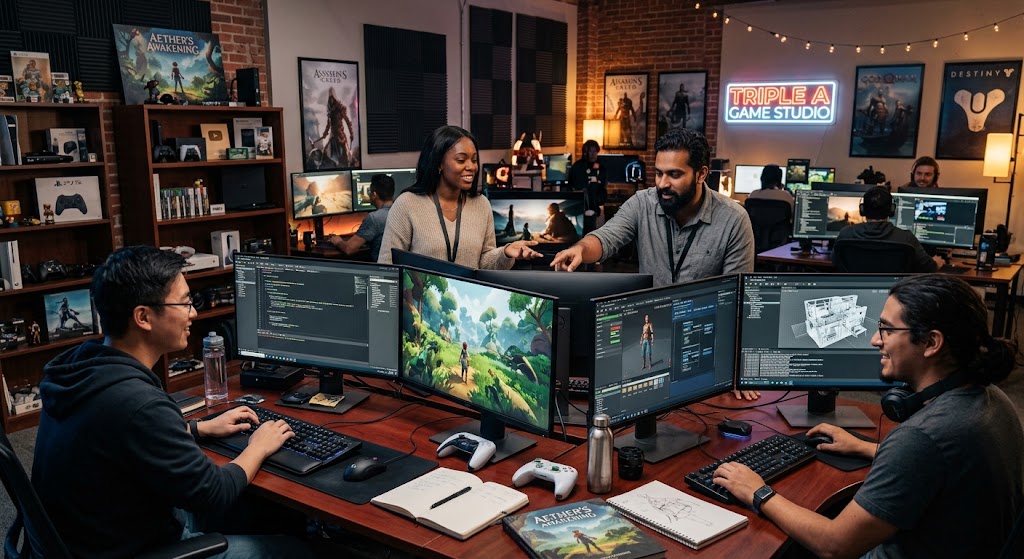
Triple A Game Production and Design Explained
Big budget games dominate the interactive entertainment space. Every year millions of players line up for the latest blockbusters. These titles promise cutting-edge graphics, expansive worlds, and hundreds of hours of immersive gameplay.
Behind these flashy releases lies a massive operation. Building a modern video game requires hundreds of specialized developers, years of focused labor, and staggering financial investments. It is a high-stakes arena where success brings fortune and failure can bankrupt studios.
So what actually sets these giant productions apart from smaller indie projects? Let us break down how the industry builds, finances, and delivers these massive digital experiences.
Understanding the Scope of a Triple A Game
The term originated in the nineties as a borrowing from credit rating agencies. Financial analysts used AAA ratings to signify the safest, highest quality investments. Game publishers adopted the phrase to signal maximum production values.
Today a modern triple a game represents the peak of commercial development. These are not projects cooked up by a small group over a weekend. They are multi-million dollar endeavours backed by global entertainment corporations like Sony, Microsoft, Electronic Arts, and Ubisoft.
Building one demands teams spanning multiple continents. Artists, programmers, audio engineers, writer rooms, quality assurance testers, and project managers must coordinate flawlessly. When everything clicks, the results define pop culture trends for years.
However, high production values also mean high risk. A single failure can erase years of corporate profits. That financial pressure shapes every decision made during development.
Development Costs and Financial Frameworks
Creating high-end games has never been more expensive. Production budgets regularly cross nine figures before marketing teams even start running campaigns. To understand where all that money goes, look at the core cost centers below.
| Cost Category | Typical Budget Allocation | Primary Expenses Included |
|---|---|---|
| Core Engineering & Design | 35% – 45% | Software engineers, gameplay programmers, system architects, level designers |
| Art & Asset Creation | 25% – 35% | 3D modeling, motion capture, environment art, animation, UI/UX design |
| Marketing & Distribution | 30% – 50% (of total budget) | Global ad campaigns, trade shows, influencer sponsorships, physical media production |
| Audio & Talent Capture | 5% – 10% | Voice acting talent, orchestral scoring, sound design, localization translation |
| Quality Assurance & Testing | 5% – 8% | Bug tracking, compliance testing, performance optimization across hardware platform targets |
Salaries form the largest single expense. Employing hundreds of senior developers in tech hubs across North America, Europe, and Asia creates a massive monthly burn rate. Development cycles lasting four to six years compound these costs quickly.
Marketing budgets often match or exceed direct development costs. A studio might spend one hundred million dollars making a triple a game, then spend another hundred million making sure everyone on the planet knows it exists.
Distribution strategy adds another layer of complexity. Physical retail shipping requires manufacturing and retail margin cuts. Digital storefronts take their own platform fees, usually ranging between twelve and thirty percent per sale.
The Life Cycle of a Major Gaming Release
Creating a major blockbuster follows a structured pipeline designed to minimize financial risk and keep massive teams aligned across years of development.
- Pre-Production and Conceptualization: Writers, directors, and lead artists establish the core concept, artistic vision, and prototype mechanics while setting overall project scope.
- Full Scale Production: The entire studio mobilizes to build assets, design levels, write code, record dialogue, and stitch individual components into a cohesive player experience.
- Alpha and Beta Testing Stages: Features freeze while internal and external testers hunt down software bugs, report balancing issues, and evaluate game performance on target hardware.
- Gold Master and Release Day: The software receives final build approval, manufacturing starts for physical discs, and server infrastructure scales up to handle opening day traffic spikes.
- Post-Launch Live Service Support: Developers transition to fixing remaining bugs, balancing competitive play, and releasing downloadable content updates over months or years.
Pre-production sets the foundation. Getting mechanics right during this early window saves tens of millions later. Changing direction mid-production remains one of the fastest ways to kill a studio budget.
Once full production hits, velocity is everything. Hundreds of people build interconnected systems simultaneously. A delay in graphics art can block level designers, which stalls lighting teams and delays QA testing.
Post-launch support has changed dramatically over the last decade. Releasing a game used to mean the project was finished. Today, launch day marks the beginning of an ongoing operational lifecycle.
How a Triple A Game Competes With Indie Studios
Independent developers have gained massive market share thanks to accessible engines like Unity and Unreal Engine. Yet major publishers maintain several key advantages that smaller teams struggle to replicate.
| Comparison Factor | Blockbuster Studio Project | Independent Studio Project |
|---|---|---|
| Average Team Size | 150 to 1,000+ developers | 1 to 30 developers |
| Development Timeline | 4 to 7 years | 1 to 3 years |
| Graphic & Visual Fidelity | Photorealistic, custom shaders, high-end mocap | Stylized, pixel art, or focused low-poly assets |
| Monetization Strategy | $70 base price, battle passes, cosmetics, DLC | $15 – $30 base price, rare expansions |
| Risk Tolerance | Low (relies on established IP and sequels) | High (experiments with unique gameplay ideas) |
Financial backing enables physical scale that small teams simply cannot touch. A triple a game can feature expansive open-world environments rendered with sub-millimeter detail. Custom facial capture setups allow virtual characters to express subtle emotional nuances seamlessly.
Marketing horsepower creates instant global visibility. Independent games often rely on organic viral reach or streamer luck to build an audience. Major publishers buy guaranteed attention across television, digital platforms, and physical billboards worldwide.
However, massive budgets limit creative risk taking. When a project costs two hundred million dollars, executives prefer safe bets. That is why the market sees a steady stream of sequels, remakes, and established franchise iterations rather than brand new experimental ideas.
Key Technical Elements in Blockbuster Game Engines
Powering these experiences requires complex software architecture capable of rendering realistic scenes in real time. Modern game engines handle complex physics, complex artificial intelligence, and real-time lighting calculations across millions of polygons every single frame.
- Hardware-Accelerated Ray Tracing: Simulates physical light behavior to generate realistic reflections, ambient occlusion, dynamic shadows, and global illumination across complex geometry.
- Photogrammetry Asset Creation: Converts hundreds of high-resolution real-world photos into high-fidelity 3D models with detailed surface textures and physical material maps.
- Dynamic Motion Capture Integration: Translates live actor performances into fluid character animations, capturing realistic facial movements, weight distribution, and subtle physical nuances.
Ray tracing has reshaped visual presentation. Instead of relying on pre-baked lighting tricks, engines calculate dynamic light rays as they bounce off virtual surfaces. The visual outcome looks closer to live-action cinema than traditional computer graphics.
Photogrammetry drastically reduces asset creation time while pushing realism higher. Artists scan real rocks, trees, buildings, and clothing garments using high-res cameras. Software stitches those photos into precise 3D assets ready for game environments.
Performance optimization remains a constant battle. Developers must balance high-end visual features against strict hardware constraints. Maintaining steady sixty-frames-per-second performance on consumer hardware demands constant code refactoring.
Monetization Models and Business Strategies
The seventy-dollar retail price point no longer covers full production costs for many companies. Studios turned to alternative monetization strategies to ensure long-term profitability and fund long development cycles.
- Live Service Operations: Delivering continuous software updates, seasonal event passes, and new narrative content to retain active player communities over multiple years.
- In-Game Cosmetics and Microtransactions: Selling optional character outfits, weapon skins, and digital collectibles that offer visual customization without granting gameplay advantages.
- Subscription Service Licensing: Partnering with platform subscription services like Xbox Game Pass or PlayStation Plus to secure guaranteed upfront payout revenues.
Live service models transform games into ongoing platforms. Players keep returning month after month for new challenges, storyline developments, and social events. This provides publishers with steady, predictable recurring cash flow.
Monetization balance requires careful design. Players push back hard when paid systems compromise gameplay balance. Successful studios stick strictly to cosmetic purchases, keeping gameplay competitive mechanics accessible and fair for everyone.
Subscription services offer a new revenue stream for publishers. Adding a new title to a platform service provides immediate cash injections while building massive player bases on day one. It also gives older back-catalog games a second commercial life.
Future Trends Shaping Industry Productions
The gaming industry never stands still. Technical breakthroughs and shifting consumer habits continue to reshape how blockbuster titles get made and played.
Artificial intelligence tools are entering production pipelines. Teams use machine learning algorithms to generate environment terrain variations, clean up motion capture data, and streamline localized voice acting tasks. These tools assist artists rather than replacing them, speeding up iteration cycles.
Cross-platform play has become standard expectation. Players want to join their friends regardless of whether they own a console or a high-end gaming PC. Building cross-platform netcode adds engineering complexity, but dramatically expands active player pools.
Cloud gaming technology continues to improve. Streaming high-end games directly to low-power laptops, mobile devices, and smart televisions removes traditional hardware barriers. As internet infrastructure improves globally, accessibility to top-tier gaming experiences will keep expanding.
Frequently Asked Questions
What Is a Triple A Game?
A triple a game is a high-budget video game developed and published by a major gaming studio. These projects feature large development teams, advanced technical capabilities, and massive marketing campaigns aimed at global mainstream audiences.
How Much Does a Triple A Game Cost to Make?
Production budgets for blockbuster titles typically range from fifty million to over two hundred million dollars. When including global marketing and promotional expenses, total investments for major franchise titles can easily exceed three hundred million dollars.
Why Do Triple A Games Take So Long to Develop?
Modern game development requires thousands of detailed 3D assets, complex programming, extensive voice acting, and rigorous quality assurance testing. Coordinating hundreds of developers while optimizing performance for complex hardware targets naturally takes four to six years.
What Is the Difference Between Triple A and Indie Games?
Triple A titles are created by large studios backed by major publishers with massive financial budgets and focus on high graphical fidelity. Indie games are built by small independent teams with modest budgets, prioritizing creative gameplay concepts over cutting-edge visual production.
Why Do Triple A Games Cost Seventy Dollars?
Rising development costs, inflation, and expanding team sizes drove the base price shift from sixty to seventy dollars for modern hardware releases. The increase helps studios cover inflated production overhead while continuing to deliver modern graphical standards.
What Does Live Service Mean in Modern Gaming?
Live service refers to a business model where developers continuously update a game post-launch with fresh content, seasonal passes, and online events. This strategy keeps player communities active and engaged over long periods while generating recurring revenue.
Are Triple A Games Always Successful Financially?
No, high production budgets create significant financial risks for publishers. If a blockbuster project fails to meet sales expectations or receives poor critical reception, the resulting financial losses can result in studio closures, project cancellations, or strategic layoffs.
The world of blockbuster game production remains a fascinating intersection of artistry, engineering prowess, and high-stakes business strategy. As technology evolves and player expectations rise, studios will keep pushing boundaries to deliver incredible digital worlds. Understanding the financial reality, creative effort, and technical skill required behind each major release helps us appreciate the sheer scale of modern interactive entertainment.



Leave a Reply