
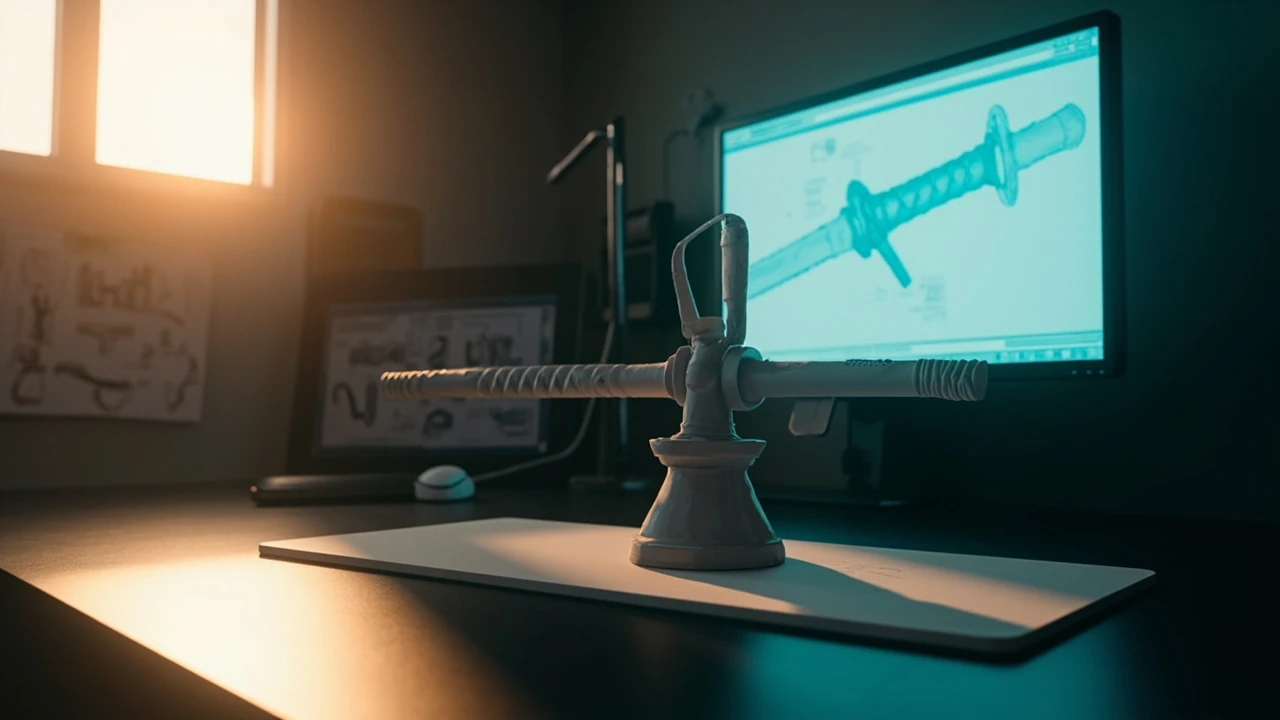
Hwando in game design: reference, silhouette, and combat behavior
A hwando is a single-edged Korean saber whose curved blade, ring pommel, and slung wooden scabbard make it one of the most visually distinct melee weapons a game team can adopt. When the same weapon has to read correctly in a menu icon, a close-up idle, a combat swing, and a mid-distance killcam, every millimeter of the model and every keyframe of the animation has to serve the same silhouette story. This article is a developer-facing walkthrough of how a hwando is researched, modeled, rigged, animated, integrated into a combat system, and validated against historical reference, without turning into either a museum catalog or a generic sword tutorial.
The hwando sits inside a wider Korean sword family that includes the geom and the longer yeombeh do, and it shares visual DNA with the Japanese katana and the Chinese dao. The differences are real but subtle, and they matter in production because a player who knows the genre will notice if the curve, pommel, or scabbard is wrong. A team that treats the hwando as just another curved blade gives up one of the easiest ways to make a melee archetype feel rooted in a specific culture and period.
What a hwando actually is
The hwando is a short to mid-length saber worn by Korean infantry and officers from the late Joseon period onward. The blade is forged with a gentle curve, the grip is wrapped for one-handed use, and the pommel typically carries a circular ring that the wearer could loop a cord through. The scabbard is wooden, often lacquered, and traditionally carried edge-up using a suspension cord instead of a rigid belt loop. Visually, the silhouette is defined by three readable elements: the shallow curve of the blade, the round pommel ring, and the diagonal line of the scabbard across the back.
For a developer, that combination is a gift. Most fantasy swords are differentiated by blade length, crossguard shape, or material. A hwando differentiates itself on three orthogonal axes at once, so the player can identify it from the back, in peripheral vision, or in a low-resolution icon. That is exactly the kind of “read at a glance” geometry that combat UI designers look for.
The For additional context, Hwando entry on English Wikipedia is the practical starting point for visual reference. It groups the weapon with other Korean single-edged swords, lists the typical blade and grip dimensions, and describes how the scabbard was carried. Use it as a sanity check against concept art, not as a substitute for high-resolution photographs of museum pieces.
Why the hwando is worth a dedicated article
Most online sword references collapse Korean, Chinese, and Japanese curved blades into a single visual bucket. In production, that flattening is expensive. A weapon concept artist will spend a week redrawing the same blade to “make it feel different,” an animator will guess at the center of mass, and a combat designer will tune swing arcs that have no real-world anchor. The cost is not the redraw. The cost is the small, repeated compromises that accumulate into a melee archetype that feels generic.
A hwando is also a useful test case for the way game teams handle culturally specific melee weapons in general. The same pipeline questions appear for a Viking seax, a Persian shamshir, or a Filipino kris. The silhouette, the carry, the cultural context, and the combat use case all have to be researched, modeled, and integrated together. The hwando is a small enough subject to use as a worked example, and detailed enough to expose the real production decisions.
Scope of this article
The rest of this article works through a hwando in the order a small team would actually build one. It starts with reference gathering and silhouette analysis, moves into modeling and texturing, then rigging and animation, and ends with combat integration, accessibility, and live operations concerns. Each section explains the decision a developer needs to make, the trade-offs involved, and the kind of validation that turns a beautiful prop into a shippable game asset.
This is not a historical survey and it is not a polemical piece about cultural representation. It is a production-focused look at a specific weapon that happens to be interesting, with enough historical grounding that the design choices have a real reference behind them.
Gathering reference and locking the silhouette
Reference gathering is the cheapest part of the pipeline and the most expensive to skip. A hwando has a small number of defining features, and each one needs at least one clean reference image. Without that, every later decision becomes a guess that drifts further from the original intent.
Primary reference sources
Start with three categories of reference, in roughly this order:
- Museum photography. High-resolution, evenly lit photographs of preserved blades, hilts, and scabbards. These provide the real measurements and material details that concept art tends to fudge.
- Reconstruction and martial arts footage. Videos of trained practitioners drawing, cutting, and resheathing. These expose the carry, the grip, the draw angle, and the natural swing arcs that the animation rig will eventually need to match.
- Player-facing reference. Screenshots and gameplay footage of any existing game that has shipped a hwando or a close analog. These are not the source of truth, but they show what players have already accepted as “looking right” in a given genre.
Store all of this in a single reference board per weapon, and tag each image with the feature it documents: blade geometry, pommel, grip wrap, scabbard shape, suspension cord, and so on. The tags do double duty as a checklist during modeling and again during QA.
Silhouette read test
Once the reference board is in place, run a silhouette read test. Flatten each reference image to pure black and white, then place the proposed concept art next to them. The hwando silhouette should still be distinguishable from a Japanese katana, a Chinese dao, and a Western saber. If the silhouette collapses into a generic curved blade, one of the three defining features is wrong: the curve is too aggressive, the pommel is missing the ring, or the scabbard is too straight.
This test is especially important for low-poly work and for icon art. A 64×64 menu icon cannot show ring detail, so the silhouette has to do the work. If the silhouette test fails at 64×64, the weapon will feel generic on console dashboards and inventory grids even if the in-hand model is beautiful.
Locking measurements and the center of mass
Convert at least one museum reference into a real measurement. The full blade length, grip length, pommel diameter, and overall mass are the numbers that drive animation, collision, and balance. Most of the reference you will find gives a blade length in the 70 to 90 centimeter range and an overall length around 90 to 110 centimeters, which is a useful working window.
The center of mass is the single most important derived number, because the swing arc, the recoil animation, and the idle sway all flow from it. For a hwando, the balance point sits roughly a hand’s width forward of the guard, biased toward the blade but not dramatically. Get this wrong and every combat animation has to be re-tuned.
Modeling the blade, hilt, and scabbard
With the silhouette locked, the modeling pass is mostly about respecting the three defining features. The temptation at this stage is to add detail, but a hwando is a spare, functional object, and over-modeling it is a common mistake.
Blade geometry
The blade is single-edged with a shallow curve and a thin spine. In game terms, the modeler needs to decide three things early:
- Polygon density along the edge. Enough to catch specular highlights during a swing without breaking the silhouette. Edge loops near the cutting edge are worth the cost; edge loops along the flat of the spine usually are not.
- Bevel strategy. Either a hard normal map edge or a soft beveled mesh edge. Hard normal edges are cheaper and read well at distance; soft bevels are more expensive but more forgiving under close inspection.
- Tip treatment. The hwando tip is typically a gentle point, not a tanto-style angular tip. Reinforcing the tip with a small bevel cluster helps the highlight roll correctly during fast swings.
The shallow curve is the easiest feature to lose. A 3D modeler working from front-view concept art will often overshoot the curve and end up with something closer to a shamshir. Keep the curve subtle, and validate against the reference board at every LOD step.
Hilt, guard, and pommel ring
The hilt is wooden, the guard is a simple oval or D-shaped plate, and the pommel carries the ring. The ring is the single most identifiable feature of the weapon, and it is also the easiest to lose at low poly counts. A flat torus will read as a ring; a thin disc with a hole will read as a washer. Keep the ring’s outer diameter large enough that it survives silhouette reduction, and consider keeping the ring as a separate mesh so it can be detached for variants or broken in damage states.
For the grip wrap, a normal map with a subtle cord pattern is usually enough. The player will rarely see the wrap up close, and a real cord pattern at full resolution can produce moiré on console hardware. Save the high-resolution wrap for first-person inspection scenes only.
Scabbard and suspension
The wooden scabbard is straightforward to model but easy to texture incorrectly. The lacquer is usually a dark brown or black, sometimes with metal fittings at the throat and chape. A subtle anisotropic highlight along the length sells the wooden grain without an expensive wood shader.
The suspension cord is the part most teams skip. Historically the hwando was carried edge-up with the scabbard slung across the back. If the character is shown carrying the weapon that way, the cord is mandatory. If the character carries it at the hip in a fantasy belt rig, the cord can be omitted, but that decision is a genre choice and should be made consciously, not by accident.
Rigging and weighting for animation
A weapon rig looks simple and behaves badly if it is treated as simple. The hwando has a small number of moving parts, but the parts it does have interact in ways that are easy to get wrong.
Joint count and hierarchy
For a one-handed saber, the working rig is usually four joints: root, grip, pommel, and a tip control. Anything more is wasted on the weapon itself, and anything less forces the animator to overwork the character rig. The hierarchy should put the weapon root under the character’s hand joint, not under the character root, so the weapon follows the hand without inheriting unnecessary pelvic motion.
The grip joint is the master. Animators rarely need to rotate the pommel independently of the grip, but they do need the ability to push the tip relative to the grip for soft-tip effects during fast swings. A single tip control with a small range of motion is enough for that.
Skinning and deformation
The hwando does not deform much during animation, but the connection between the hand and the grip does. The most common visible bug on a one-handed weapon rig is the hand sliding off the grip during fast swings. Solve that with a careful skin weighting pass on the grip, not by adding extra constraints to the hand. Constraints that hold the hand to the grip will fight the animator and produce visible stretching during recoil.
Add a small collision proxy at the pommel ring so it does not clip through the character’s hip or thigh during sheath animations. The ring is exactly the kind of feature that players will notice clipping, because it is the most identifiable part of the weapon.
Twist distribution
Distribute the wrist twist across the grip and the first third of the blade, not across the whole weapon. A hwando with full-length twist distribution will look whippy and unconvincing. Real Korean saber use keeps the blade mostly aligned with the forearm during cuts, with the wrist providing the direction change, not the rotation.
Animation: draw, cut, recover, sheathe
Animation is where the hwando either becomes a believable melee weapon or a generic flailing prop. The key is to anchor every motion in a real cutting technique, then compress the timing for game feel without losing the underlying intent.
Draw and ready stance
The historical draw brings the scabbard forward, clears the throat, and pulls the blade out along a near-vertical line. In a third-person action game, the draw is usually compressed to one to one and a half seconds and ends in a ready stance with the blade held low and slightly forward. The ready stance should let the player see the full silhouette of the weapon, including the pommel ring. If the pommel is hidden behind the character’s hip, the silhouette work in the previous section is wasted.
A common mistake is to copy a katana draw and apply it to a hwando. The hwando carry is different, the grip is shorter, and the cutting culture is different. The result looks like a competent katana animation, which is the opposite of the goal.
Cutting arcs
Cutting arcs in a game do not have to match historical forms beat for beat, but they have to feel consistent with the balance of the weapon. A hwando is light and curved, which means:
- Diagonal cuts feel natural, with the curve adding a slicing quality to the motion.
- Horizontal cuts are possible but feel committed, because the curve does not help with a straight lateral sweep.
- Thrusts are shorter and more controlled than with a straight sword, because the curve reduces the effective thrust line.
Build at least three distinct light-attack arcs, one heavy-attack arc, and one thrust. The thrust should be visibly shorter and more deliberate than the equivalent on a straight sword, or the player will feel that the weapon is not behaving as expected.
Recoil and recovery
Recoil is the part of the animation pipeline that almost always gets under-budgeted. A hwando hit should produce a small, controlled recoil along the line of the cut, not a large follow-through that looks like the character has just thrown a hammer. The blade is light, the balance is forward but not extreme, and the recovery should bring the blade back to a guard position in roughly the same time it took to commit the cut.
Recovery timing has a direct effect on combat feel. If the recovery is too long, the player feels punished for committing to a swing. If the recovery is too short, the weapon feels weightless. The right answer depends on the broader combat system, but a workable starting point is a recovery window of 300 to 500 milliseconds after the contact frame for a light attack.
Combat integration and feel
Animation is half the problem. The other half is the combat system that consumes those animations and turns them into hit reactions, stamina costs, and damage numbers.
Hitbox design
For a one-handed saber, the active hit region is the last two-thirds of the blade. The first third near the guard is the “dead” zone where contact is rare and usually indicates a missed swing. The tip is the most damaging region and should be tuned to feel like a precise, committed strike.
Build the hitbox as a small number of capsule segments along the blade, not a single sweeping capsule. Multiple segments give the combat system enough granularity to differentiate a glancing edge hit from a clean tip hit, which matters for damage scaling and for the player’s sense of skill differentiation.
Stamina, weight, and swing speed
The hwando sits in a comfortable middle ground for stamina and swing speed. It should feel faster than a two-handed greatsword and slower than a one-handed dagger, with a stamina cost that reflects the real energy expenditure of a committed cut. Avoid the temptation to make it feel “light” by giving it a very low stamina cost, because that is the fastest way to lose the cultural identity of the weapon in gameplay terms.
| Parameter | Working range | Reasoning |
|---|---|---|
| Light attack windup | 250 to 350 ms | Long enough to read, short enough to feel responsive |
| Light attack recovery | 300 to 500 ms | Matches the blade’s balance and the player’s expected commitment |
| Heavy attack windup | 600 to 800 ms | Two-handed commitment or a one-handed power cut |
| Stamina cost, light | 8 to 12 units | Cheap enough to chain, expensive enough to matter |
| Stamina cost, heavy | 18 to 24 units | Riskier than light, reward should justify the cost |
| Thrust stamina cost | 10 to 14 units | Slightly higher than a light cut because the thrust is shorter and more controlled |
These ranges are starting points, not absolute values. The actual numbers depend on the rest of the combat system, the player’s level curve, and the encounter design. The point is to tune the hwando as a mid-weight one-handed saber, not as a light dueling weapon and not as a heavy chopper.
Combo windows and chaining
Combo windows are where the hwando’s identity gets lost most often. If the combo system lets the player chain light attacks into infinite strings with no stamina penalty, the weapon becomes indistinguishable from any other fast one-handed blade. Reserve a stamina ramp for the third and fourth hits in a chain, so the player feels the cost of commitment without losing the satisfaction of a clean string.
A useful pattern is to allow light-light-light into a heavy finisher, with the heavy finisher costing noticeably more stamina but dealing noticeably more posture damage on a blocking target. That mirrors the real Korean saber use of a controlled flurry followed by a decisive cut.
Audio design and haptic feedback
A hwando without the right sound design is a missed opportunity. The blade is thin, the cut is slicing rather than crushing, and the sheath has a distinct wooden click when the weapon seats.
Whoosh, cut, and sheath layers
Build the swing audio in layers, with each layer tunable independently:
- Whoosh layer. The air movement of the swing, tuned to match the swing speed and the blade’s surface area.
- Edge contact layer. A slicing transient, not a thud, because the hwando is a cutting weapon rather than a percussive one.
- Sheath click layer. A wooden and metal sound for the moment the blade seats in the scabbard. This is a small detail that adds a lot of perceived quality.
Randomize pitch and timing within small ranges so repeated swings do not sound mechanical. A hwando that produces the exact same whoosh on every light attack will feel cheap long before the player notices the texture or the animation.
Haptic feedback on controller
On platforms with controller haptics, use a short, sharp pulse on the contact frame and a softer trailing pulse during recovery. The hwando is not a heavy hammer, so the haptic should not feel like one. A clean tip hit can carry a slightly stronger pulse than a glancing edge hit, which reinforces the hitbox differentiation described earlier.
Accessibility, readability, and player comfort
A weapon that looks great but is hostile to a significant slice of the player base is a self-inflicted problem. The hwando has a few specific accessibility risks that are easy to mitigate during production.
Motion sickness and swing speed
Fast, screen-filling swings are a known motion sickness trigger. The hwando’s swing speed is moderate, which helps, but the recovery animation should not whip the camera around the character. Keep the camera offset within a narrow range during attacks and let the weapon motion do the visual work, not the camera motion.
Visual readability for low-vision players
High-contrast outline shaders and clear silhouette readouts help players with low vision track the weapon. The hwando’s pommel ring is a natural anchor for an outline highlight, and the curved blade gives the outline a distinctive shape. Avoid tinting the weapon in ways that blend it into a busy environment, especially in dark dungeon or nighttime scenes.
Colorblind-safe hit feedback
Hit feedback should never rely on color alone. Pair the red hit flash with a small scale pulse and a directional hit marker, so colorblind players get the same information through shape and motion. The hwando’s contact frame is a natural place to attach that pulse, because the player is already looking at the blade.
| Accessibility risk | Symptom | Mitigation |
|---|---|---|
| Camera whip during recovery | Motion sickness in sensitive players | Limit camera offset, keep weapon motion inside a stable frame |
| Low contrast in dark scenes | Weapon disappears into the background | Outline shader, pommel ring highlight, environment-aware tint |
| Color-only hit feedback | Colorblind players miss the hit confirmation | Combine color flash with a scale pulse and a directional marker |
| Fast combo chains | Timing-intolerant for players with motor impairments | Optional input buffer window, adjustable combo timing |
None of these mitigations are expensive. They are all small, design-time decisions that pay off across the entire life of the weapon and across every player who picks it up.
QA, validation, and certification
The QA pass for a culturally specific weapon like the hwando has to cover both the usual technical checks and the harder-to-automate cultural and historical checks.
Technical QA
The technical checklist is the same as for any melee weapon, with a few hwando-specific additions:
- Animation clipping through the character mesh during draw, sheathe, and idle.
- Pommel ring clipping through the hip or thigh during sheath animations.
- Hitbox alignment with the visible blade across all attack angles.
- Stamina cost consistency across the combo tree.
- Audio layer synchronization with the contact frame across all attacks.
- Performance cost on the lowest target hardware, especially during the draw and sheathe animations, which often carry the highest vertex count on screen.
Run a build that strips the environment to a flat gray plane, then play through the full attack tree. Any clipping, audio desync, or hitbox misalignment is much easier to spot without the environment’s visual noise.
Cultural and historical review
For a culturally specific weapon, add a review pass with at least one external advisor or community liaison. The goal is not to make the weapon “perfectly accurate,” which is unrealistic for a game, but to avoid the specific mistakes that players who know the source material will spot immediately: the wrong pommel style, the wrong scabbard carry, the wrong cultural association. A single bad screenshot on a community forum can do more damage to the studio’s reputation than any number of small design choices.
Document the review, the changes that came out of it, and the trade-offs that were consciously accepted. That documentation is useful for future weapons and for explaining design decisions in post-launch communication.
Platform certification
Console and storefront certification for a melee weapon is usually uneventful, but the hwando’s draw and sheathe animations can produce a brief moment of high screen luminance if the studio uses a strong specular highlight on the blade. Check the luminance envelope on every target platform and reduce the highlight if the certification tooling flags it. This is a common cause of late-stage certification failures for shiny weapons.
Live operations and post-launch support
If the hwando is part of a live game, the work does not end at ship. Melee weapons are common targets for balance passes, skin releases, and community feedback cycles, and a culturally specific weapon carries extra post-launch responsibility.
Balance passes
Track win rate, pick rate, and average time-to-kill for the hwando, broken down by skill bracket. A weapon that is dominant in low brackets and weak in high brackets usually has a tuning problem with its stamina cost or its recovery window. A weapon that is uniformly weak usually has a perception problem on top of a tuning problem, because players will under-pick a weapon they do not understand.
Run balance changes against the existing animations first. Changing the swing speed without changing the animation will create a visual mismatch that players will notice. If the swing speed has to change significantly, plan a small animation pass to keep the motion consistent with the new number.
Skins and variants
Skins are where the studio can either strengthen or dilute the weapon’s identity. A hwando skin line that leans into the historical reference, with materials and patinas that match real museum pieces, is more cohesive than a skin line that throws fantasy colors at the model. The latter is easier to produce and tends to sell well in the short term, but it erodes the very identity that made the weapon worth building in the first place.
For variants, consider:
- Officer’s hwando, with a more elaborate pommel and a decorated scabbard.
- Infantry hwando, with a simpler pommel and a service-grade scabbard.
- Field-modified hwando, with visible wear and a replaced grip wrap.
Each variant is a small modeling and texturing job, not a new weapon, so the production cost is modest and the design payoff is significant.
Community feedback and correction
Open a quiet channel for community feedback on the weapon, and be prepared to correct mistakes. A hwando that ships with the wrong pommel style is not a disaster, but it is a missed opportunity if the mistake is never acknowledged and fixed. Post-launch patches that include small weapon corrections are a strong signal that the studio takes its cultural references seriously.
Working with external artists and outsourcers
Most studios do not build weapons like the hwando entirely in-house. A typical pipeline includes at least one external artist for the high-poly sculpt, sometimes an external texture artist, and an internal team for rigging, animation, and integration. The hwando is a good case study in how to make that collaboration work.
Brief writing
The brief is the single most important document. It should include the reference board, the locked silhouette, the polygon budget at each LOD, the texture budget, the rigging requirements, and the animation requirements. A brief that says “make a hwando” will produce a generic curved sword. A brief that includes the silhouette test, the measurement table, and the cultural review notes will produce something close to the intended result.
Include a “do not” list alongside the “do” list. “Do not round the pommel into a sphere” and “do not straighten the scabbard” are both more useful than a general “make it look like a hwando.”
Review cycles
Plan for at least three review cycles: a silhouette review on a low-poly blockout, a proportion review on the high-poly sculpt, and a final review on the textured in-game model. Skipping the silhouette review is the most common way to discover, weeks later, that the outsourced model does not read as a hwando in motion.
Use the same reference board at every review. Consistency of reference is what makes the difference between a weapon that survives contact with the player and one that does not.
Payment and IP
This article is not the place to advise on contracts, but it is the place to note that culturally specific weapons have a higher-than-usual risk of revision requests. Build a small revision budget into the contract, and document the cultural review process so that the revision requests are grounded in evidence rather than preference.
Internal links in context
The hwando is one of several melee archetypes a game team will build, and it sits next to broader questions about combat feel, asset pipelines, and cultural specificity. Two adjacent articles on this site are particularly useful as follow-up reading for the decisions described above. The first is a developer-facing look at how reward strings are built and redeemed, which is a useful counterpoint to a physical weapon: Plants vs Brainrots codes: a developer-grade look at how reward strings are built, served, and redeemed. The second is a broader piece on how the industry frames top-tier production values, which is useful context for any team deciding how much budget a culturally specific weapon like the hwando deserves: Triple A Game: Industry Standards, Budget & Design Evolution.
Frequently asked questions
How is a hwando different from a katana?
A hwando is a Korean single-edged saber with a shorter blade, a ring pommel, and a wooden scabbard traditionally carried edge-up on the back. A katana is a Japanese sword with a longer blade, a different pommel, and a scabbard worn edge-up through the obi. In a game, the differences show up in the silhouette, the carry, and the swing feel, with the hwando feeling lighter and shorter than a typical katana.
What blade length should I target for a game-ready hwando?
For a one-handed melee weapon in a third-person action game, a working blade length of 70 to 90 centimeters and an overall length of 90 to 110 centimeters lines up with the historical reference and reads well in the player’s hand. Adjust within that range based on the character’s body proportions and the camera distance.
Do I need to model the suspension cord?
Model the cord if the character carries the hwando on the back. Omit the cord if the character carries it at the hip in a fantasy belt rig, and document that as a conscious genre choice. A missing cord on a back-carried hwando will be one of the first things players notice.
How many attack animations does a hwando need?
For a baseline combat system, plan for at least three light attacks, one heavy attack, one thrust, a draw, a sheathe, an idle, and a block or parry. That set covers the basic combat verbs without ballooning the animation budget.
What is the single most important feature of a hwando in a game?
The pommel ring. It is the one feature that distinguishes a hwando from a generic curved blade at any LOD and at any camera distance. If the ring is wrong, the weapon is wrong.
Can a hwando be used as a two-handed weapon in a game?
Historically it was a one-handed weapon, but game teams often two-hand one-handed swords for power attacks. A two-handed grip on a hwando is acceptable as a design choice, but it should change the animation set and the stamina profile, not just the hand placement on the existing one-handed rig.
How do I avoid the “generic curved sword” problem?
Lock the silhouette early, keep the pommel ring readable at low poly counts, and run a cultural review pass before the weapon is finalized. The three defining features are the curve, the pommel ring, and the scabbard. If all three are correct, the weapon will not feel generic.
What is a reasonable polygon budget for a hwando in a modern third-person action game?
A working budget is around 6,000 to 10,000 triangles for the in-game model on a high-end PC or current-generation console, dropping to around 1,500 to 3,000 triangles for LOD1 and around 400 to 800 for LOD2. These numbers depend on the rest of the asset budget and the target frame rate, but they are a sensible starting point.
Should the hwando be a rare or a common weapon in my game?
That is a design decision, not a production decision. A rare hwando justifies more modeling and animation investment, while a common hwando benefits from a clean, simple design that reads correctly at distance. Either way, the cultural specificity of the weapon is an asset, not a liability.
What is the biggest mistake teams make when implementing a hwando?
Treating it as a katana variant. The grip, the carry, the pommel, and the cultural context are all different, and a hwando that looks and feels like a katana has lost the very thing that made it worth building. The fix is to start from the hwando’s own reference, not from a katana with a different skin.
Leave a Reply