
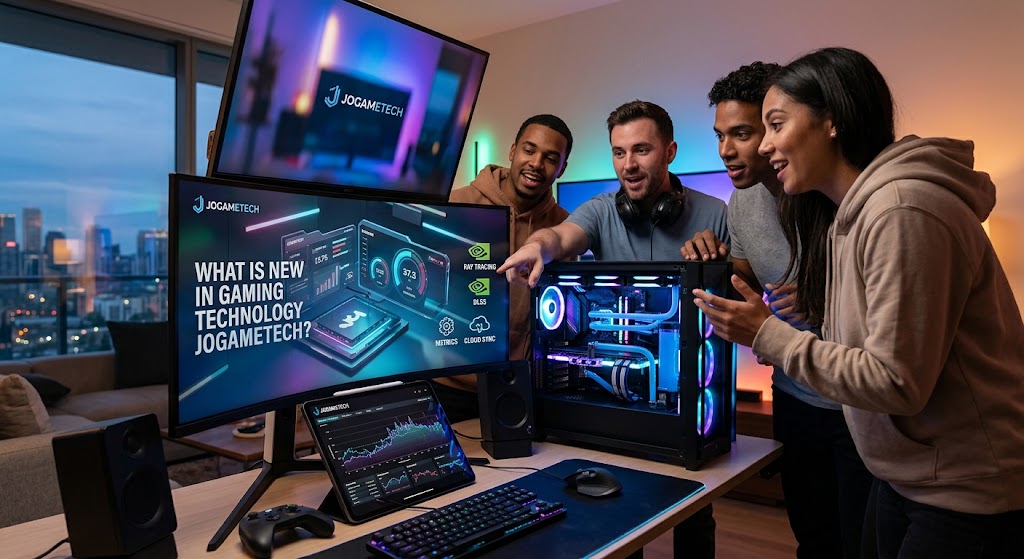
What Is New in Gaming Technology Jogametech
Games do not feel the same as they did five years ago. Frame rates are higher, lighting looks real, and physical consoles are no longer the only way to enjoy rich, interactive worlds.
So, what is new in gaming technology jogametech right now? The short answer comes down to smarter chips, cloud platforms, real-time lighting engines, and subtle changes in how hardware interacts with software.
Everything is moving fast. If you stepped away from tech updates for a few months, you likely missed major shifts in how hardware handles graphics processing and local data storage.
What Is New in Gaming Technology Jogametech Hardware
Silicon design is changing. Graphics processing units no longer rely solely on raw brute force to render complex scenes at high frame rates.
Instead, modern graphics cards use neural reconstruction and upscaling. They calculate a lower resolution image internally and then reconstruct it to full crisp 4K quality in microsecond intervals.
That means higher performance without generating massive amounts of extra heat. Power consumption remains manageable while image quality stays sharp.
Solid-state drives have also altered game architecture. Developers no longer build fake elevator scenes or long empty hallways just to hide loading screens.
Data streams directly from NVMe drives straight to GPU memory. Asset streaming happens instantaneously, allowing vast open worlds to render detailed geometry without visible pop-in.
Here is a breakdown comparing standard legacy tech against modern jogametech implementations:
| Component Area | Legacy Gaming Setup | Jogametech Modern Standard |
|---|---|---|
| Graphics Rendering | Native rasterization with high performance penalty | AI-assisted upscaling and neural frame generation |
| Storage Architecture | SATA SSD or mechanical HDD with cache bottlenecks | DirectStorage NVMe PCIe 4.0/5.0 direct pipeline |
| Audio Processing | Basic stereo or simulated 5.1 channel surround | Hardware-accelerated 3D spatial audio mapping |
| Thermal Management | Standard air coolers with noisy fan curves | Vapor chambers and phase-change liquid cooling |
| Display Refresh Rate | Static 60Hz or standard 144Hz panels | Variable Refresh Rate (VRR) OLED up to 360Hz |
Display technology has evolved in tandem with internal hardware. OLED panels are now standard for serious setups, offering true blacks and sub-millisecond response times.
Variable Refresh Rate (VRR) eliminates screen tearing completely. You get smooth motion even when game frame rates fluctuate during intense action sequences.
Haptic feedback in controllers has also grown up. Simple vibration motors have been replaced by dual actuators that simulate textures, resistance, and environmental impacts.
Understanding Cloud Integration in What Is New in Gaming Technology Jogametech
Cloud streaming used to be a gimmick riddled with input lag and muddy visuals. That is no longer the case for most players with fast broadband connections.
Server nodes now sit closer to urban hubs, dropping latency dramatically. Edge computing handles the heavy lifting, encoding video streams in real time with minimal compression artifacts.
This allows high-end titles to run on low-power devices. You can start a session on a handheld unit and seamlessly transfer your progress to a TV or laptop screen.
Consider these core hardware features transforming modern player setups:
- Ray reconstruction algorithms that calculate bouncing light rays and reflections with minimal performance loss.
- Handheld gaming PCs equipped with low-power custom APUs capable of running heavy modern software natively.
- Wireless audio protocols offering uncompressed low-latency sound transmission without bulk dongles.
- Dynamic thermal throttling mechanisms that adjust clock speeds based on real-time surface temperatures.
Artificial intelligence plays a bigger role than just graphics reconstruction. It actively shapes NPC behavior, audio balancing, and system resource distribution.
Game engines now feature non-player characters that adapt to your combat style. They flank, retreat, and coordinate rather than following static pathing scripts.
Audio chips isolate voice chat from background game noise automatically. Machine learning filters out mechanical keyboard clicks, barking dogs, and room reverb without degrading voice quality.
System software also learns your play schedule. It downloads background updates during idle hours so your library is always ready when you launch a title.
Here is how soft ecosystem tools and system integrations line up across common user priorities:
| Feature Category | Primary Tech Mechanism | Direct Player Benefit |
|---|---|---|
| Ray Tracing | Hardware Bounding Volume Hierarchy (BVH) engines | Lifelike reflections, shadows, and global illumination |
| Frame Generation | Optical flow accelerators predicting intermediate frames | Smoother perceived motion on high refresh displays |
| Spatial Audio | Binaural HRTF filtering and object-based sound | Precise positional awareness in competitive play |
| Zero-Lag Input | Low-latency controller polling and Reflex technology | Instant command execution with negligible delay |
| Cloud Saves | Automated background synchronization to edge nodes | Seamless cross-platform play across multiple devices |
Peripherals have become much smarter as well. Keyboards feature Hall Effect magnetic switches that allow you to set exact actuation points down to fractions of a millimeter.
Mice use optical switches that eliminate double-click failures while reducing weight through ultralight honeycomb or magnesium alloy frames.
Monitors now integrate ambient light sensors. They adjust color temperature and brightness dynamically to reduce eye fatigue during late-night sessions.
Look at how ecosystem habits are shifting among enthusiast communities:
- Switching from static IPS screens to high-refresh quantum-dot OLED monitors for better contrast.
- Adopting magnetic actuation keyboards for custom rapid-trigger capabilities in fast-paced competitive shooters.
- Replacing heavy wired headsets with lightweight wireless open-back acoustics designed for long sessions.
- Utilizing external capture cards with hardware passthrough for zero-latency local gameplay recording.
Customization is no longer limited to RGB lighting strips. Modular gear allows players to swap switch plates, thumbsticks, and cooling units in seconds.
Power delivery systems in custom PCs have shifted to ATX 3.0 standards. This handles transient power spikes cleanly without triggering system shutdowns during heavy loads.
Software suites now consolidate controller mapping, fan curves, and lighting under single lightweight applications rather than bloated background programs.
Here are key factors driving software and driver optimizations today:
- Shader pre-compilation during installation to prevent unexpected micro-stuttering during gameplay.
- Variable Rate Shading (VRS) that allocates GPU power only to areas of the screen where details matter most.
- DirectX 12 Ultimate feature sets enabling mesh shaders and sampler feedback for dense virtual worlds.
- Custom kernel-level security integrations designed to curb cheating in competitive ranked playlists.
Virtual reality and augmented reality gear have also shed excess bulk. Pancake lenses have replaced chunky Fresnel designs, making headsets lighter and sharper.
Inside-out tracking uses embedded high-resolution cameras, eliminating the need for awkward wall-mounted tracking sensors around your desk.
Haptic vests and spatial gloves are creeping out of military tech labs into high-end consumer gaming rooms, adding physical sensation to virtual feedback loops.
Cross-platform ecosystems mean you rarely get locked into a single device brand. Your purchases, saves, and friend lists follow you everywhere.
Frequently Asked Questions
What Is New in Gaming Technology Jogametech graphics rendering?
Modern graphics technology relies heavily on neural reconstruction, ray tracing, and frame generation. Instead of rendering every pixel raw, AI algorithms predict missing visual details, delivering higher frame rates and cinematic lighting without excessive heat or power drain.
How Does DirectStorage Improve Game Loading Times?
DirectStorage bypasses traditional CPU bottlenecks by routing asset data directly from fast NVMe solid-state drives into GPU memory. This drastically cuts down load screens, removes texture pop-in, and allows developers to design vast, continuous open worlds.
What Are Hall Effect Switches in Modern Keyboards?
Hall Effect switches use magnetic sensors instead of physical metal contacts to register keypresses. This setup prevents physical wear and allows players to adjust the exact actuation point and reset distance for every individual key on their keyboard.
Why Is OLED Becoming Popular for Gaming Displays?
OLED displays offer self-lit pixels that provide true black levels, infinite contrast ratios, and sub-millisecond response times. Combined with high refresh rates and Variable Refresh Rate tech, OLED panels deliver ultra-smooth motion with virtually zero ghosting.
How Has Cloud Gaming Performance Improved Recently?
Cloud gaming is significantly better due to expanded edge node networks, improved video compression codecs, and lower network latency. Modern server infrastructure streams high-end gameplay smoothly to budget laptops, phones, and smart TVs with low input delay.
What Role Does AI Play inside Modern Games?
AI goes beyond graphics upscaling. It powers realistic NPC pathfinding and decision-making, isolates clear audio in multi-player voice channels, optimizes dynamic system cooling, and pre-compiles game shaders to eliminate visual micro-stuttering during play.
Are Handheld Gaming PCs Replacing Desktop Computers?
Handheld gaming PCs offer incredible portability for modern titles thanks to efficient APUs. However, they complement desktop rigs rather than fully replacing them, as desktop hardware still provides superior thermal capacity and raw performance for demanding settings.
Gaming technology is evolving faster than ever, driven by smart upscaling, rapid storage pipelines, and refined peripherals. Whether you play on a custom desktop, a handheld unit, or stream through cloud servers, modern innovations make interactive media smoother, more realistic, and endlessly accessible for everyone involved.




Leave a Reply