
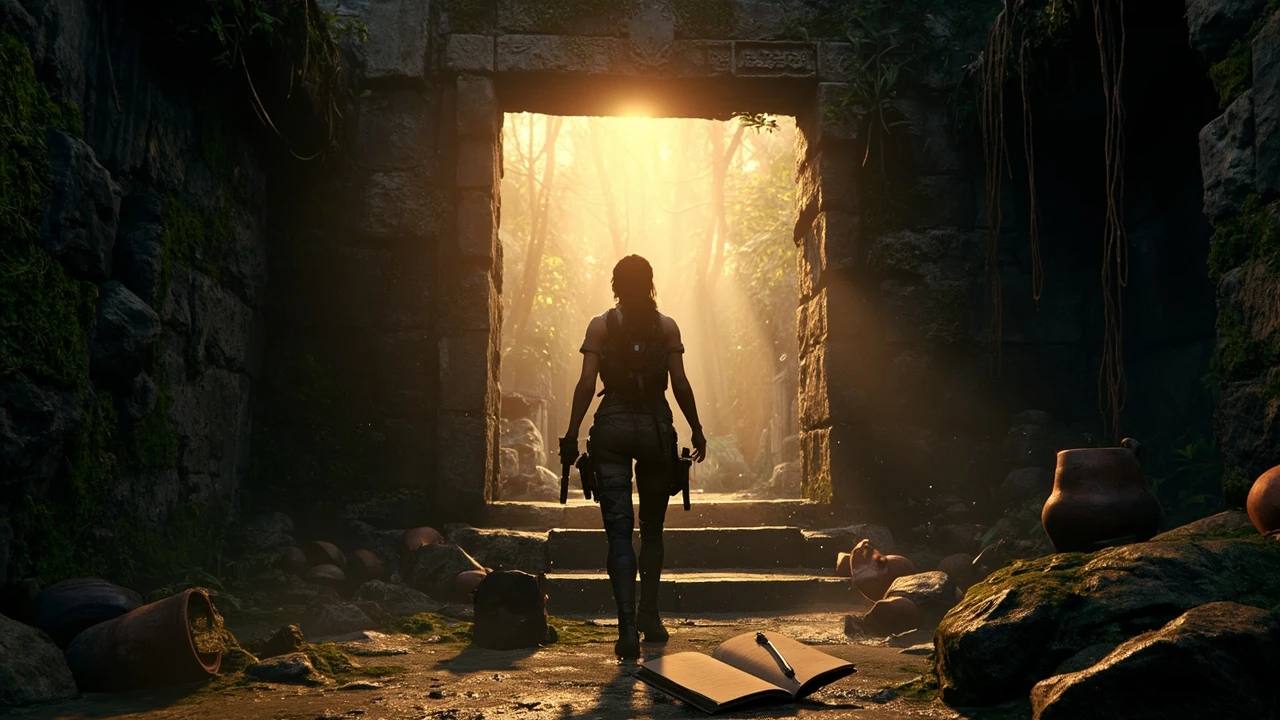
Shadow of the Tomb Raider walkthrough: how this guide reads the game like a developer
A shadow of the tomb raider walkthrough usually focuses on completing every tomb, collecting every artifact, and rescuing Lara from another apocalypse. This article takes the same progression data and reads it the way a designer or technical artist would: as a series of system decisions, level structures, and collectible loops that explain why the game is paced the way it is. The goal is to treat the verified walkthrough pages as production material, not just a checklist.
Shadow of the Tomb Raider is the third entry in the Survivor trilogy developed by Eidos-Montréal and published by Square Enix, with Crystal Dynamics handling the reboot continuity. The release pattern, edition structure, and DLC schedule are documented in detail by a long-running community walkthrough project that has tracked each level, crypt, and challenge tomb since launch, and the verified release, edition, and content facts referenced here come from that project.
Throughout this piece, “the verified walkthrough” refers to the comprehensive shadow of the tomb raider walkthrough maintained at tombraiders.net. Where a claim depends on its data, the link is provided as a source. Where a claim reflects editorial reading or design interpretation, that is labeled as such so the boundary between evidence and opinion stays clear.
Release and edition structure developers need to understand
Before looking at any level-by-level map, it helps to know the release and edition structure, because the walkthrough branches significantly depending on what the player owns.
The original game launched on September 14, 2018, for Windows PC (Steam), PlayStation 4, PS4 Pro, Xbox One, and Xbox One X. A Definitive Edition followed on November 5, 2019, for the same platforms plus macOS and Linux, with the Mac and Linux versions handled by Feral Interactive. A Stadia release happened in 2019 as well. These dates and platforms are documented in the verified walkthrough’s release section, and they are the foundation for any technical analysis of the game because the Definitive Edition carried graphical upgrades and bundled previously released DLC.
Launch editions and what they meant for content
At launch, the game shipped in several special editions that bundled story and tomb DLC, outfits, skills, weapons, and physical collectibles. A free demo was also made available on Steam, PS4, and Xbox One. A Season Pass introduced seven new adventures, each called a “Path,” and each Path added a challenge tomb, a story mission, and new outfit, weapon, and skill rewards. Some of the Paths also included a co-op mode, and one pack, The Path Home, was exclusive to the Season Pass and could not be purchased separately.
With the Definitive Edition, the Season Pass was discontinued. Its content was folded into a Definitive Edition Extra Content bundle. Existing owners of the base game and Season Pass received the Definitive Edition upgrade at no cost. That lifecycle tells developers a familiar story: live-service content that seemed durable was retired when the product shifted to a more comprehensive re-release targeting players who had not engaged with the original DLC cycle.
Definitive Edition changes that affect the walkthrough
The Definitive Edition added the base game with graphical upgrades, all previously released DLC, and a new outfit called Croft Fitness. It was primarily aimed at new players rather than returning ones. From a walkthrough perspective, the change is small but real: a player using the Definitive Edition starts with a larger content footprint, but the level order, tomb triggers, and collectible placement remain the same. Any build of the shadow of the tomb raider walkthrough that cites a DLC-only item needs to check whether the player owns a pre-Definitive base game with a Season Pass, or a Definitive Edition with the Extra Content bundle, before predicting what they will encounter.
| Edition | Release date | Platforms | Notable content |
|---|---|---|---|
| Standard | September 14, 2018 | PC, PS4, PS4 Pro, Xbox One, Xbox One X | Base campaign, optional special-edition DLC |
| Season Pass (original) | Monthly from November 2018 | PC, PS4, Xbox One | Seven Paths with tombs, story missions, rewards; one exclusive pack |
| Definitive Edition | November 5, 2019 | PC, PS4, Xbox One, macOS, Linux (Stadia 2019) | Graphical upgrades, all prior DLC, new outfit |
| Definitive Edition Extra Content | Replaced Season Pass | Same as Definitive Edition | Path content redistributed as a bundle |
How the verified walkthrough is organized
Understanding the structure of the source walkthrough is what allows it to be repurposed as a developer reference rather than a player’s to-do list.
The verified project documents walkthroughs for each main level, each crypt, and each challenge tomb, plus annotated maps and screenshots for collectible items. Quick collectibles guides are intended for players who have already finished a level and are missing a few items. Video walkthroughs for Score Attack and Time Attack runs, credited to a community contributor named Treeble, are linked from the same page. That layering is itself a design decision: the project separates the main path, the optional puzzle content, the collectible sweep, and the score-based replay runs, which mirrors the way the game treats those as distinct content loops.
Why level, crypt, and challenge tomb are tracked separately
Crypts and challenge tombs are the two main optional puzzle structures in the game, and the walkthrough lists ten crypts and nine challenge tombs in the base content, plus additional tombs inside the DLC Paths. The verified project nests their walkthroughs inside the main levels where they are located, while also linking them from a global list, so a player can approach them in either order. For a developer, the take-away is that puzzle content is authored into a level’s streaming volume rather than living on a separate map, which is why each crypt is discoverable only after a specific main story beat.
The Survival Guide and why it matters
The game exposes an in-game Survival Guide that updates as the player progresses. On PC it is opened with Tab, on PS4 with the Touchpad, and on Xbox One with the View button, and the icon set places it as the fourth tile in the top-left of the pause menu. The verified walkthrough explicitly recommends the Survival Guide for players who want context without leaving the game, which is a useful signal for designers: the game already routes players to its own documentation, so a community walkthrough complements rather than replaces that system.
Reading the main path as a level designer
The base campaign is structured around a sequence of main levels, each with its own environment, traversal challenges, and collectible density. The verified walkthrough walks through them in the order they are encountered, providing maps and screenshots that show where artifacts, documents, and challenge-tomb entrances are placed within each space. For a developer, that is enough to reason about pacing: the level list functions as a difficulty and mood curve, and the collectible density inside each level tells you where the team wanted exploration to feel rewarding versus where it wanted the player to push forward.
For a player reading the shadow of the tomb raider walkthrough as a checklist, the level walkthroughs provide the fastest route through the story. For a developer, the same walkthroughs are a record of how the team distributed optional content inside a scripted path. The collectible annotations effectively function as a heatmap of intended exploration.
Collectibles as a system, not a list
Rather than treating every artifact and document as a separate task, the verified walkthrough groups them so that the player can sweep a region in a single pass. That organization is worth borrowing. It treats the level as a system with three distinct layers: required progression, optional puzzle content (crypts and challenge tombs), and a freeform collectible layer. Players who want only the story can ignore the third layer; players chasing 100% completion can run a dedicated pass.
- Main story objectives drive forward motion and are the only layer required to finish the game.
- Crypts and challenge tombs are optional puzzle spaces that also feed skill and reward progression.
- Documents, artifacts, and similar items form a collectible layer that the verified walkthrough maps per level.
- Score Attack and Time Attack runs are replayable challenge loops on existing geometry.
Challenge tombs: a developer reading
Challenge tombs are the cleanest design unit in Shadow of the Tomb Raider, which is why the verified walkthrough lists them separately. Each tomb is a self-contained puzzle arena with its own mechanic, its own visual identity, and a clear reward on completion. The nine base-game challenge tombs are documented inside the level walkthroughs and in a global list, and the DLC Paths add more tombs with the same structure.
What a challenge tomb is responsible for
A challenge tomb is expected to teach a single environmental idea, then layer a second idea on top, then resolve in a traversal or visual payoff. Reading the verified walkthroughs with that in mind shows that the tombs vary the mix: some are about rope and gear traversal, some are about moving environmental pieces, some are about light and shadow. The walkthrough’s per-tomb page is therefore also a small catalog of puzzle archetypes, which is useful for level designers studying how to keep a series of optional puzzles from feeling repetitive.
Crypts versus challenge tombs
Crypts and challenge tombs are not interchangeable. Crypts tend to be shorter, combat-light spaces that often contain a major story artifact or a skill upgrade. Challenge tombs are puzzle-focused, lengthier, and reward completion with a skill point or a gear upgrade. The verified walkthrough tracks ten crypts in the base game and nine challenge tombs, a ratio that suggests the team wanted crypts to feel like a frequent, smaller reward and challenge tombs to feel like a rarer, larger one.
| Optional content type | Approximate base count | Primary reward | Design role |
|---|---|---|---|
| Crypt | 10 | Story artifacts, skill upgrades | Frequent, short, narrative-tinged reward beats |
| Challenge tomb | 9 | Skill points, gear upgrades | Rare, mechanical, longer puzzle arenas |
| DLC Path tomb | 1 per Path | Outfit, weapon, skill | Self-contained expansion content with co-op for some |
| Score Attack / Time Attack | Per tomb | Leaderboard placement | Replay loops on existing geometry |
Collectible loops and the Quick Collectibles Guides
The verified project has begun publishing Quick Collectibles Guides specifically to help players who have finished a level and are missing a handful of items. From a developer perspective, this is a recognition that the level design makes the last 5% of a sweep harder than the first 95%. Items placed in hard-to-reach ledges, behind stealth encounters, or inside late-arriving sub-areas demand a guide, and a generic walkthrough becomes a wall of text at that stage. The decision to publish shorter, targeted guides for those late sweeps is a useful pattern: a production system should plan for the part of completion that most players will need help with, not only the average run.
What the Quick Collectibles Guides reveal about the level design
Because the Quick guides are still being added, the pattern of which levels get them first is informative. Levels with a high density of artifacts and side documents, or with collectibles that depend on gear unlocked later in the campaign, appear first. That is consistent with how the team placed collectibles: items that require a hook, a rope ascender, or a specific outfit to reach are deliberately scattered, so a player who runs through the campaign once and returns to sweep will find that some pickups are not reachable until a later ability is acquired.
- Items that depend on a later ability form a deliberate return-loop and are why a single forward pass never clears a level.
- Annotated level maps are the right format for late sweeps because they show vertical layers the main walkthrough text cannot easily describe.
- Document and artifact placement often clusters near crypts and tombs, so a quick collectibles sweep usually overlaps with optional puzzle content.
Combat, traversal, and skill economy
Although the verified walkthrough is focused on maps and collectibles rather than combat systems, the level structure reveals how the skill economy is paced. Skill points are concentrated in optional content, particularly challenge tombs, which means a player who skips the optional layer enters late-game encounters with fewer abilities and finds combat and stealth harder as a result. The game’s design is closer to an open-encouragement system than a strict gating system: the player is allowed to skip optional content, but the late game responds to that choice.
Outfits, weapons, and resources as a tuning layer
Outfits and weapons are tuned through special editions and DLC. The Croft Fitness outfit was added with the Definitive Edition, and each Path introduced a coordinated outfit, weapon, and skill set. From a developer perspective, the outfit and weapon lists function as a difficulty-tuning layer the player chooses to engage with, and the walkthrough does not need to track them to be useful because their effects are communicated inside the Survival Guide. The verified walkthrough is therefore deliberately minimal about combat tips, leaving the tuning system in the game’s own UI.
Stealth and predator design
Levels include stealth sections that the walkthrough treats as part of the path rather than as separate encounters. The same regions typically contain documents and artifacts, so a careful stealth approach often yields a higher collectible count. This overlap is itself a developer signal: the game rewards patient traversal with optional rewards and punishes a pure run-and-gun approach by skipping past discovery. Reading the walkthroughs with that in mind clarifies why the main path is paced the way it is.
PC version specifics worth documenting
Developers often care about platform-specific performance and input details, and the verified walkthrough captures the relevant PC facts. The minimum and recommended system requirements are listed for the Windows version, and the activation model requires a Steam account, though most of the game is playable offline. The Mac and Linux versions are handled by Feral Interactive, which means a separate compatibility surface for those platforms.
| Tier | OS | CPU | Memory | Graphics | Storage |
|---|---|---|---|---|---|
| Minimum | Windows 7 64-bit | Intel i3-3220 or AMD equivalent | 8 GB RAM | Nvidia GTX 660 / GTX 1050 or AMD Radeon HD 7770 | 40 GB available |
| Recommended | Windows 10 64-bit | Intel Core i7 4770K (3.40 GHz) or AMD Ryzen 5 1600 (3.20 GHz) | 16 GB RAM | Nvidia GTX 1060 6 GB or AMD Radeon RX 480 8 GB | 40 GB available |
Those numbers, including the DirectX 11 minimum and DirectX 12 recommended spec, are listed in the verified walkthrough’s PC resources section. A separate tool, System Requirements Lab’s “Can You RUN It” page, is also linked there as an external check, which is a small but useful pattern: official requirements plus a third-party compatibility tool is a common combination for PC release pages.
Bug reporting, support, and where the walkthrough stops
The verified walkthrough is explicit about the boundary between community content and official support. For technical issues and bugs, the project points players to the Crystal Dynamics support site and to the r/TombRaider subreddit. That boundary is worth respecting in any developer-style article about a game: the walkthrough covers content, while bugs, crashes, and platform-specific issues belong to the publisher and to community troubleshooting threads.
Why this boundary is healthy
From a production standpoint, keeping bug reporting in official channels and content help in community channels prevents the walkthrough from becoming a support ticket queue. It also reflects the reality that the game ships patches and platform updates that the walkthrough cannot track in real time. Players reading the shadow of the tomb raider walkthrough for content help should be able to assume the level and item information is current as of the last verified edit, while still routing platform or crash issues to the right teams.
How to use this walkthrough as a developer reference
For a developer, the most useful reading pattern is to treat the verified walkthrough as a per-level table of contents, not as a single linear document. The project indexes by level, by crypt, by challenge tomb, and by collectible layer. Reading the same region across those indices shows how the team composed a single space to serve multiple goals at once.
- Use the level walkthrough to understand the main path, scripted events, and the order in which major abilities unlock.
- Use the crypt and challenge tomb pages as a catalog of optional puzzle content and as a record of the skill economy’s pacing.
- Use the Quick Collectibles Guides, where available, to see which levels are the hardest to sweep and which reward layers depend on late-game abilities.
- Use the video walkthroughs for Score Attack and Time Attack as references for how a single tomb is replayed under different rules.
Frequently asked questions
Is there an official shadow of the tomb raider walkthrough in the game itself?
Yes. The in-game Survival Guide is the official reference. It is opened with Tab on PC, the Touchpad on PS4, and the View button on Xbox One, and it sits as the fourth icon in the top-left of the pause menu. The Survival Guide updates as the player progresses and covers gear, abilities, mechanics, and collectibles, which is why community walkthroughs reference it as a complement rather than a replacement.
How many crypts and challenge tombs are in the base game?
According to the verified walkthrough, the base game includes ten crypts and nine challenge tombs. The walkthrough places each crypt and tomb inside the main level where it is located, while also linking them from a global list so players can approach them in either order.
What changed when the Definitive Edition was released?
The Definitive Edition added graphical upgrades, included all previously released DLC, and introduced a new outfit called Croft Fitness. It launched on November 5, 2019, for PC, PS4, Xbox One, macOS, and Linux, with the Stadia release following in 2019. It was primarily aimed at players who had not previously played the base game and Season Pass cycle.
What happened to the original Season Pass?
The original Season Pass is no longer available. With the launch of the Definitive Edition, its content was folded into a Definitive Edition Extra Content bundle. Players who already owned the base game and Season Pass received the Definitive Edition upgrade free, while one of the original DLC packs, The Path Home, was Season Pass exclusive and was never sold individually.
Which platforms are still officially supported for the Definitive Edition?
The verified walkthrough lists the Definitive Edition for Windows PC, PS4, Xbox One, macOS, and Linux, with macOS and Linux handled by Feral Interactive. A Stadia release also happened in 2019. Availability on specific storefronts and the status of any later platform changes are not covered in the walkthrough itself, so current storefront listings are the safer reference for live availability.
What are the PC minimum and recommended system requirements?
The verified walkthrough lists Windows 7 64-bit with an Intel i3-3220 or AMD equivalent, 8 GB of RAM, and an Nvidia GTX 660, GTX 1050, or AMD Radeon HD 7770 as the minimum. The recommended spec is Windows 10 64-bit with an Intel Core i7 4770K or AMD Ryzen 5 1600, 16 GB of RAM, and an Nvidia GTX 1060 6 GB or AMD Radeon RX 480 8 GB. Storage is 40 GB on both tiers, and DirectX 11 is the minimum while DirectX 12 is the recommended API level.
Do I need an internet connection to play the PC version?
The PC editions require a Steam account for activation, but the verified walkthrough notes that most of the game is playable offline. That applies to the campaign and most of the optional content; online features and any platform-specific services are not covered in detail by the walkthrough and should be checked against current Steam notes.
How does the shadow of the tomb raider walkthrough help with 100% completion?
It separates the level walkthrough from the collectible sweep. The level walkthrough handles the main path and the location of each crypt and challenge tomb, while the Quick Collectibles Guides, which are being added over time, target players who have finished a level and only need to find a few remaining items. Annotated maps and screenshots accompany the collectible guides to make late-stage sweeps easier.
Where should I report a bug or a crash?
The verified walkthrough explicitly points players to the Crystal Dynamics support site for bugs and technical issues, and to the r/TombRaider subreddit for community discussion. The walkthrough itself is focused on content, not on platform support, so official support channels are the right place for crashes, install issues, or save problems.
Are the Score Attack and Time Attack runs part of the base game?
Yes. The verified walkthrough links video walkthroughs for Score Attack and Time Attack runs on the existing tombs, credited to a community contributor named Treeble. Those runs are a replayable layer on top of the base-game geometry rather than separate content, which is why the same tomb maps and layouts apply.


Leave a Reply